Question
✓
Answer
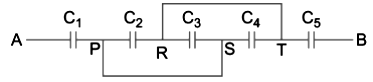
Capacitors $C_2$, $C_3$ $\text{and}$ $C_4 $$\ \ \text{are in parallel}$
$\therefore C_{234}=C_2+C_3+C_4$
$\therefore C_{234}=6\mu F$
Capacitors $C_1$,$C_{234}$ $\text{and}$ $C_5$ are in series
$\frac{1}{C_{eq}}=\frac{1}{C_1}+\frac{1}{C_{234}}+\frac{1}{C_5}=\frac{1}{2}+\frac{1}{6}+\frac{1}{2}$
$=\frac{7}{6}\mu F$
$C_{equivalent}=\frac{6}{7}\mu F$
Charge drawn from the source
$Q=C_{eq}V,$
$=\frac{6}{7}\times7\mu C=6\mu C$
Energy stored $U=\frac{Q^2}{2C}$
$=\frac{6\times6\times10^{-12}\times7}{2\times6\times10^{-6}}\text{J}$
$=21\mu \text{J}$.
$\therefore C_{234}=C_2+C_3+C_4$
$\therefore C_{234}=6\mu F$
Capacitors $C_1$,$C_{234}$ $\text{and}$ $C_5$ are in series
$\frac{1}{C_{eq}}=\frac{1}{C_1}+\frac{1}{C_{234}}+\frac{1}{C_5}=\frac{1}{2}+\frac{1}{6}+\frac{1}{2}$
$=\frac{7}{6}\mu F$
$C_{equivalent}=\frac{6}{7}\mu F$
Charge drawn from the source
$Q=C_{eq}V,$
$=\frac{6}{7}\times7\mu C=6\mu C$
Energy stored $U=\frac{Q^2}{2C}$
$=\frac{6\times6\times10^{-12}\times7}{2\times6\times10^{-6}}\text{J}$
$=21\mu \text{J}$.
Need a full question paper?
Generate a complete, print-ready paper with questions like this in minutes — across 16+ boards, with answer keys.
Explore more
Similar questions
A short bar magnet has a magnetic moment of 0.48 J T–1. Give the direction and magnitude of the magnetic field produced by the magnet at a distance of 10 cm from the centre of the magnet on.(a) the axis, (b) the equatorial lines (normal bisector) of the magnet.
The earth’s surface has a negative surface charge density of 10-9 Cm-2. The potential difference of 400 kV between the top of the atmosphere and the surface results (due to the low conductivity of the lower atmosphere) in a current of only 1800 A over the entire globe. If there were no mechanism of sustaining atmospheric electric field, how much time (roughly) would be required to neutralise the earth’s surface? (This never happens in practice because there is a mechanism to replenish electric charges, namely the continual thunderstorms and lightning in different parts of the globe). (Radius of earth = 6.37 × 10⁶ m.)
A particle is released from the top of an incline of height h. Does the kinetic energy of the particle at the bottom of the incline depend on the angle of incline? Do you need any more information to answer this question in Yes or No?
A long straight wire carrying current of 25A rests on a table as shown in Fig. Another wire PQ of length 1m, mass 2.5g carries the same current but in the opposite direction. The wire PQ is free to slide up and down. To what height will PQ rise?
Figure shows a rectangular conducting loop PQRS in which arm RS of length I is movable. The loop is kept in a uniform magnetic field B directed downward perpendicular to the plane of the loop. The arm RS is moved with a uniform speed v.
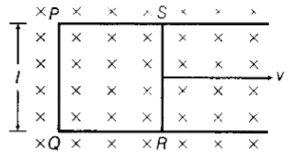
Deduce an expression for
i. the emf induced across the arm RS
ii. the external force required to move the arm and
iii. the power dissipated as heat.
Deduce an expression for
i. the emf induced across the arm RS
ii. the external force required to move the arm and
iii. the power dissipated as heat.
Whenever a photon is emitted by hydrogen in Balmer series, it is followed by another photon in Lyman series. What wavelength does this latter photon correspond to?
A person looks at different trees in an open space with the following details. Arrange the trees in decreasing order of their apparent sizes.
| Tree | Height(m) | Distance form the eye(m) |
| A | 2.8 | 50 |
| B | 2.5 | 80 |
| C | 1.8 | 70 |
| D | 2.8 | 100 |
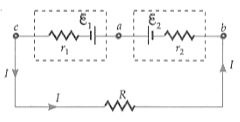
In Figure, $\varepsilon_1$ and $\varepsilon_2$ are respectively 2.0 V and 4.0 V and the resistances $r _1, r _2$ and R are respectively $1.0 \Omega$ $2.0 \Omega$ and $5.0 \Omega$. Calculate the current in the circuit. Also, calculate:
i. potential difference between the points b and a,
ii. potential difference between a and c.
→i. potential difference between the points b and a,
ii. potential difference between a and c.
The noise level in a class-room in absence of the teacher is 50dB when 50 students are present. Assuming that on the average each student outputs same sound energy per second, what will be the noise level if the number of students is increased to 100?
$\text{ }^{197}_{80}\text{Hg}$ decay to $\text{ }^{197}_{79}\text{Au}$ through electron capture with a decay constant of 0.257 per day.
→- What other particle or particles are emitted in the decay?
- Assume that the electron is captured from the K shell. Use Moseley's law $\sqrt{\text{v}}=\text{a(Z}-\text{b})$ with $\text{a}=4.95\times10^7\text{s}^{-\frac{1}{2}}$ and b = 1 to find the wavelength of the $\text{K}_{\alpha}$ X-ray emitted following the electron capture.