Question
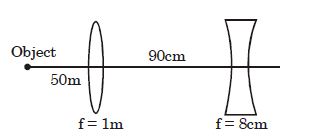
Find linear magnification in the given diagram.
Answer

$\mathrm{m}_{1}=-\frac{\mathrm{f}}{\mathrm{x}_{1}}=\frac{-1}{49}$

$\mathrm{v}=\mathrm{m}_{1} \mathrm{u}=\frac{-1}{49} \times-50=1.02 \mathrm{\,m}=102 \mathrm{\,cm}$

first image will act as object for second lens

$\mathrm{u}=+12 \mathrm{\,cm}, \mathrm{f}=-8 \mathrm{\,cm}$

$\mathrm{m}_{2}=\frac{-8}{-8+12}=-2$

$\mathrm{m}=\mathrm{m}_{1} \times \mathrm{m}_{2}=-2 \times \frac{-1}{49}=0.04$

Need a full question paper?

Generate a complete, print-ready paper with questions like this in minutes — across 16+ boards, with answer keys.
Start Generating Free

Similar questions

A particle is excuting a simple harmonic motion. Its maximum acceleration is $\alpha $ and maximum velocity is $\beta $. Then its frequency of vibration will be
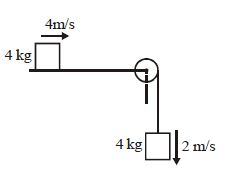
Two blocks of same mass $(4\ kg)$ are placed according to diagram. Initial velocities of bodies are $4\ m/s$ and $2\ m/s$ and the string is taut. Find the impulse on $4\ kg$ when the string again becomes taut  .......... $N-s$
A block of mass $5\,kg$ is moving horizontally at a speed of $1.5\, m/s$. A perpendicular force of $5\,N$ acts on it for $4 \,sec$. What will be the distance of the block from the point where the force started acting ........... $m$
The ionic bond is absent in
The position vector of a particle $\vec R$ as a function of time is given by $\overrightarrow {\;R} = 4\sin \left( {2\pi t} \right)\hat i + 4\cos \left( {2\pi t} \right)\hat j$ where $R$ is in meters, $t$ is in seconds and  $\hat i$ and $\hat j$  denote unit vectors along $x-$ and $y-$directions, respectively. Which one of the following statements is wrong for the motion of particle? 
A white screen illuminated by green and red light appears to be
If $t =\sqrt{ x }+4$, then $\left(\frac{ dx }{ dt }\right)_{ t =4}$ is.
Five masses each of $2\,kg$ are placed on a horizontal circular disc, which can be rotated about a vertical axis passing through its centre and all the masses be equidistant from the axis and at a distance of $10\,cm$ from it. The moment of inertia of the whole system (in $gm-cm^2$ ) is (Assume disc is of negligible mass)
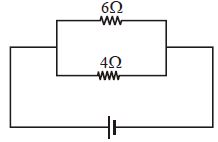
In the circuit shown, the power developed in the $6\,\Omega $ resistor is $6\,W.$ The power developed in the $4\,\Omega $ resistor is .............. $W$
A man moves in $x-y$ plane along the path shown. At what point is his average velocity vector in the same direction as his instantaneous velocity vector. The man starts from point $P$.