Question
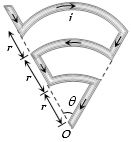
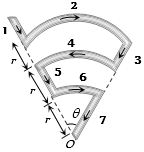
Find magnetic field at $O$
Answer

(a) ${B_1} = {B_3} = {B_5} = 0$
${B_2} = \frac{{{\mu _0}}}{{4\pi }}.\frac{{\theta i}}{{3r}} \otimes ,\;{B_4} = \frac{{{\mu _0}}}{{4\pi }}.\frac{{\theta i}}{{2r}}$ $\odot$ 
and ${B_6} = \frac{{{\mu _0}}}{{4\pi }}.\frac{{\theta i}}{r} \otimes $
$\therefore $ Net magnetic field at $O$,
${B_{net}} = {B_2} - {B_4} + {B_6}$ $ = \frac{{{\mu _0}}}{{4\pi }}.\frac{{\theta i}}{r}\left( {\frac{1}{3} - \frac{1}{2} + 1} \right) = \frac{{5{\mu _0}\theta i}}{{24\pi r}}$

Need a full question paper?

Generate a complete, print-ready paper with questions like this in minutes — across 16+ boards, with answer keys.

Start Generating Free

Similar questions

A wave can transmit ...... from one place to another
An alternating voltage is represented as $E = 20\,sin \,300t.$ The average value of voltage over one cycle will be.......$V$
$STATEMENT$-$1$ In an elastic collision between two bodies, the relative speed of the bodies after collision is equal to the relative speed before the collision. because

$STATEMENT$-$2$ In an elastic collision, the linear momentum of the system is conserved.

The displacement of a particle is given at time $t$, by:$x=A \sin (-2 \omega t)+B \sin ^2 \omega t \quad$ Then,
Three discs $A, B$ and $C$ having radii $2\; m, 4\;m,$ and $6 \;m$, respectively are coated with carbon black on their outer surfaces. The wavelengths corresponding to maximum intensity are $300\; nm, 400\; nm$ and $500\; nm$, respectively. The power radiated by them are $Q_A,Q_B$ and $Q_C$ respectively.
When the pressure on $1200\, ml$ of a gas in increased from $70\, cm $ to $120\, cm$ of mercury at constant temperature, the new volume of the gas will be ........ $ml$
The displacement of a particle is given by $y = 5 \times {10^{ - 4}}\sin (100t - 50x)$, where $x$ is in meter and $t$ in sec, find out the velocity of the wave  .... $m/sec$
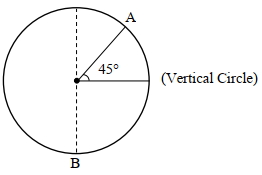
A body of $\mathrm{m} \mathrm{kg}$ slides from rest along the curve of vertical circle from point $A$ to $B$ in friction less path. The velocity of the body at $B$ is:

(given, $\mathrm{R}=14 \mathrm{~m}, \mathrm{~g}=10 \mathrm{~m} / \mathrm{s}^2$ and $\sqrt{2}=1.4$ )
A planet has twice the radius but the mean density is $\frac{1}{4}^{th}$ as compared to earth. What is the ratio of escape velocity from earth to that from the planet
The electric potential $V$ at any point $O$ ($x$, $y$, $z$ all in metres) in space is given by $V = 4{x^2}\,volt$. The electric field at the point $(1m,\,0,\,2m)$ in $volt/metre$ is