The displacement of a particle is given by $y = 5 \times {10^{ - 4}}\sin (100t - 50x)$, where $x$ is in meter and $t$ in sec, find out the velocity of the wave .... $m/sec$
Easy


Download our appand get started for free
Experience the future of education. Simply download our apps or reach out to us for more information. Let's shape the future of learning together!No signup needed.*
Similar Questions
- 1View SolutionWater waves are
- 2When a train approaches a stationary observer, the apparent frequency of the whistle is $n'$ and when the same train recedes away from the observer, the apparent frequency is $n''.$ Then, the apparent frequency $n$ when the observer moves with the train isView Solution
- 3If $V_m$ is the velocity of sound in moist air, $V_d$ is the velocity of sound in dry air, under identical conditions of pressure and temperatureView Solution
- 4A string in musical instrument is $50 cm$ long and its fundamental frequency is $800 Hz.$ If a frequency of $1000 Hz$ is to be produced, then required length of string is ..... $cm$View Solution
- 5Two tuning forks $A$ and $B$ give $4$ beats per second. The frequency of $A$ is $256 Hz$. On loading $B$ slightly, we get $5$ beats in $2$ seconds. The frequency of $B$ after loading is .... $Hz$View Solution
- 6A tuning fork of known frequency $256\,Hz$ makes $5$ beats per second with the vibrating string of a guitar. The beat frequency decreases to $2$ beats per second when the tension in the guitar string slightly increased. The frequency of the guitar string before increasing the tension was ..... $Hz$View Solution
- 7A source emits a sound of frequency of $400 Hz$, but the listener hears it to be $390 Hz.$ ThenView Solution
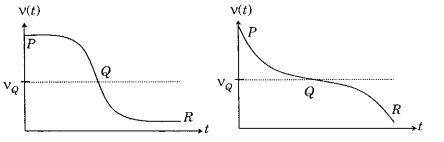
- 8Two loudspeakers $M$ and $N$ are located $20 \mathrm{~m}$ apart and emit sound at frequencies $118 \mathrm{~Hz}$ and $121 \mathrm{~Hz}$, respectively. $A$ car is initially at a point $P, 1800 \mathrm{~m}$ away from the midpoint $Q$ of the line $M N$ and moves towards $Q$ constantly at $60 \mathrm{~km} / \mathrm{hr}$ along the perpendicular bisector of $M N$. It crosses $Q$ and eventually reaches a point $R, 1800(m$ away from $Q$. Let $v(t)$ represent the beat frequency measured by a person sitting in tlie car at time $t$. Let $v_P, v_Q$ and $v_R$ be the beat frequencies measured at locations $P . Q$ and $R$, respectively. The speed of sound in air is $330 \mathrm{~m} \mathrm{~s}^{-1}$. Which of the following statement($s$) is(are) true regarding the sound heard by the person?View Solution
($A$) $v_P+v_R=2 v_Q$
($B$) The rate of change in beat frequency is maximum when the car passes through $Q$
($C$) The plot below represents schematically the variation of beat frequency with time
(image)
($D$) The plot below represents schematically the variation of beat frequency with time
(image)
- 9View SolutionThe nature of sound waves in gases is
- 10A source of sound $A$ emitting waves of frequency $1800\,Hz$ is falling towards ground with a terminal speed $v.$ The observer $B$ on the ground directly beneath the source receives waves of frequency $2150\,Hz.$ The source $A$ receives waves, reflected from ground of frequency nearly ..... $Hz$ (Speed of sound $= 343\,m/s$ )View Solution