Question
Find magnetic field on the axis of a circular current carrying loop.

Answer

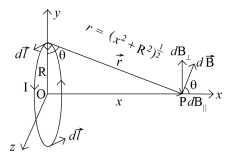
→ As shown in the figure, a steady current I is flowing through a conducting loop of radius R .
Image

→ The loop is placed in such a way that it lies in the $y-z$ plane and the $X$-axis passing through its axis.
→ A point P lies at a distance $x$ on the X -axis from its origin. We want to calculate the magnetic field at the point P .
→ Consider a current element $I d \vec{l}$ from the loop shown in figure. The magnitude of the magnetic field due to this element is,
$
d B=\frac{\mu_0}{4 \pi} \cdot \frac{|I d \vec{l} \times \vec{r}|}{r^3} \ldots(1)
$
→ But $I d \vec{l} \perp \vec{r}$ because $I d \vec{l}$ is in the $y z$ plane and the position vector $(\vec{r})$ is in $x y$ plane.
$
\begin{array}{l}
\therefore d B=\frac{\mu_0}{4 \pi} \cdot \frac{I d l r \sin 90}{r^3} \\
\therefore d B=\frac{\mu_0}{4 \pi} \cdot \frac{I d l}{r^2} \ldots(2)
\end{array}
$
→ From the figure, $r^2= R ^2+x^2$. Hence,
$
d B=\frac{\mu_0}{4 \pi} \cdot \frac{I d l}{\left(R^2+x^2\right)}
...(3)$
→ The magnetic field has two components at point P
(i) Perpendicular component $\left(d B_{\perp}=d B \sin \theta\right)$
→ When the perpendicular components are summed to get the net magnetic field, they cancel each other and the result is zero(ii) Parallel component $\left(d B_{\|}=d B \cos \theta\right)$
→ The parallel components are summed up to get the net magnetic field, so it can be obtained by integrating $d B_x=$ $d B \cos \theta$ over the loop.
→ $
d B(x)=d B \cos \theta
$
$\therefore d B(x)=\frac{\mu_0}{4 \pi} \cdot \frac{ l d l}{ R ^2+x^2} \cdot \cos \theta \ldots$ (4) $(\because$ from equation (3))
→ From the figure,
$
\begin{array}{l}
\cos \theta=\frac{R}{\left(x^2+R^2\right)^{\frac{1}{2}}} \\
\therefore d B(x)=\frac{\mu_0}{4 \pi} \cdot \frac{I d l}{R^2+x^2} \cdot \frac{R}{\left(R^2+x^2\right)^{\frac{1}{2}}} \\
\therefore d B(x)=\frac{\mu_0}{4 \pi} \cdot \frac{I d l \cdot R}{\left(R^2+x^2\right)^{\frac{3}{2}}}
\end{array}
$
→ The resultant magnetic field.
$
\begin{array}{l}
B=\oint_{d B(x)=} \frac{\mu_0 IR}{4 \pi\left(R^2+x^2\right)^{\frac{3}{2}}} \oint_{d l} \\
\therefore B=\frac{\mu_0 IR}{4 \pi\left(R^2+x^2\right)^{\frac{3}{2}}}(2 \pi R)\left(\because \oint_{d l=2 \pi R)}\right. \\
\therefore B=\frac{\mu_0 IR^2}{2\left(R^2+x^2\right)^{\frac{3}{2}}}
\end{array}
$
→ In vector form,
$
\overrightarrow{B}=\frac{\mu_0 IR^2}{2\left(R^2+x^2\right)^{\frac{3}{2}}} \cdot \hat{i}
$
→ To obtain the magnetic field at the centre of the loop $x=0$
$
\therefore B=\frac{\frac{\mu_0 IR^2}{2 R^3}=\frac{\mu_0 I}{2 R}, ~}{2 R}
$
→ If there are N turns, then
$
\overrightarrow{B}=\frac{\mu_0 NIR^2}{2\left(R^2+x^2\right)^{\frac{3}{2}}}
$

Need a full question paper?

Generate a complete, print-ready paper with questions like this in minutes — across 16+ boards, with answer keys.

Start Generating Free

Similar questions

  1. State the principle of working of a meter bridge.
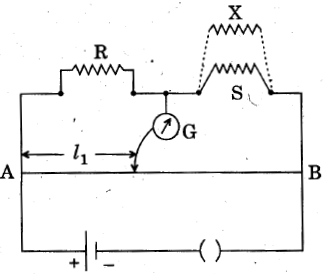
  2. In a meter bridge balance point is found at a distance l1 with resistances R and S as shown in the figure.

When an unknown resistance X is connected in parallel with the resistance S, the balance point shifts to a distance l2. Find the expression for X in terms of l1, land S.

In a soccer practice session the football is kept at the centre of the field 40 yards from the 10ft high goalposts. A goal is attempted by kicking the football at a speed of 64ft/s at an angle of 45° to the horizontal. Will the ball reach the goal post?
A double convex lens, made from a material of refractive index $\mu_1,$ is immersed in a liquid of refractive index $\mu_2$ where $\mu_1>\mu_2.$ What change, if any, would occur in the nature of the lens?
Calculate the Q-value of the fusion reaction
4He + 4He = 8Be.
Is such a fusion energetically favourable? Atomic mass of 8Be is 8.0053u and that of 4He is 4.0026u.
Draw the circuit diagram of a common emitter amplifier using n-p-n transistor. What is the phase differnece between the input signal and output voltage? State two reasons why a common emitter amplifier is preferred to a common base amplifier.
Write and explain the super position principle (of waves).
A river 400m wide is flowing at a rate of 2.0m/s. A boat is sailing at a velocity of 10m/s with respect to the water, in a direction perpendicular to the river.
  1. Find the time taken by the boat to reach the opposite bank.
  2. How far from the point directly opposite to the starting point does the boat reach the opposite bank?
Explain the construction of refracting telescope by figure and obtain the equation of magnification.
If $10^9$ electrons move out of a body to another body every second, how much time is required to get a total charge of $1 C$ on the other body?
Consider a head-on collision between two particles of masses m1 and m2. The initial speeds of the particles are u1 and u2 in the same direction. The collision starts 2 at t = 0 and the particles interact for a time interval $\triangle\text{t}.$ During the collision, the speed of the first particle varies as.

$\text{v}(\text{t})=\text{u}_1+\frac{\text{t}}{\triangle\text{t}}(\text{v}_1-\text{u}_1).$

Find the speed of the second particle as a function of time during the collision.