MCQ
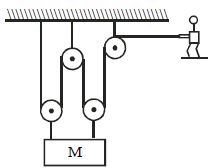
Find Mechanical advantage for pulling mass $M$ by the person
  • A
    $2$
  • $4$
  • C
    $8$
  • D
    $16$

Answer

Correct option: B.
$4$
b
$\mathrm{M.A.}=\frac{\mathrm{Load}}{\varepsilon \mathrm{ffort}}=\frac{\mathrm{Mg}}{\mathrm{T}}$

$\mathrm{Mg}=4 \mathrm{T}$

$\Rightarrow \mathrm{M.} \mathrm{A.}=4$

Need a full question paper?

Generate a complete, print-ready paper with questions like this in minutes — across 16+ boards, with answer keys.
Start Generating Free

Similar questions

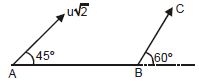
A particle is projected from a point $A$ with velocity $u\sqrt 2$ at an angle of $45^o$ with horizontal as shown in fig. It strikes the plane $BC$ at right angles. The velocity of the particle at the time of collision is
For a certain gas, the ratio of specific heats is given to be $\gamma = 1.5$. For this gas
The $SI$ unit of the inductance, the henry cannot be written as
$Assertion :$ Sound travels faster in solids than gases.
$Reason :$ Solids possess greater density than gases.
A $1\, kg$ stone at the end of $1\, m$ long string is whirled in a vertical circle at constant speed of $4\, m/s$. The tension in the string is $6\, N$ when the stone is at $(g = 10\, m/s^2)$
When 1 m, 1 kg and 1 min are taken as the fundamental units, the magnitude of the force is 36 units. What will be the value of this force in CGS system?
Different physical quantities are given in Column - $\mathrm{I}$ and their dimensional formula are given in Column - $\mathrm{II}$. Match them appropriately.
Column - $\mathrm{I}$ Column - $\mathrm{II}$
$(a)$ Viscous force $(i)$ $\left[ {{M^1}{L^1}{T^{ - 2}}} \right]$
$(b)$ Coefficient of viscosity $(ii)$ $\left[ {{M^1}{L^{ - 1}}{T^{ - 1}}} \right]$
  $(iii)$ $\left[ {{M^1}{L^{ - 1}}{T^{ - 2}}} \right]$
The equation of wave is given by $Y=10^{-2} \sin 2 \pi\left(160 t-0.5 x+\frac{\pi}{4}\right)$ Where $x$ and $Y$ are in $m$ and $t$ in $s$. The speed of the wave is $.....\,km h ^{-1}$
The measured value of the length of a simple pendulum is $20 \mathrm{~cm}$ with $2 \mathrm{~mm}$ accuracy. The time for $50$ oscillations was measured to be $40$ seconds with $1$ second resolution. From these measurements, the accuracy in the measurement of acceleration due to gravity is $\mathrm{N} \%$. The value of $\mathrm{N}$ is:
A rocket is fired vertically up from the ground with a resultant vertical acceleration of $10\  m/s^2$. The fuel is finished in $1\  minute$ and it continues to move up.$(a)$ the maximum height reached.$(b)$ After how much time from then will the maximum height be reached (Take $g = 10\  m/s^2$)