Question
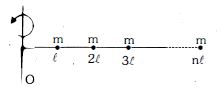
Find moment of inertia about axis $OA$
Answer

$\Sigma \mathrm{I}=\mathrm{mr}_{1}^{2}+\mathrm{mr}_{2}^{2}+\ldots \ldots \ldots+\mathrm{mr}_{n}^{2}$

$=m \ell^{2}+m(2 \ell)^{2}+\ldots \ldots+m(n \ell)^{2}$

$\Rightarrow \mathrm{m} \ell^{2}\left[1^{2}+2^{2}+\ldots \ldots \mathrm{n}^{2}\right]$

$=\frac{m \ell^{2}}{6} n(n+1)(2 n+1)$

Need a full question paper?

Generate a complete, print-ready paper with questions like this in minutes — across 16+ boards, with answer keys.
Start Generating Free

Similar questions

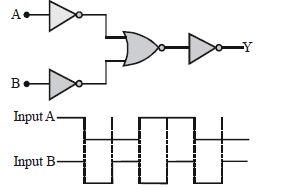
The logic circuit shown has the input waveforms $'A'$ and $'B'$ as shown. Pick out the CORRECT output waveform
A mass of $50\,g$ of water in a closed vessel, with surroundings at a constant temperature takes $2\, minutes$ to cool from $30\,^oC$ to $25\,^oC$. A mass of $100\,g$ of another liquid in an identical vessel with identical surroundings takes the same time to cool from $30\,^oC$ to $25\,^o C$. The specific heat of the liquid is .......... $kcal/kg$ (The water equivalent of the vessel is $30\,g$.)
A stone tied to a string is rotated in a circle. If the string is cut, the stone flies away from the circle because
In $a$ one dimensional collision between two identical particles $A$ and $B, B$ is stationary and $A$ has momentum $p$ before impact. During impact, $B$ gives impulse $J$ to $A.$
The tangent galvanometer, when connected in series with a standard resistance can be used as
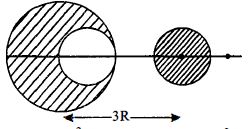
From a sphere of mass $M$ and radius $R$, a smaller sphere of radius $\frac{R}{2}$ is carved out such that the cavity made in the original sphere is between its centre and the periphery (See figure) . For the configuration in the figure where the distance between the centre of the original sphere and the removed sphere is $3R$, the gravitational force between the two sphere is
The possible value of Poisson's ratio is
A guitar string of length $90\,cm$ vibrates with a fundamental frequency of $120\,Hz.$ The length of the string producing a fundamental frequency of $180\,Hz$ will be $...........cm$.
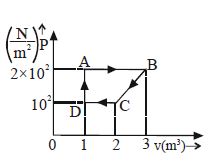
A cyclic process is shown in figure. Work done during isobaric expansion is ...... $J$
A simple harmonic motion having an amplitude $A$ and time period $T$ is represented by the equation : $y = 5 \sin \pi (t + 4) m$

Then the values of $A$ (in $m$) and $T$ (in $sec$) are :