MCQ
Find out the $e.m.f$. produced when the current changes from $0$ to $1 \,A$ in $10 \,second$, given $L = 10$ $\mu H$
  • A
    $1\, V$
  • $1$  $\mu V$
  • C
    $1\, mV$
  • D
    $0.1\,V$

Answer

Correct option: B.
$1$  $\mu V$
b
(b) $|e|\, = L\frac{{di}}{{dt}}$

$\Rightarrow \,|e|\, = 10 \times {10^{ - 6}} \times \frac{1}{{10}} = 1\,\mu V$

Need a full question paper?

Generate a complete, print-ready paper with questions like this in minutes — across 16+ boards, with answer keys.
Start Generating Free

Similar questions

A ring and a disc are initially at rest, side by side, at the top of an inclined plane which makes an angle $60^{\circ}$ with the horizontal. They start to roll without slipping at the same instant of time along the shortest path. If the time difference between their reaching the ground is $(2-\sqrt{3}) / \sqrt{10} \mathrm{~s}$, then the height of the top of the inclined plane, in metres, is. . . . . . Take $g=10 \mathrm{~m} \mathrm{~s}^{-2}$.
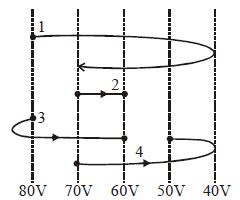
The figure shows a family of parallel equipotential surfaces and four paths along which an electron is made to move from one surface to another as shown in the figur
$(I)$ What is the direction of the electric field ?
$(II)$ Rank the paths according to magnitude of work done, greatest first
A $12\,V,60\,W$ lamp is connected to the secondary of a step down transformer, whose primary is connected to ac mains of $220\,V$. Assuming the transformer to be ideal, $..........\,A$ is the current in the primary winding.
Aldol condensation will not take place in
An electron has a mass of $9.1 \times {10^{ - 31}}kg$. It revolves round the nucleus in a circular orbit of radius $0.529 \times {10^{ - 10}}metre$ at a speed of $2.2 \times {10^6}m/s$. The magnitude of its linear momentum in this motion is
A moving coil galvanometer has $N$ number of turns in a coil of effective area $A$, it carries a current $I$. The magnetic field $B$ is radial. The torque acting on the coil is
A smooth sphere $A$ of mass $m$ collides elastically with an identical sphere $B$ at rest. The velocity of $A$ before collision is $8\ m/s$ in a direction making $60^o$ with the line of centres at the time of impact.

$(i)$ The sphere $A$ comes to rest after collision.

$(ii)$ The sphere $B$ will move with a speed of $8\ m/s$ after collision.

$(iii)$ The directions of motion $A$ and $B$ after collision are at right angles.

$(iv)$ The speed of $B$ after collision is $4\ m/s$ . The correct option is 

Calculate the value of mean free path $(\lambda)$ for oxygen molecules at temperature $27^{\circ}\, C$ and pressure $1.01 \times 10^{5} \,Pa$. Assume the molecular diameter $0.3 \,nm$ and the gas is ideal. $\left( k =1.38 \times 10^{-23}\, J\,K ^{-1}\right)$ (in $nm$)
If a car at rest accelerates uniformly to a speed of $144 \,km/h$ in $20 \,s$. Then it covers a distance of........$m$
A perfect gas at $27°C$ is heated at constant pressure so as to triple its volume. The temperature of the gas will be ...... $^oC$