The figure shows a family of parallel equipotential surfaces and four paths along which an electron is made to move from one surface to another as shown in the figur
$(I)$ What is the direction of the electric field ?
$(II)$ Rank the paths according to magnitude of work done, greatest first
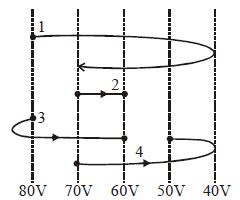
$(I)$ What is the direction of the electric field ?
$(II)$ Rank the paths according to magnitude of work done, greatest first
Medium


Download our appand get started for free
Experience the future of education. Simply download our apps or reach out to us for more information. Let's shape the future of learning together!No signup needed.*
Similar Questions
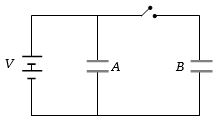
- 1Figure given below shows two identical parallel plate capacitors connected to a battery with switch $S$ closed. The switch is now opened and the free space between the plate of capacitors is filled with a dielectric of dielectric constant $3$. What will be the ratio of total electrostatic energy stored in both capacitors before and after the introduction of the dielectricView Solution
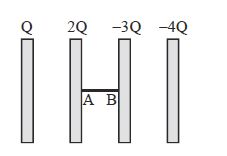
- 2View SolutionFour very large metal plates are given the charges as shown in figure. The middle two are then connected through a wire. Find the charge that will flow through the wire
- 3There is a uniform electrostatic field in a region. The potential at various points on a small sphere centred at $P$, in the region, is found to vary between in the limits $589.0\,V$ to $589.8\, V$. What is the potential at a point on the sphere whose radius vector makes an angle of $60^o$ with the direction of the field ?........$V$View Solution
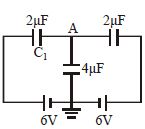
- 4Three capacitors are connected as shown in fig. Then the charge on capacitor $C_1$ is.....$\mu C$View Solution
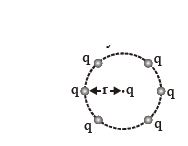
- 5A point charge is surrounded symmetrically by six identical charges at distance $r$ as shown in the figure. How much work is done by the forces of electrostatic repulsion when the point charge $q$ at the centre is removed at infinityView Solution
- 6If an electron moves from rest from a point at which potential is $50\, volt$ to another point at which potential is $70\, volt$, then its kinetic energy in the final state will beView Solution
- 7View SolutionA parallel plate air capacitor is charged and then isolated. When a dielectric material is inserted between the plates of the capacitor, then which of the following does not change
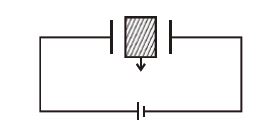
- 8View SolutionAn insulator plate is passed between the plates of a capacitor. Then the displacement current
- 9Two insulated charged spheres of radii $20\,cm$ and $25\,cm$ respectively and having an equal charge $Q$ are connected by a copper wire, then they are separatedView Solution
- 10A parallel plate capacitor is charged and then disconnected from the source steady $E.M.F.$ The plates are then drawn apart farther. Again it is connected to the same source. Then :View Solution