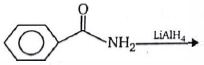
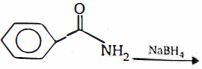
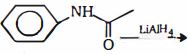
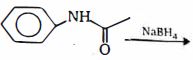
Find out the reaction in which obtained product give positive isocyanide test
- A
- B
- C
- D
Difficult



Download our appand get started for free
Experience the future of education. Simply download our apps or reach out to us for more information. Let's shape the future of learning together!No signup needed.*
Similar Questions
- 1View SolutionReaction of nitrous acid with aliphatic primary amine in the cold gives
- 2View SolutionReduction of nitroalkanes yields
- 3Carbylamine test is done by heating alcoholic $KOH$ withView Solution
- 4Isomeric amines with molecular formula $C _8 H _{11} N$ give the following testsView Solution
Isomer $(P) \Rightarrow$ Can be prepared by Gabriel phthalimide synthesis
Isomer $(Q) \Rightarrow$ Reacts with Hinsberg's reagent to give solid insoluble in $NaOH$
Isomer (R) $\Rightarrow$ Reacts with $HONO$ followed by $\beta$-naphthol in $NaOH$ to give red dye.
Isomers $( P ),( Q )$ and $( R )$ respectively are
- 5View SolutionMajor product of the reaction, when the given compound undergoes Hoffmann exhaustive methylation is

- 6Compound $A$ is converted to $B$ on reaction with $\mathrm{CHCl}_{3}$ and $\mathrm{KOH}$. The compound $\mathrm{B}$ is toxic and can be decomposed by $C.$ $A, B$ and $C$ respectively are :View Solution
- 7The increasing basicity order of the following compounds isView Solution
$(1)$ $C{H_3}C{H_2}N{H_2}$ $(2)$ $\begin{array}{*{20}{c}}
{\,\,\,\,\,\,\,\,\,\,\,\,\,\,\,\,\,\,\,\,\,\,\,\,\,\,C{H_2}C{H_3}}\\
{\,\,\,\,\,\,\,\,\,\,\,\,\,\,|\,\,\,\,}\\
{\,C{H_3}C{H_2}NH\,\,\,\,\,\,\,}
\end{array}$$(3)$ $\begin{array}{*{20}{c}}
{\,\,\,\,\,\,\,C{H_3}}\\
{\,|}\\
{{H_3}C - N - C{H_3}}
\end{array}$ $(4)$ $\begin{array}{*{20}{c}}
{\,\,\,\,\,\,\,C{H_3}}\\
{\,|}\\
{Ph - N - H}
\end{array}$ - 8Assertion : Aniline does not undergo Friedel- Crafts reaction.View Solution
Reason : $-NH_2$ group of aniline reacts with $AlCl_3$ (Lewis acid) to give acid-base reaction - 9Given below are two statements : one is labelled as Assertion $(A)$ and the other is labelled as Reason $(R)$.View Solution
Assertion $(A)$ : Experimental reaction of $CH _{3} Cl$ with aniline and anhydrous $AlCl _{3}$ does not give $o$ and $p-methylaniline$.
Reason $(R)$ : The - $NH _{2}$ group of aniline becomes deactivating because of salt formation with anhydrous $AlCl _{3}$ and hence yields $m$-methyl aniline as the product.
In the light of the above statements, choose the most appropriate answer from the options given below.
- 10In the following sequence of the reations, what is $D$?View Solution
(image) $\xrightarrow{{[O]}}A\xrightarrow{{SOC{l_2}}}B\xrightarrow{{Na{N_3}}}C\xrightarrow{{Heat}}D$
