MCQ
find out the reactivity order with $LiAlH_4$
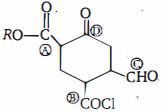
  • A
    $A > B > C > D$
  • $B > C > D > A$
  • C
    $D > C > B > A$
  • D
    $B > D > C > A$

Answer

Correct option: B.
$B > C > D > A$
b
$(b)$ Reaction is an example of nucleophilic addition Rate of $NAR$ acid halide  $>$ ald. $>$ ketone $>$ acid

Need a full question paper?

Generate a complete, print-ready paper with questions like this in minutes — across 16+ boards, with answer keys.

Start Generating Free

Similar questions

Arrange the following in order of their reactivity toward decarboxylation reaction

$\mathop {\begin{array}{*{20}{c}}
{\,\,\,\,\,\,\,\,\,\,\,\,\,\,O}\\
{\,\,\,\,\,\,\,\,\,\,\,\,\,\,||}\\
{CH \equiv C - C - OH}
\end{array}}\limits_{\rm{I}} $ $\mathop {\begin{array}{*{20}{c}}
{\,\,\,\,\,\,\,\,\,\,\,\,\,\,\,\,\,\,\,O}\\
{\,\,\,\,\,\,\,\,\,\,\,\,\,\,\,\,\,\,\,||}\\
{C{H_2} = CH - C - OH}
\end{array}}\limits_{{\rm{II}}} $ $\mathop {\begin{array}{*{20}{c}}
{\,\,\,\,\,\,\,\,\,\,\,\,\,\,\,\,\,\,\,O}\\
{\,\,\,\,\,\,\,\,\,\,\,\,\,\,\,\,\,\,\,||}\\
{C{H_3} - C{H_2} - C - OH}
\end{array}}\limits_{{\rm{III}}} $$\mathop {\begin{array}{*{20}{c}}
\,\,\,{C{H_3}\,\,\,\,\,\,O}\\
\,\,\,{|\,\,\,\,\,\,\,\,\,\,\,\,\,\,\,||}\\
{C{H_3} - CH - C - OH}
\end{array}}\limits_{{\rm{IV}}} $

Which one of the following aldehydes will not form an aldol when treated with $dil. \,NaOH$ ?
For correct statement use $'T'$ for incorrect use $'F'$

$(A)$ Hydrolysis of Marshall's acid gives $H_2SO_4$ and $H_2O_2$ as final product

$(B)$ In $SCNSiH_3$ structure around $N$ is bent

$(C)$ Basic unit for silicates is $SiO_4^{-4}$

$(D)$$N{H_4}Cl + NaOH \to N{H_3} \uparrow $

Product $A$ is
Magnetic moment of $d^6$ low spin complex is ........ $B.M.$
$\begin{array}{*{20}{c}}
  {C{l_3}\mathop C\limits^3  - \mathop C\limits^2 H = \mathop C\limits^1 {H_2}} \\ 
  {(I)} 
\end{array}\,\,\,\,\,\,\,\,\,\,\,\,\,\begin{array}{*{20}{c}}
  {{H_3}\mathop C\limits^3  - \mathop C\limits^2 H = \mathop C\limits^1 {H_2}} \\ 
  {(II)} 
\end{array}$

In addition of $HOBr$ to $(I)$ and $(II)$

Arrange the following compound in decreasing order of reactivity towards nucleophilic addition reaction

${\left( {I} \right)}$  ${{C_6}{H_5}COC{H_3}}$

${\left( {II} \right)}$  ${C{H_3}COC{H_3}}$

${\left( {III} \right)}$  ${C{H_3} - CHO}$
If there be a compound of the formula $C{H_3}C{(OH)_3}$ which one of the following compounds would be obtained from it without reaction with any reagent
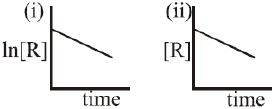
The given plots represent the variation of the concentration of a reactant $R$ with time for two different reactions $(i)$ and $(ii).$ The respective orders of the reactions are
The first transition element is