MCQ
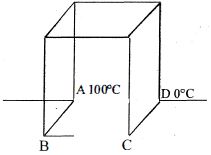
Find Temperature difference between $B$ and $C$ ? (All rods are identical)
  • A
    $\frac{{600}}{{13}}\ ^oC$
  • $\frac{{500}}{{7}}\ ^oC$
  • C
    $\frac{{400}}{{13}}\ ^oC$
  • D
    $\frac{{700}}{{6}}\ ^oC$

Answer

Correct option: B.
$\frac{{500}}{{7}}\ ^oC$
b
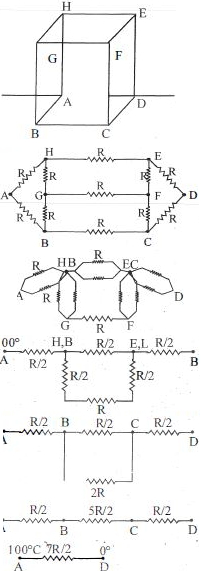
Resistance of all rods $=\mathrm{R}$

$\Delta \mathrm{T}=100^\circ \mathrm{C}$

Expanding it on a plan

$\text { By symmetry } \quad \mathrm{T}_{\mathrm{H}}=\mathrm{T}_{\mathrm{B}}$

$\mathrm{T}_{\mathrm{C}}=\mathrm{T}_{\mathrm{E}}$

$\Rightarrow$ Points $\mathrm{B}$ and $\mathrm{H} \& \mathrm{E}$ and $\mathrm{C}$ coule

ai ned toget her.

olving it like normal current circuit

Temp. difference across $\mathrm{BC}$

$\frac{{{{100}^ \circ } - {0^ \circ }C}}{{\frac{{7R}}{2}}} \times \frac{{5R}}{2} = \frac{{100}}{7} \times 5 = \frac{{500}}{7}{\,^ \circ }C$
Need a full question paper?

Generate a complete, print-ready paper with questions like this in minutes — across 16+ boards, with answer keys.
Start Generating Free

Similar questions

Which is reverse biased diode
A satellite is orbiting the earth in a circular orbit of radius $r.$ Its
A body is dropped from a satellite in parking orbit. Which of the following describes its behaviour correctly?
A bus driving along at $39.6 \,km / h$ is approaching a person who is standing at the bus stop, while honking repeatedly at an interval of $30 \,s$. If the speed of sound is $330 \,ms ^{-1}$, at what interval will the person hear the horn?
A parallel plate capacitor with width $4\,cm$, length $8\,cm$ and separation between the plates of $4\,mm$ is connected to a battery of $20\,V$. A dielectric slab of dielectric constant $5$ having length $1\,cm$, width $4\,cm$ and thickness $4\,mm$ is inserted between the plates of parallel plate capacitor. The electrostatic energy of this system will be......... $\in_{0}\,J$. (Where $\epsilon_{0}$ is the permittivity of free space)
An ideal monoatomic gas is confined in a cylinder by a spring loaded piston of cross section $8.0\times10^{-3}\, m^2$ . Initially the gas is at $300\, K$ and occupies a volume of $2.4\times10^{-3}\, m^3$ and the spring is in its relaxed state as shown in figure. The gas is heated by a small heater until the piston moves out slowly by $0.1\, m$. The force constant of the spring is $8000\, N/m$ and the atmospheric pressure is $1.0\times10^5\, N/m^2$ . The cylinder and the piston are thermally insulated. The piston and the spring are massless and there is no friction between the piston and the cylinder. The final temperature of the gas will be: (Neglect the heat loss through the lead wires of the heater . The heat capacity of the heater coil is also negligible)
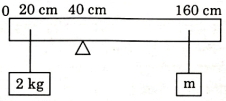
A uniform rod of length $200 \,\mathrm{~cm}$ and mass $500 \,\mathrm{~g}$ is balanced on a wedge placed at $40\,cm$ mark. A mass of $2\, \mathrm{~kg}$ is suspended from the rod at $20\, \mathrm{~cm}$ and another unknown mass $'m'$ is suspended from the rod at $160\, \mathrm{~cm}$ mark as shown in the figure. Find the value of $'m'$ such that the rod is in equilibrium. $\left(\mathrm{g}=10 \,\mathrm{~m} / \mathrm{s}^{2}\right)$
In a photo-emissive cell, with exciting wavelength $\lambda$ , the maximum kinetic energy of electron is $K$. If the exciting wavelength is changed to $\frac{3\lambda}{4}$ the kinetic energy of the fastest emitted electron will be:
When a body is taken from the equator to the poles, its weight
Consider two identical springs each of spring constant $k$ and negligible mass compared to the mass $M$ as shown. Fig. $1$ shows one of them and Fig. $2$ shows their series combination. The ratios of time period of oscillation of the two $SHM$ is $\frac{ T _{ b }}{ T _{ a }}=\sqrt{ x },$ where value of $x$ is

(Round off to the Nearest Integer)