MCQ
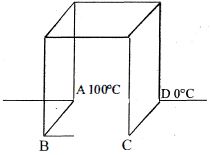
Find Temperature difference between $B$ and $C$ ? (All rods are identical)
  • A
    $\frac{{600}}{{13}}\ ^oC$
  • $\frac{{500}}{{7}}\ ^oC$
  • C
    $\frac{{400}}{{13}}\ ^oC$
  • D
    $\frac{{700}}{{6}}\ ^oC$

Answer

Correct option: B.
$\frac{{500}}{{7}}\ ^oC$
b
Resistance of all rods $=\mathrm{R}$

$\Delta \mathrm{T}=100^\circ \mathrm{C}$

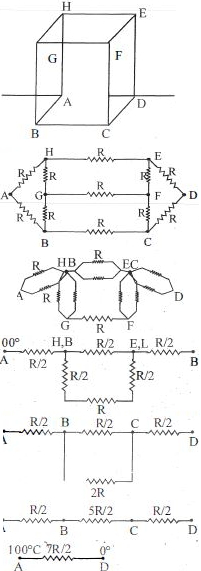
Expanding it on a plan

$\text { By symmetry } \quad \mathrm{T}_{\mathrm{H}}=\mathrm{T}_{\mathrm{B}}$

$\mathrm{T}_{\mathrm{C}}=\mathrm{T}_{\mathrm{E}}$

$\Rightarrow$ Points $\mathrm{B}$ and $\mathrm{H} \& \mathrm{E}$ and $\mathrm{C}$ coule

ai ned toget her.

olving it like normal current circuit

Temp. difference across $\mathrm{BC}$

$\frac{{{{100}^ \circ } - {0^ \circ }C}}{{\frac{{7R}}{2}}} \times \frac{{5R}}{2} = \frac{{100}}{7} \times 5 = \frac{{500}}{7}{\,^ \circ }C$
Need a full question paper?

Generate a complete, print-ready paper with questions like this in minutes — across 16+ boards, with answer keys.
Start Generating Free

Similar questions

The gas law $\frac{{PV}}{T} = $ constant is true for
$A$ body $A$ is thrown vertically upwards with such a velocity that it reaches a maximum height of $h$. Simultaneously another body $B$ is dropped from height $h$. It strikes the ground and does not rebound. The velocity of $A$ relative to $B v/s$ time graph is best represented by : (upward direction is positive)
Determine the maximum acceleration in $m/s^2$ of the train in which a box lying on its floor will remain stationary, given that the co-efficient of static friction between the box and the train’s floor is $0.15.$
The magnitude of force acting on a particle moving along $x$-axis varies with time $(t)$ as shown in figure. If at $t=0$ the velocity of particle is $v_0$, then its velocity at $t=T_0$ will be
A car moving with a velocity of $10 \,m/s$ can be stopped by the application of a constant force $F$ in a distance of $20\, m$. If the velocity of the car is $30\, m/s$, it can be stopped by this force in......$m$
A sound absorber attenuates the sound level by $20\ dB$. The intensity decreases by a factor of
For the velocity-time graph shown in the figure, in a time interval from $t=0$ to $t=6\,s$, match the following columns.
Colum $I$ Colum $II$
$(A)$ Change in velocity $(p)$ $-5 / 3\,Sl$ unit
$(B)$ Average acceleration $(q)$ $-20\,SI$ unit
$(C)$ Total displacement $(r)$ $-10\,SI$ unit
$(D)$ Acceleration at $t=3\,s$ $(s)$ $-5\,SI$ unit

According to Newtonl's law of cooling, the rate of cooling is :
Mass is distributed uniformly over a thin square plate. If two end points of diagonal are $(-2, 0)$ and $(2, 2)$, what are the coordinates of centre of mass of plate ?
At a temperature $T K,$ the pressure of $4.0\,\,g$ argon in a bulb is $p$. The bulb is put in a bath having temperature higher by $50\,\,K$ than the first one. $0.8\,\,g$ of argon gas had to be removed to maintained original pressure. The temperature $T$ is equal to ..... $K$