MCQ
The gas law $\frac{{PV}}{T} = $ constant is true for
  • A
    Isothermal changes only
  • B
    Adiabatic changes only
  • Both isothermal and adiabatic changes
  • D
    Neither isothermal nor adiabatic changes

Answer

Correct option: C.
Both isothermal and adiabatic changes
c
(c) For an ideal gas$:$

$P V=n R T$

$\frac{P V}{T}=n R=$ constant

Which is valid for all processes, which includes isothermal or adiabatic.

Hence option $\mathrm{C}$ is correct.

Need a full question paper?

Generate a complete, print-ready paper with questions like this in minutes — across 16+ boards, with answer keys.
Start Generating Free

Similar questions

A car is moving towards a high cliff. The car driver sounds a horn of frequency $f$. The reflected sound heard by the driver has a frequency $2f$. If $v$ be the velocity of sound then the velocity of the car, in the same velocity units, will be
The SI unit of mechanical equivalent of heat (J) is:
Venus looks brighter than other planets because
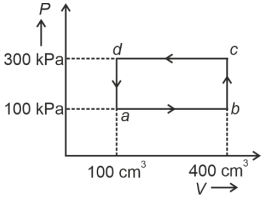
A cyclic process of a thermodynamic system is taken through $a$ $b$ $c$ $d$ $a$. The work done by the gas along the path $b$ $c$ is
The power (P) of an engine lifting a mass of 100kg upto a height of 10m in 1 min is:
A player kicks a football with an initial speed of $25\, {ms}^{-1}$ at an angle of $45^{\circ}$ from the ground. What are the maximum height and the time taken by the football to reach at the highest point during motion ? (Take g $=10 \,{ms}^{-2}$ )
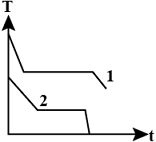
Two different liquids of same mass are kept in two identical vessels, which are placed in a freezer that extracts heat from them at the same rate causing each liquid to transform into a solid. The schematic figure below shows that temperature $T$ versus time $t$ plot for the two materials. We denote the specific heat of materials in the liquid (solid) states to be $C_{L 1}$ $\left(C_{S 1}\right)$ and $C_{L 2}\left(C_{S 2}\right)$, respectively. Choose the correct option given below.
The ratio of angular speeds of minute hand and hour hand of a watch is
A simple harmonic motion is represented by $F(t) = 10\sin \,(20\,t + 0.5)$. The amplitude of the $S.H.M.$ is  $a$ $=$ .... 
Elasticity of a material can be altered by: