MCQ
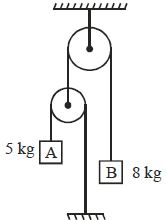
Find the acceleration of block $B$
  • A
    $0$
  • B
    $\frac{5}{2}\,m/s^2$
  • $\frac{5}{7}\,m/s^2$
  • D
    $\frac{5}{14}\,m/s^2$

Answer

Correct option: C.
$\frac{5}{7}\,m/s^2$
c
$A: 5 g-T=5(2 a)$

$B: 2 T-8 g=8(a)$

Where $'a'$ is acceleration of block $B$ upwards

$\Rightarrow 2 g=28(a)$

$a=\frac{20}{28}=\frac{5}{7} \mathrm{m} / \mathrm{s}^{2}$

Need a full question paper?

Generate a complete, print-ready paper with questions like this in minutes — across 16+ boards, with answer keys.
Start Generating Free

Similar questions

A string of length $1\ m$ fixed at both ends is vibrating in $3^{rd}$ overtone. Tension in string is $200\ N$ and linear mass density is $5\ gm/m$ . Frequency of these vibrations is ..... $Hz$
Bernoulli's principle does not explain
The number of molecules in one litre of an ideal gas at $300 \,{K}$ and $2$ atmospheric pressure with mean kinetic energy $2 \times 10^{-9}\, {J}$ per molecules is $....\, \times 10^{11}$
If the temperature of the sun (black body) is doubled, the rate of energy received on earth will be increased by a factor of
Assuming the earth to be a sphere of uniform mass density, a body weighed $300 \mathrm{~N}$ on the surface of earth. How much it would weigh at $R / 4$ depth under surface of earth?
According to Reynolds, what will be the value of critical velocity?
The height ${ }^{\prime} h ^{\prime}$ at which the weight of a body will be the same as that at the same depth $'h'$ from the surface of the earth is (Radius of the earth is $R$ and effect of the rotation of the earth is neglected):
An elevator accelerates upwards at a constant rate. A uniform string of length $L$ and mass $m$ supports a small block of mass $M$ that hangs from the ceiling of the elevator. The tension at distance $l$ from the ceiling is $T$ . The acceleration of the elevator is
An ideal gas follows a process described by the equation $PV ^2= C$ from the initial $\left( P _1, V _1, T _1\right)$ to final $\left(P_2, V_2, T_2\right)$ thermodynamics states, where $C$ is a constant. Then
A conical pendulum of length $1\,m$ makes an angle $\theta \, = 45^o$ w.r.t. $Z-$ axis and moves in a circle in the $XY$ plane.The radius of the circle is $0.4\, m$ and its centre is vertically below $O$. The speed of the pendulum, in its circular path, will be ..... $m/s$ (Take $g\, = 10\, ms^{-2}$)