Question
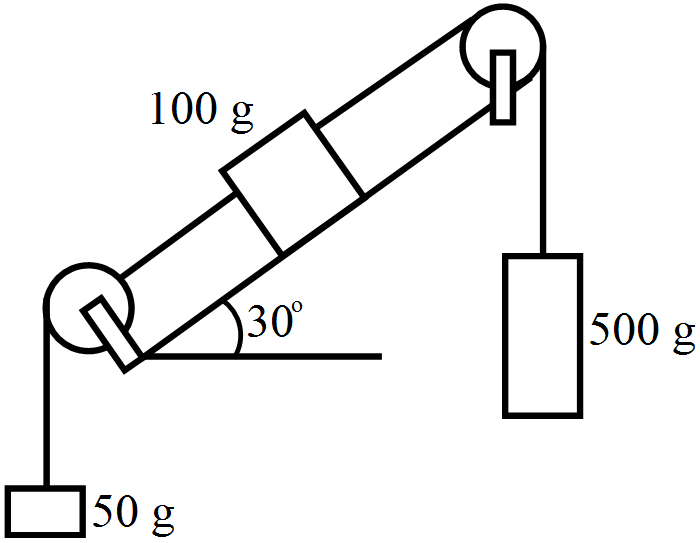
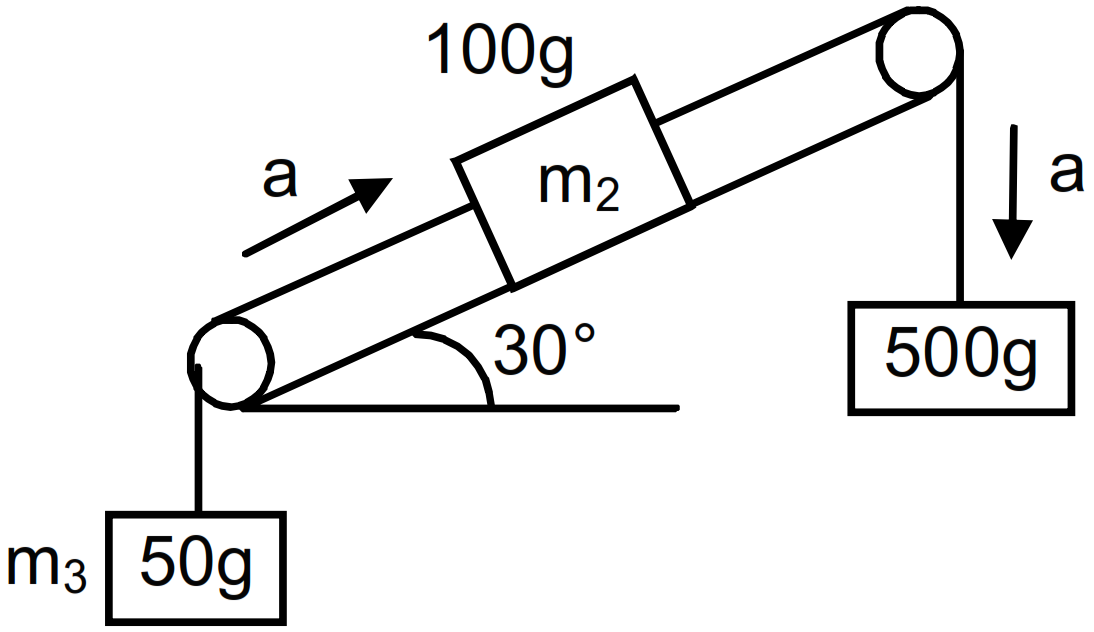
Find the acceleration of the $500\ g$ block in figure.

Answer


$m_1 = 100g = 0.1kg$
$m_2 = 500g = 0.5kg$
$m_3 = 50g = 0.05kg.$
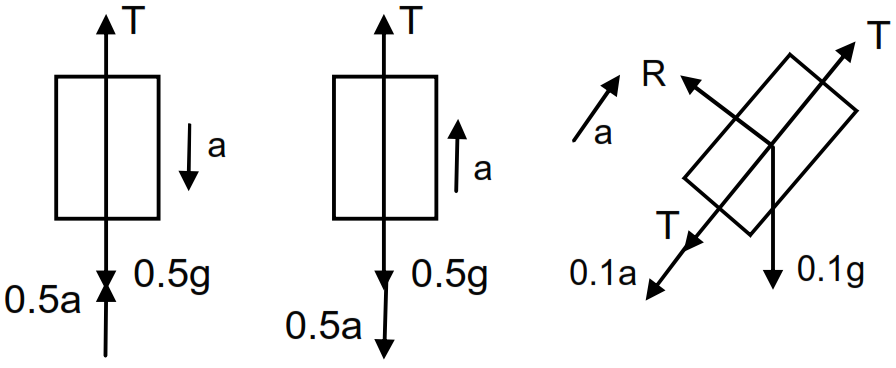
$T + 0.5a - 0.5g = 0 ...(i)$
$T_1- 0.5a - 0.05g = a ...(ii)$
$T_1 + 0.1a - T + 0.05g = 0 ...(iii)$
From equn $(ii) T_1 = 0.05g + 0.05a ...(iv)$
From equn $(i) T_1 = 0.5g - 0.5a ...(v)$
Equn $(iii)$ becomes $T_1 + 0.1a - T + 0.05g = 0$​​​​​​​

$\Rightarrow 0.05g + 0.05a + 0.1a - 0.5g + 0.5a + 0.05g = 0$ [From (iv) and (v)]
$\Rightarrow0.65\text{a}=0.4\text{g}\Rightarrow\text{a}=\frac{0.4}{0.65}=\frac{40}{65}\text{g}=\frac{8}{13}\text{g}$ downward
Acceleration of 500gm block is $\frac{8\text{g}}{13\text{g}}$ downward

Need a full question paper?

Generate a complete, print-ready paper with questions like this in minutes — across 16+ boards, with answer keys.
Start Generating Free

Similar questions

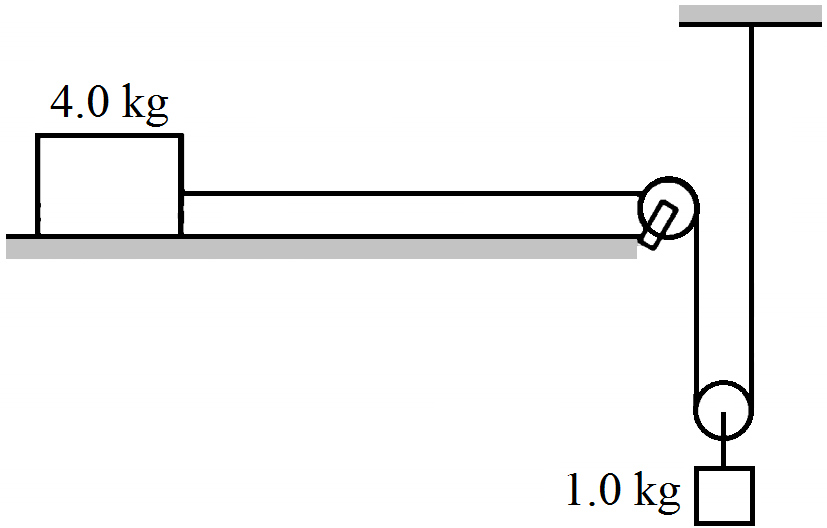
Consider the situation shown in figure. The system is released from rest and the block of mass $1.0kg$ is found to have a speed $0.3m/s$ after it has descended through a distance of $1m$. Find the coefficient of kinetic friction between the block and the table.
The ratio of the coefficients of thermal conductivity of two different materials is 4 : 3. If the thermal resistance of the rods of the same thickness of these materials is same, then what is the ratio of the lengths of these rods?
Show that the motion of the fluid filled is the U-tube is simple harmonic motion. Establish the formula for time period of the motion.
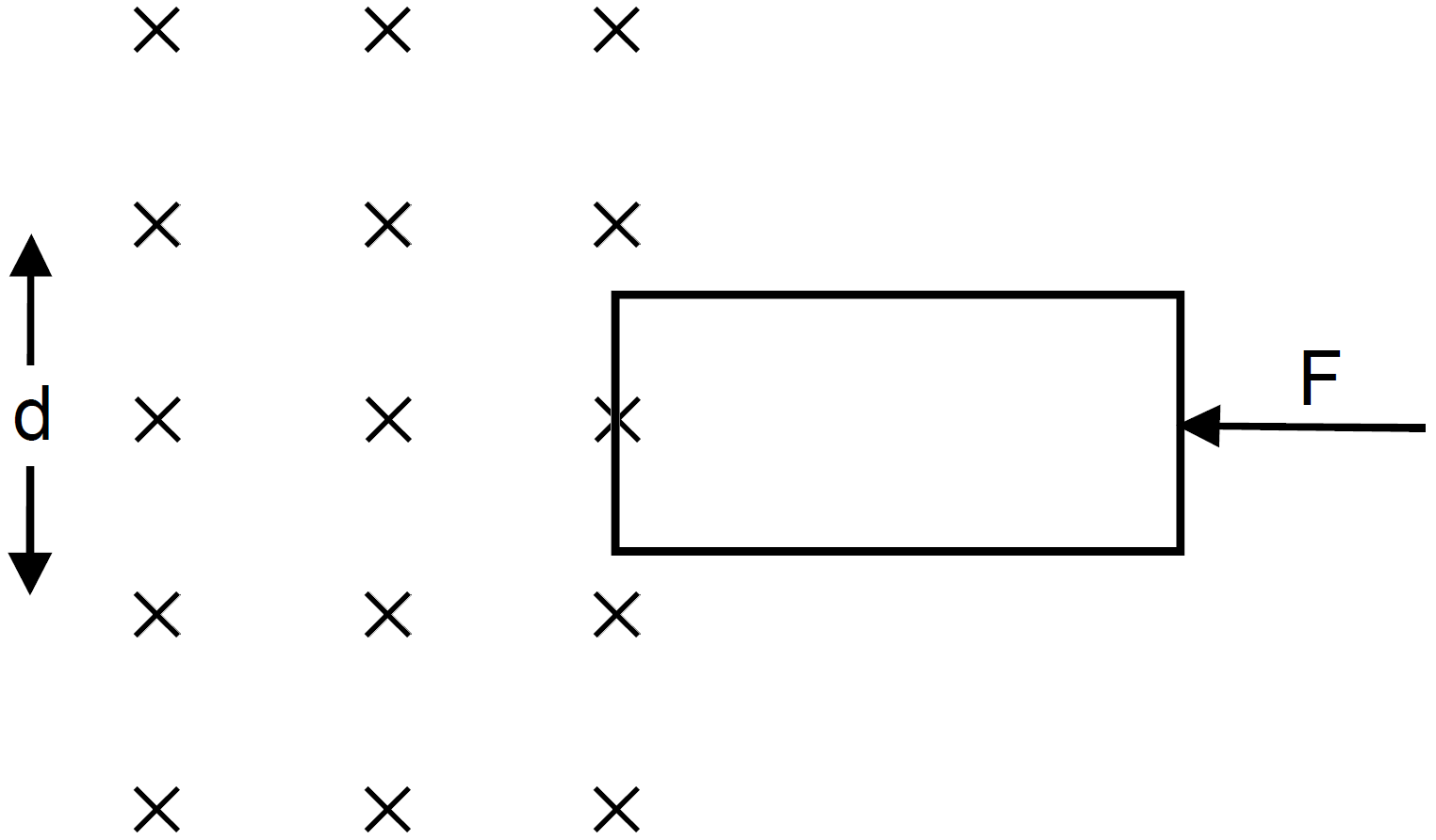
The rectangular wire-frame, shown in figure, has a width d, mass m, resistance R and a large length. A uniform magnetic field B exists to the left of the frame. A constant force F starts pushing the frame into the magnetic field at $t = 0$.
  1. Find the acceleration of the frame when its speed has increased to v.
  2. Show that after some time the frame will move with a constant velocity till the whole frame enters into the magnetic field. Find this velocity $v_0$.
  3. Show that the velocity at time t is given by $\text{v}=\text{v}_0\Big(1-\text{e}^{-\frac{\text{ft}}{\text{mv}_0}}\Big)$
A man weighing $50kg$ supports a body of $25kg$ on his head. What is the work done when he moves a distance of $20m$ up an incline of $1$ in $10$? Take, $g = 9.8m/ s^2$.
Define 1st law of thermodynamics. By using this law, derive relationship between $C_p$ and $C_v.$
Calculate the center of mass of a uniform thin rod.
A capacitor of capacitance $8.0\mu\text{F}$ is connected to a battery of emf 6.0V through a resistance of $24\Omega.$ Find the current in the circuit (a) just after the connections are made and (b) one time constant after the connections are made.
Using the correspondence of S.H.M. and uniform circular motion, find displacement, velocity, amplitude, time period and frequency of a particle executing S.H.M?
The electric field at a point associated with a light wave is $\text{E}=\big(100\frac{\text{v}}{\text{m}}\big)\sin[(3.0\times10^{15}\text{s}^{-1})\text{t]sin[(6.0}\times10^{15}\text{s}^{-1})\text{t}].$ If this light falls on a metal surface having a work function of $2.0eV$, what will be the maximum kinetic energy of the photoelectrons?