Question
The electric field at a point associated with a light wave is $\text{E}=\big(100\frac{\text{v}}{\text{m}}\big)\sin[(3.0\times10^{15}\text{s}^{-1})\text{t]sin[(6.0}\times10^{15}\text{s}^{-1})\text{t}].$ If this light falls on a metal surface having a work function of $2.0eV$, what will be the maximum kinetic energy of the photoelectrons?
Answer

$\text{E}=100\sin[(3\times10^{15}\text{s}^{-1})\text{t}]-\cos[3\times10^{15}\text{s}^{-1} )\text{t]}$$=100\frac{1}{2}[\cos[9\times10^{15}\text{s}^{-1})\text{t}]-\cos[3\times10^{15}\text{s}^{-1})\text{t}]$
The w are $9 \times 10^{15}$ and $3 \times 10^{15}$ for largest K.E.
$\text{f}_\text{max}=\frac{\text{W}_{\text{max}}}{2\pi}=\frac{9\times10^{15}}{2\pi}$
$\text{E}-\phi=\text{K.E}.$
$\Rightarrow\text{hf}-\phi_0=\text{K.E}.$
$\Rightarrow\frac{6.63\times10^{-34}\times9\times10^{15}}{2\pi\times1.6\times10^{-19}}-2=\text{KE}$
$\Rightarrow\text{KE}=3.938\text{ev}=3.93\text{ev}.$

Need a full question paper?

Generate a complete, print-ready paper with questions like this in minutes — across 16+ boards, with answer keys.

Start Generating Free

Similar questions

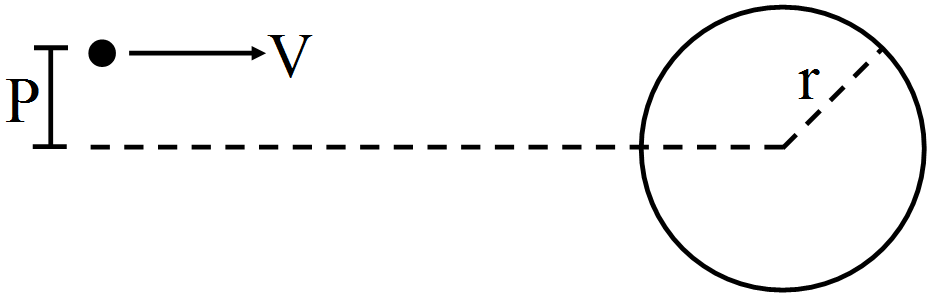
A small particle travelling with a velocity u collides elastically with a spherical body of equal mass and of radius r initially kept at rest. The centre of this spherical body is located a distance (p < r) away from the direction of motion of the particle. Find the final velocities of the two particles. [Hint: The force acts along the normal to the sphere through the contact. Treat the collision as onedimensional for this direction. In the tangential direction no force acts and the velocities do not change].
A satellite of mass $1000kg$ is supposed to orbit the earth at a height of $2000km$ above the earth's surface. Find
  1. Its speed in the orbit.
  2. Its kinetic energy.
  3. The potential energy of the earth-satellite system.
  4. Its time period. Mass of the earth = $6 \times 10^{24}kg$.
Does the escape speed of a body from the earth depend on (a) the mass of the body, (b) the location from where it is projected, (c) the direction of projection, (d) the height of the location from where the body is launched?
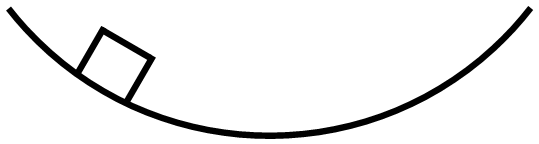
A small block oscillates back and forth on a smooth concave surface of radius R figure. Find the time period of small oscillation.
Show that the motion of the fluid filled is the U-tube is simple harmonic motion. Establish the formula for time period of the motion.
A threaded rod with 12turns/ cm and diameter 1.18cm is mounted horizontally. A bar with a threaded hole to match the rod is screwed onto the rod. The bar spins at 216rev/ min. How long will it take for the bar to move 1.50cm along the rod?
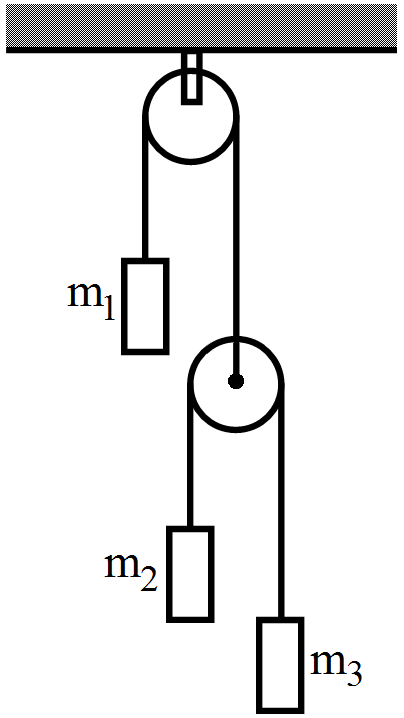
Let $m_1 = 1kg, m_2 = 2kg$ and $m_3 = 3kg$ in figure. Find the accelerations of $m_1, m_2$ and $m_3$. The string from the upper pulley to $m_1$​​​​​​​ is $20cm$ when the system is released from rest. How long will it take before m, strikes the pulley?
A table with smooth horizontal surface is fixed in a cabin that rotates with a uniform angular velocity $\omega$ in a circular path of radius R (In figure). A smooth groove AB of length L(<$\theta$ with the radius OA of the circle in which the cabin rotates. A small particle is kept at the point A in the groove and is released to move along AB. Find the time taken by the particle to reach the point B.
Explain the principle of moments.
A 'thermacole' icebox is a cheap and an efficient method for storing small quantities of cooked food in summer in particular. A cubical icebox of side 30 cm has a thickness of 5.0 cm . If 4.0 kg of ice is put in the box, estimate the amount of ice remaining after 6 h . The outside temperature is $45^{\circ} \mathrm{C}$, and co-efficient of thermal conductivity of thermacole is $0.01 \mathrm{~J} \mathrm{~s}^{-1} \mathrm{~m}^{-1} \mathrm{~K}^{-1}$. [Heat of fusion of water $=335 \times 103 \mathrm{~J} \mathrm{~kg}^{-1}$ ].