Question
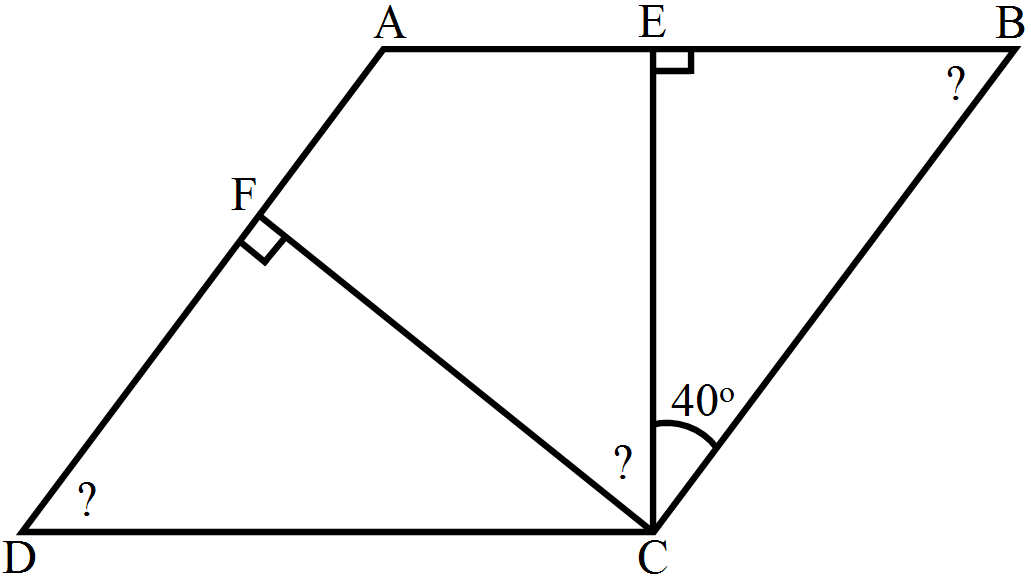
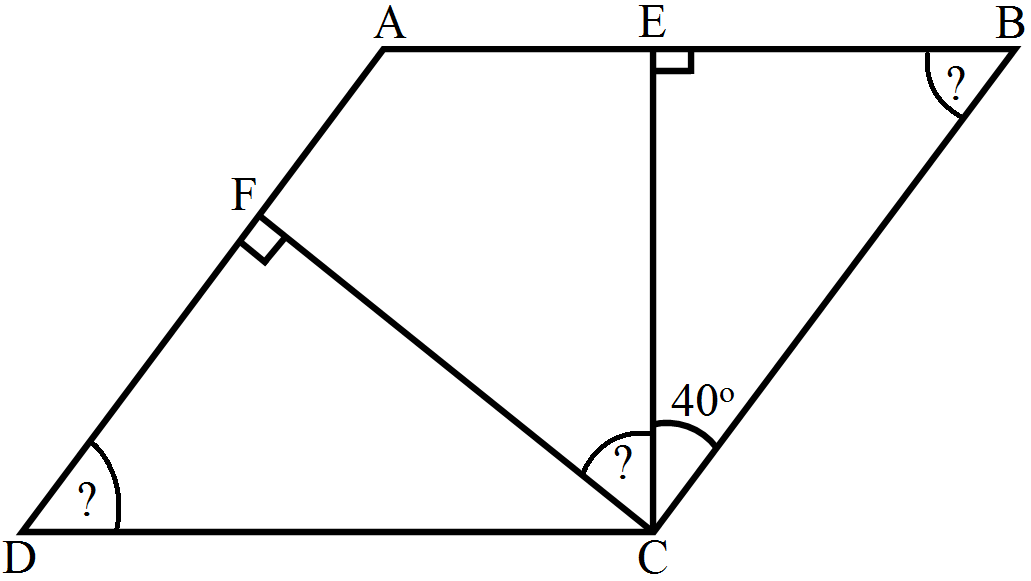
Find the angles marked with a question mark shown in the figure.
Answer


In parallelogram ABCD,
CE ⊥ AB and CF ⊥ AD
$\angle\text{BCE}=40^\circ$
In $\triangle\text{BCE}$,
$\angle\text{BCE}+\angle\text{CEB}+\angle\text{EBC}=180^\circ$ (Sum of angles of a triangle)
$\Rightarrow40^\circ +90^\circ+\angle\text{EBC}=180^\circ$
$\Rightarrow130^\circ+\angle\text{EBC}=180^\circ$
$\Rightarrow\angle\text{EBC}=180^\circ-130^\circ$
$\Rightarrow\angle\text{EBC}=50^\circ$
or $\angle\text{B}=50^\circ$
But $\angle\text{D}=\angle\text{B}$ (Opposite angles)
$\angle\text{D}=50^\circ$ or $\angle\text{ADC}=50^\circ$
Similarly in $\triangle\text{DCF}$,
$\angle\text{DCF}+\angle\text{CFD}+\angle\text{FDC}=180^\circ$
$\Rightarrow\angle\text{DCF}+90^\circ+50^\circ=180^\circ$
$\Rightarrow\angle\text{DCF}+140^\circ=180^\circ$
$\Rightarrow\angle\text{DCF}=180^\circ-140^\circ$
$\Rightarrow\angle\text{DCF}=40^\circ$
But $\angle\text{C}+\angle\text{B}=180^\circ$ (Sum of adjacent angles)
$\Rightarrow\angle\text{BCE}+\angle\text{ECF}+\angle\text{DCF}+\angle\text{A}=180^\circ$
$\Rightarrow40^\circ+\angle\text{ECF}+40^\circ+50^\circ=180^\circ$
$\Rightarrow\angle\text{ECF}+130^\circ=180^\circ$
$\Rightarrow\angle\text{ECF}=180^\circ-130^\circ$
$\Rightarrow\angle\text{ECF}=50^\circ$

Need a full question paper?

Generate a complete, print-ready paper with questions like this in minutes — across 16+ boards, with answer keys.
Start Generating Free

Similar questions

Leonard Euler, discovered an interesting formula regarding the faces, vertices and edges of solid figures.
Count and write the faces, vertices and edges of the following figures and complete the table. From the table verify Euler’s formula, F + V = E + 2.
Image
The marks obtained by Sudhir in an examination are given below:
Subject
English
Hindi
Mathematics
Science
Social science
Marks obtained
105
75
150
120
90
Represent the above data by a pie chart.
Solve the following equation and verify your answer:
$\frac{2-\text{y}}{\text{y}+7}=\frac{3}{5}$
The breadth of a room is twice its height, one half of its length and the volume of the room is 512 cu.dm. Find its dimensions.
Solve the following equation and also check your result in case:
$6.5\text{x}+\frac{19.5\text{x}-32.5}{2}=6.5\text{x}+13+\Big(\frac{13\text{x}-26}{2}\Big)$
Solve the following equation and verify your answer:
$\frac{3\text{x}+5}{2\text{x}+7}=4$
Construct a quadrilateral ABCD in which AB = 7.7cm, BC = 6.8cm, CD = 5.1cm, AD = 3.6cm and $\angle\text{C}=120^\circ.$
Construct a quadrilateral PQRS, where PQ = 3.5cm, QR = 6.5cm, $\angle\text{P}=\angle\text{R}=105^\circ$ and $\angle\text{S}=75^\circ$
Given below is the result of an annual examination of a class, showing the percentage of students in each category.
First division
Second division
Third division
Failed
25%
45%
20%
10%
Represent the above data by a pie chart.
In a two-digit number, digit at the ten’s place is twice the digit at unit’s place. If the number obtained by interchanging the digits is added to the original number, the sum is 66. Find the number.