Question
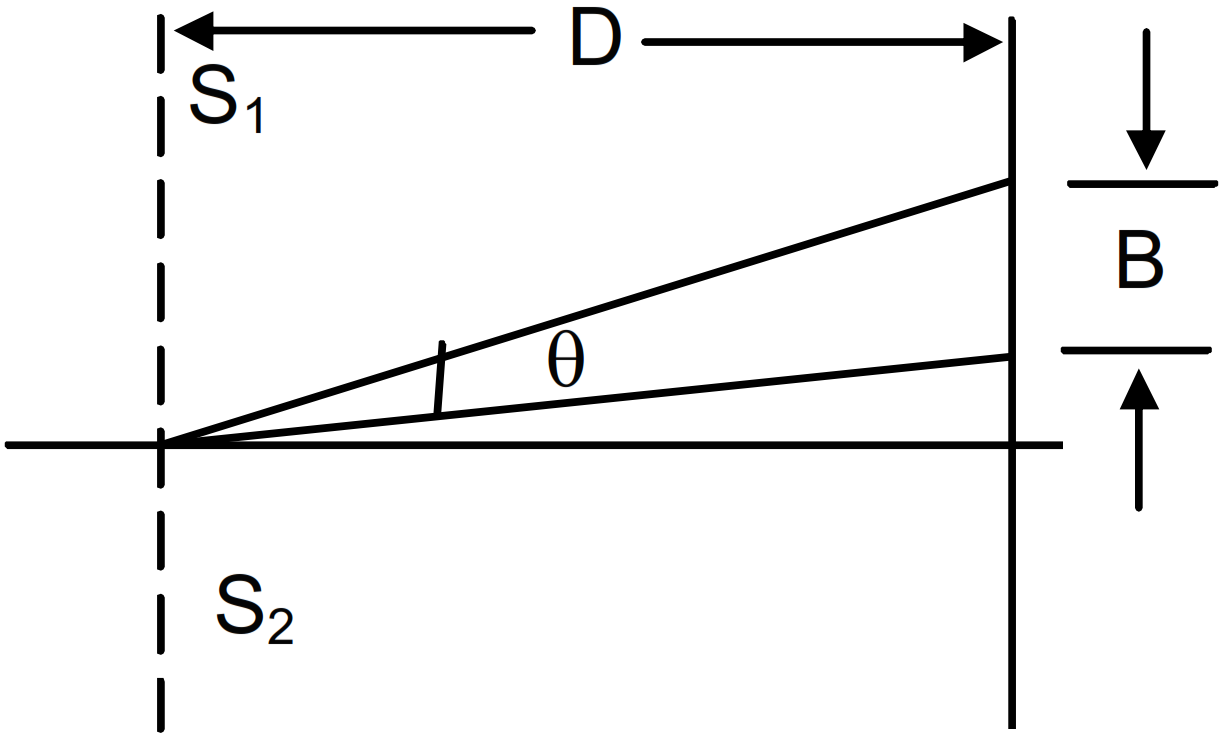
Find the angular separation between the consecutive bright fringes in a Young's double slit experiment with blue-green light of wavelength 500nm. The separation between the slits is 2.0 × 10⁻³m.
Answer

Given that, $\lambda=500\text{nm}=500\times10^{-9}\text{m}$ and d = 2 × 10⁻³m

As shown in the figure, angular separation $\theta=\frac{\beta}{\text{D}}=\frac{\lambda\text{D}}{\text{dD}}=\frac{\lambda}{\text{d}}$
So, $\theta=\frac{\beta}{\text{D}}=\frac{\lambda}{\text{d}}=\frac{500\times10^{-9}}{2\times10^{-3}}=250\times10^{-6}$
= 25 × 10-5 radian = 0.014 degree.

Need a full question paper?

Generate a complete, print-ready paper with questions like this in minutes — across 16+ boards, with answer keys.

Start Generating Free

Similar questions

Which of the following can act as a source of electromagnetic waves:
  1. A charge moving with a constant velocity.
  2. A charge moving in a circular orbit.
  3. A charge at rest.
Give reason.
Two identical coils, radius of each is 8 cm and number of turns is 100 are coaxial and their centers are 12 cm apart. If current of 1 A flows in each coil in the same direction, then calculate the magnetic field at the midpoint on the axial line.
A particle of mass 0.3kg is subjected to a force F = -kx with k = 15N/m. What will be its initial acceleration if it is released from a point x = 20cm?
Answer the following questions:
In any ac circuit, is the applied instantaneous voltage equal to the algebraic sum of the instantaneous voltages across the series elements of the circuit? Is the same true for rms voltage?
Calculate the energy in fusion reaction:
$^{2}_{1}\text{H} + ^{2}_{1}\text{H}\rightarrow^{3}_{2}\text{H}+ \text{n}, \text{where BE}\text{ of} ^{ 2}_{1}\text{H} = 2.23 \text{MeV} \text{and} \text{of} ^{3}_{2}\text{He} = 7.73 \text{MeV}.$
A square coil of 200 turns of size $\frac{50}{\pi}$ is rotated in a magnetic field of 2.0 weber/ at the speed of 1200 rotations/minute. Calculate the magnitude of maximum induced electromotive force in the coil.
Write and explain Ampere's circuital law.
A proton and an a-particle have the same de-Broglie wavelength. Determine the ratio of (i) Their accelerating potentials and (ii) Their speeds.
A short bar magnet placed in a horizontal plane has its axis aligned along the magnetic north-sourth direction. Null points are found on the axis of the magnet at 14 cm from the centre of the magnet. The earth's magnetic field at the place is 0.36 G and the angle of dip is zero. What is the total magnetic field on the normal bisector of the magnet at the same distance as the null points (i.e. 14 cm) from the centre of the magnet? (at null points, field due to a magnet is equal and opposite to the horizontal component of earth's magnetic field).
Find the dimensions of:

  1. Electric field E,
  2. Magnetic field B and
  3. Magnetic permeability $\mu_0.$
The relevant equations are

$\text{F = qE, F = qvB,}$ and $\text{B}=\frac{\mu_0\text{I}}{2\pi\alpha};$

where F is force, q is charge, v is speed, I is current, and a is distance.