Question
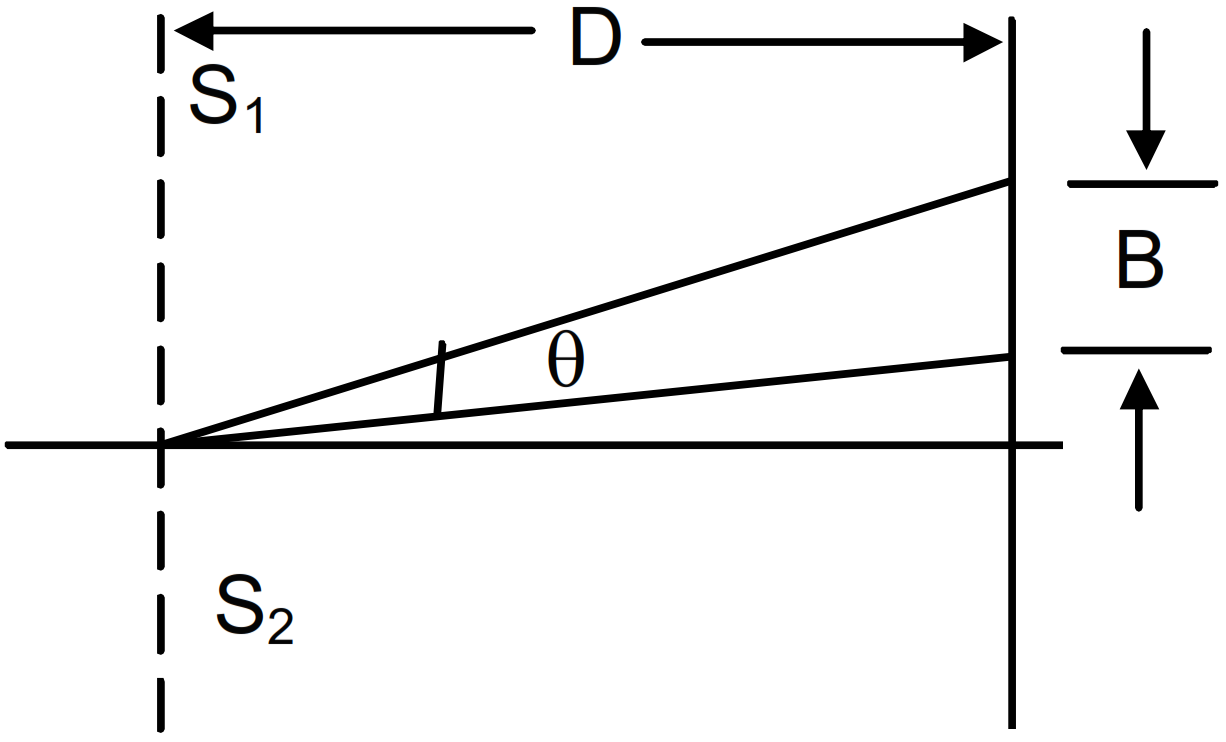
Find the angular separation between the consecutive bright fringes in a Young's double slit experiment with blue-green light of wavelength 500nm. The separation between the slits is $2.0 × 10^{-3}m.$
Answer

Given that, $\lambda=500\text{nm}=500\times10^{-9}\text{m}$ and $d = 2 \times 10^{-3}m$

As shown in the figure, angular separation $\theta=\frac{\beta}{\text{D}}=\frac{\lambda\text{D}}{\text{dD}}=\frac{\lambda}{\text{d}}$
So, $\theta=\frac{\beta}{\text{D}}=\frac{\lambda}{\text{d}}=\frac{500\times10^{-9}}{2\times10^{-3}}=250\times10^{-6}$
$= 25 \times 10^{-5}$ radian = 0.014 degree.

Need a full question paper?

Generate a complete, print-ready paper with questions like this in minutes — across 16+ boards, with answer keys.
Start Generating Free

Similar questions

Give explanation of linearly pofarized, unpolarized and plane polarized wave.
Think over the experiment number 2 of Faraday and Henry and tell :
(a) What will you do to obtain more deflection in the galvanometer?
(b) How will you show the presence of current in the absence of a galvanometer?
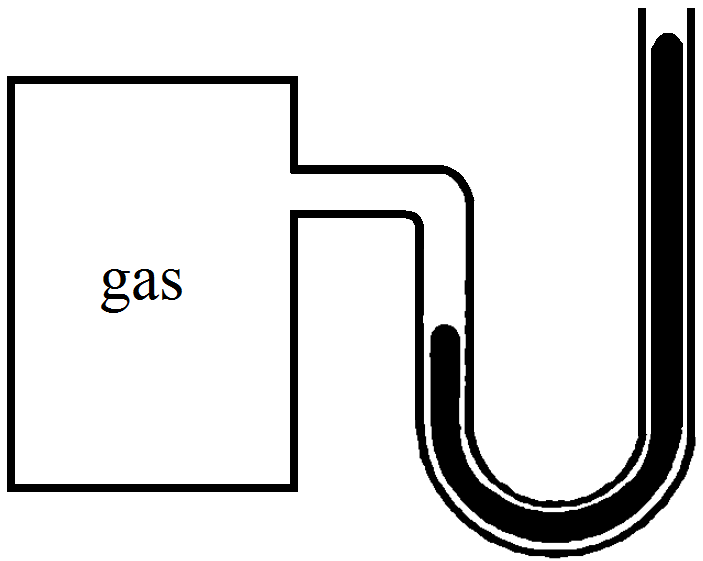
The heights of mercury surfaces in the two arms of the manometer shown in figure are 2cm and 8cm. Atmospheric pressure $= 1. 01 x 10^5N/rn^2$. Find.
  1. Thepressure of the gas in the cylinder and.
  2. The pressure of mercury at the bottom of the U tube.
Find the maximum wavelength of electromagnetic radiation which can create a hole-electron pair in germanium. The band gap in germanium is 0.65eV.
Give the information about charge and atomic number of the nucleus.
It is found experimentally that $13.6 eV$ energy is required to separate a hydrogen atom into a proton and an electron. Compute the orbital radius and the velocity of the electron in a hydrogen atom.
The equation of refraction at a spherical surface is $\frac{\mu_2}{\text{v}}-\frac{\mu_1}{\text{u}}-=\frac{\mu_2-\mu_1}{\text{R}}.$ Taking $\text{R}=\infty,$ show that this equation leads to the equation $\frac{\text{Real depth}}{\text{Apparent depth}}=\frac{\mu_2}{\mu_1}$ for refraction at a plane surface.
Show that the equipotential surfaces are closed together in the regions of strong field and far apart in the regions of weak field. Draw equipotential surfaces for an electric dipole.
Ultraviolet radiations of different frequencies $v_1$ and $v_2$, are incident on two photosensitive materials having work functions $W_1$ and $W_2\left(W_1>W_2\right)$ respectively. The kinetic energy of the emitted photoelectrons is same in both the cases. Which one of the two relations will be of the higher frequency?
A galvanometer has a resistance of 30Ω. It gives full scale deflection with a current of 2 mA. Calculate the value of the resistance needed to convert it into an ammeter of range 0-0.3 A.