Question
It is found experimentally that $13.6 eV$ energy is required to separate a hydrogen atom into a proton and an electron. Compute the orbital radius and the velocity of the electron in a hydrogen atom.

Answer

Total energy of the electron in hydrogen atom is $-13.6 eV =$ $-13.6 \times 1.6 \times 10^{-19} J =-2.2 \times 10^{-18} J$. Thus from Eq. (12.4), we have
$
E=-\frac{e^2}{8 \pi \varepsilon_0 r}=-2.2 \times 10^{-18} J
$
This gives the orbital radius
$
\begin{aligned}
r & =-\frac{e^2}{8 \pi \varepsilon_0 E}=-\frac{\left(9 \times 10^9 N m ^2 / C ^2\right)\left(1.6 \times 10^{-19} C \right)^2}{(2)\left(-2.2 \times 10^{-18} J \right)} \\
& =5.3 \times 10^{-11} m .
\end{aligned}
$
The velocity of the revolving electron can be computed from Eq. (12.3) with $m=9.1 \times 10^{-31} kg$,
$
v=\frac{e}{\sqrt{4 \pi \varepsilon_0 m r}}=2.2 \times 10^6 m / s
$

Need a full question paper?

Generate a complete, print-ready paper with questions like this in minutes — across 16+ boards, with answer keys.
Start Generating Free

Similar questions

The ground state energy of hydrogen atom is – 13·6 eV. If an electron makes a transition from an energy level – 1·51 eV to – 3·4 eV, calculate the wavelength of the spectral line emitted and name the series of hydrogen spectrum to which it belongs.
A monkey is sitting on a tree limb. The limb exerts a normal force of 48N and a frictional force of 20N. Find the magnitude of the total force exerted by the limb on the monkey.
Estimate the distance for which ray optics is good approximation for an aperture of 4 mm and wavelength 400 nm.
State Bohr’s quantisation condition of angular momentum. Calculate the shortest wavelength of the Bracket series and state to which part of the electromagnetic spectrum does it belong.
You are facing a circular wire carrying an electric current. The current is clockwise as seen by you. Is the field at the centre coming towards you or going away from you?
An electric dipole of dipole moment $20 \times 10^{-6} \mathrm{C}$ is enclosed by closed surface. What is the net electric flux coming out of this surface?
Write statement of Lenz's law of electromagnetism. A 2 m long straight vertical wire is falling perpendicularly to horizontal component at speed of 5 $m / s$ in the magnetic field of earth of $0.3 \times 10^{-4} T$. Calculate the magnitude of instantaneous value of induced emf across the ends of the wire.
In the Rutherford's nuclear model of the atom, the nucleus (radius about $10^{-15} m$ ) is analogous to the sun about which the electron move in orbit (radius $\approx 10^{-10} m$ ) like the earth orbits around the sun. If the dimensions of the solar system had the same proportions as those of the atom, would the earth be closer to or farther away from the sun than actually it is? The radius of earth's orbit is about $1.5 \times 10^{11} m$. The radius of sun is taken as $7 \times 10^8 m$.
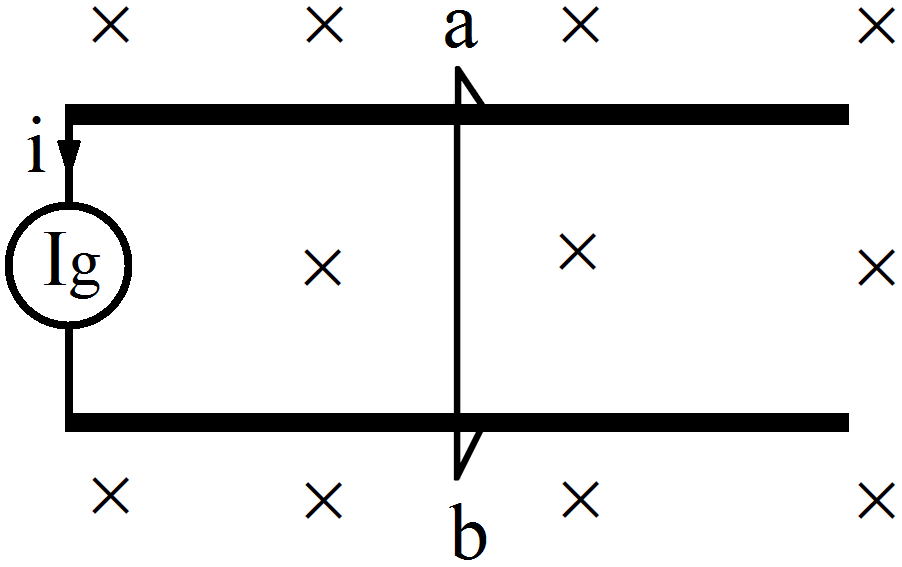
The current generator $I_g$ shown in figure, sends a constant current i through the circuit. The wire ab has a length l and mass m and can slide on the smooth, horizontal rails connected to $I_g.$  The entire system lies in a vertical magnetic field B. Find the velocity of the wire as a function of time.
Complete the following decay schemes.
  1. $\text{ }^{226}_{88}\text{Ra}\rightarrow\alpha+$
  2. $\text{ }^{19}_8\text{O}\rightarrow\text{ }^{19}_9\text{F}+$
  3. $\text{ }^{25}_{13}\text{Al}\rightarrow\text{ }^{25}_{12}\text{Mg}+$