Question
Find the area between the parabolas $y^2 = 5x$ and $x^2 = 5y$
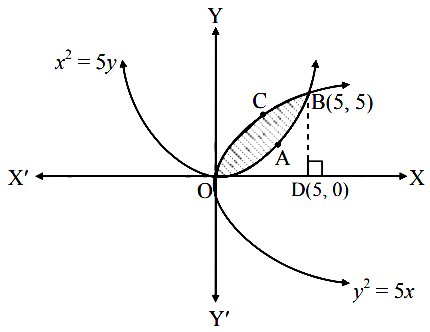
Answer


Given equations of the parabolas are $y^2 = 5x ......(i)$
and $x^2 = 5y.$
$\therefore y =\frac{x^2}{5}$
From (i), we get
$y =\sqrt{5 x}$ (iii) $[\because \ln$ first quadrant, $y>0]$
Find the points of intersection of $y^2=5 x$ and $x^2=5 y$.
Substituting (ii) in (i), we get
$ \left(\frac{x^2}{5}\right)^2=5 x$
$\therefore x^4=125 x$
$\therefore x^4-125 x=0$
$\therefore x\left(x^3-125\right)=0$
$\therefore x=0 \text { or } x^3=125=5^3$
$\therefore x=0 \text { or } x=5 $
When $x=0, y=0$ and when $x=5, y=5$
$\therefore$ The points of intersection of $y^2=5 x$ and $x^2=5 y$ are $O(0,0)$ and $B(5,5)$.
Draw $BD \perp OX$
Required area $=$ area of the region $OABCO$
$=$ area of the region $O D B C O-$ area of the region $ODBAO$
$=$ area under the parabola $y^2=5 x-$ area under the parabola $x^2=5 y$
$=\int_0^5 \sqrt{5 x} d x-\int_0^5 \frac{x^2}{5} d x \ldots . .[$ From (iii) and (ii)]
$=\sqrt{5} \int_0^5 x^{\frac{1}{2}} d x-\frac{1}{5} \int_0^5 x^2 d x$
$=\sqrt{5}\left[\frac{x^{\frac{3}{2}}}{\frac{3}{2}}\right]_0^5-\frac{1}{5}\left[\frac{x^3}{3}\right]_0^5$
$=\frac{2 \sqrt{5}}{3}\left[(5)^{\frac{3}{2}}-0\right]-\frac{1}{15}\left[(5)^3-0\right]$
$=\frac{2 \sqrt{5}}{3}(5 \sqrt{5})-\frac{1}{15}(125)$
$=\frac{50}{3}-\frac{25}{3}$
$=\frac{25}{3} \text { sq.units }$

Need a full question paper?

Generate a complete, print-ready paper with questions like this in minutes — across 16+ boards, with answer keys.

Start Generating Free

Similar questions

Calculate Value Index Number for the following using Simple Aggregate Method
Commodity Base Year Current Year
Price Quantity Price Quantity
A 30 13 40 15
B 40 15 70 20
C 10 12 60 22
D 50 10 90 18
E 20 14 100 16
If $A=\left[\begin{array}{ccc}-1 & 2 & 1 \\ -3 & 2 & -3\end{array}\right]$ and $B=\left[\begin{array}{cc}2 & 1 \\ -3 & 2 \\ -1 & 3\end{array}\right]$, prove that $\left(A+B^{\top}\right)^{\top}=$
$
A^{\top}+B
$
Two samples from bivariate populations have $15$ observations each. The sample means of $X$ and $Y$ are $25$ and $18$ respectively. The corresponding sum of squares of deviations from means are $136$ and $148$ respectively. The sum of product of deviations from respective means is $122.$ Obtain the regression equation of $x$ on $y$
x y $x-\bar{x}$ $y-\bar{y}$ $(x-\bar{x})(y-\bar{y})$ $(x-\bar{x})^2$ $(y-\bar{y})^2$
1 5 -2 -4 8 4 16
2 7 -1 -2 $\square$ 1 4
3 9 0 0 0 0 0
4 11 1 2 2 4 4
5 13 2 4 8 1 16
Total = 15 Total = 45 Total = 0 Total = 0 Total =$\square$ Total = 10 Total = 40
Mean of $x =\bar{x}=$$\square$
Mean of $y =\bar{y}=$$\square$
$ b_{x y}=\frac{\square}{\square}$
$b_{y x}=\frac{\square}{\square} $
Regression equation of $x$ on $y$ is $(x-\bar{x})= b _{x y}(y-\bar{y})$
$\therefore$ Regression equation $x$ on $y$ is$\square$
Regression equation of $y$ on $x$ is $(y-\bar{y})= b _{y x}(x-\bar{x})$
$\therefore$ Regression equation of $y$ on $x$ is$\square$
For manufacturing $x$ units, labour cost is $150-54 x$ and processing cost is $x^2$. Price of each unit is $p=10800-4 x^2$. Find the values of $x$ for which
(i) total cost is decreasing
(ii) revenue is increasing.
Following table shows the all India infant mortality rates (per ‘000) for years 1980 to 2010
Year 1980 1985 1990 1995
IMR 10 7 5 4
Year 2000 2005 2010  
IMR 3 1 0  
Fit a trend line by the method of least squares
Solution: Let us fit equation of trend line for above data.
Let the equation of trend line be $y=a+b x$$\ldots(i)$
Here $n =7$ (odd), middle year is $\square$ and $h =5$
Year IMR (y) x $x^2$ x.y
1980 10 – 3 9 – 30
1985 7 – 2 4 – 14
1990 5 – 1 1 – 5
1995 4 0 0 0
2000 3 1 1 3
2005 1 2 4 2
2010 0 3 9 0
Total 30 0 28 – 44
The normal equations are
$\Sigma y=n a+b \Sigma x$
As, $\Sigma x=0, a=\square$
Also, $\Sigma x y=a \Sigma x+b \Sigma x^2$
As, $\Sigma x=0, b=\square$
$\therefore$ The equation of trend line is $y=\square$
Solve the following differential equation
$\sec ^2 x \tan y d x+\sec ^2 y \tan x d y=0$
Solution: $\sec ^2 x \tan y d x+\sec ^2 y \tan x d y=0$
$\therefore \frac{\sec ^2 x}{\tan x} d x+\square=0$
Integrating, we get
$\square+\int \frac{\sec ^2 y}{\tan y} d y=\log c$
Each of these integral is of the type
$\int \frac{ f ^{\prime}(x)}{ f (x)} d x=\log | f ( x )|+\log C$
$\therefore$ the general solution is
$\square+\log |\tan y|=\log c$
$\therefore \log |\tan x \cdot \tan y|=\log c$
$\square$
This is the general solution.
A dealer deals in two products X and Y. He has ₹ 1,00,000/- to invest and space to store 80 pieces. Product X costs ₹ 2500/- and product Y costs ₹ 1000/- per unit. He can sell the items X and Y at respective profits of ₹ 300 and ₹ 90. Construct the LPP and find the number of units of each product to be purchased to maximize its profit
Solve the differential equation $\frac{ d y}{ d x}+\frac{x-2 y}{2 x-y}=0$
Given the following table, find Walsh’s Price Index Number by completing the activity.
Commodity $p_0$ $q_0$ $p_1$ $q_1$ $q_0q_1$ $\sqrt{ q _0 q _1}$ $p _0 \sqrt{q_0 q_1}$ $p _1 \sqrt{ q _0 q _1}$
I 20 9 30 4 36 $\square$ $\square$ 180
II 10 5 50 5 $\square$ 5 50 $\square$
III 40 8 10 2 16 $\square$ 160 $\square$
IV 30 4 20 1 $\square$ 2 $\square$ 40
Total     390 $\square$

Walsh's price Index Number is
$ P _{01}( W )=\frac{\square}{\sum p _0 \sqrt{ q _0 q _1}} \times 100$
$=\frac{510}{\square} \times 100$
$=\square $