Question
Find the centre of mass of a uniform:
  1. Half-disc.
  2. Quarter-disc.

Answer

Let mass of half disc is M. Area of half disc $=\frac{\pi\text{R}^2}{2}$ Mass per unit area $\text{m}=\frac{2\text{M}}{\pi\text{R}^2}$
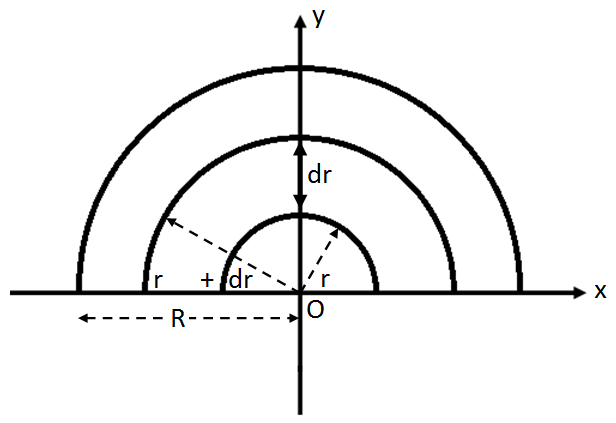
  1. The half disc can be divided into a larger number of semi circular strips.
Whose radii veries from 0 → R.
Surface area of a semicircular strip $=\frac{\pi}{2}\big[(\text{r}+\text{dr})^2-\text{r}^2\big]$
$=\frac{\pi}{2}\big[\text{r}^2+\text{dr}^2+2\text{rdr}-\text{r}^2\big]$
$=\pi\text{r dr} $
$\therefore$ Mass of strip $\text{dm}=\frac{2\text{M}}{\pi\text{R}^2}\cdot\pi\text{r dr}$
$\text{dm}=\frac{2\text{M}}{\text{R}^2}\cdot\text{r dr}$
Let (x, y) are the co-ordinates of c.m. of this strip $(\text{x},\text{y})=\Big(0,\frac{2\text{r}}{\pi}\Big)$
$\text{x}=\text{x}_\text{cm}=\frac{1}{\text{M}}\int\limits^{\text{R}}_0\text{x dm}=\int\limits^{\text{R}}_00\text{ dm}=0$
$\text{y}_\text{cm}=\frac{1}{\text{M}}\int\limits^{\text{R}}_0\text{y dm}=\frac{1}{\text{M}}\int\limits^{\text{R}}_0\frac{2\text{r}}{\pi}\times\frac{\text{2}\text{M}}{\text{R}^2}\text{r dr}$
$=\frac{1}{\text{m}}\cdot\frac{4\text{M}}{\pi\text{R}^2}\int\limits^{\text{R}}_0\text{r}^2\text{ dr}=\frac{4\text{M}}{\pi\text{R}^2}\Big[\frac{\text{r}^3}{3}\Big]_0^{\text{R}}=\frac{4}{3\pi\text{R}^2}\cdot\text{R}^3$
$\text{y}_\text{cm}=\frac{4\text{R}}{3\pi}$
So, centre of mass of circular half disc $=\Big(0,\frac{4\text{R}}{3\pi}\Big)$
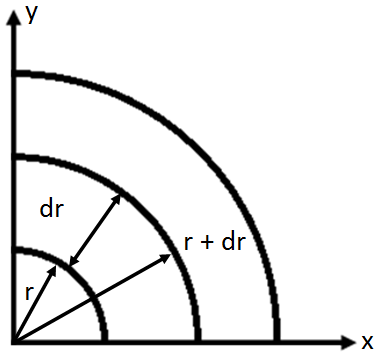
  1. Mass per unit area of quarter disc centre of mass of a uniform quarter disc,
$=\frac{\text{M}}{\frac{\pi\text{R}^2}{4}}=\frac{4\text{M}}{\pi\text{R}^2}$

Using symmetry,
For a half disc along y-axis c.m. will be at $\text{y}=\frac{4\text{R}}{3\pi}$
So, the c.m. of quarter disc $=\Big(\frac{4\text{R}}{3\pi},\frac{4\text{R}}{3\pi}\Big)$

Need a full question paper?

Generate a complete, print-ready paper with questions like this in minutes — across 16+ boards, with answer keys.
Start Generating Free

Similar questions

Obtain an expression for the linear acceleration of a cylinder rolling down an inclined plane and hence find the condition for the cylinder to roll down without slipping.
What do you understand by friction? Discuss about static friction, limiting friction, kinetic friction and rolling friction.
If a drop of liquid breaks into smaller droplets, it results in lowering of temperature of the droplets. Let a drop of radius R, break into N small droplets each of radius r. Estimate the drop in temperature.
A 6.5m long ladder rests against a vertical wall reaching a height of 6.0m. A 60kg man stands half way up the ladder.
  1. Find the torque of the force exerted by the man on the ladder about the upper end of the ladder.
  2. Assuming the weight of the ladder to be negligible as compared to the man and assuming the wall to be smooth, find the force exerted by the ground on the ladder.
Estimate the fraction of molecular volume to the actual volume occupied by oxygen gas at STP. Take the diameter of an oxygen molecule to be $3\mathring{\text{A}}$
A person of mass $60kg$ wants to lose $5kg$ by going up and down a $10m$ high stairs. Assume he burns twice as much fat while going up than coming down. If $1kg$ of fat is burnt on expending $7000$ kilo calories, how many times must he go up and down to reduce his weight by $5kg$?
A resistor of resistance $100\Omega$ is connected to an AC source $\in=(12\text{V})\sin(250\pi\text{s}^{-1})\text{t}.$ Find the energy dissipated as heat during $\text{t}=0$ to $\text{t}=1.0\text{ms}.$
An LR circuit having a time constant of 50ms is connected with an ideal battery of emf $\in.$ Find the time elapsed before:
  1. The current reaches half its maximum value.
  2. The power dissipated in heat reaches half its maximum value.
  3. The magnetic field energy stored in the circuit reaches half its maximum value.
India has had a long and unbroken tradition of great scholarship-in mathematics, astronomy, linguistics, logic and ethics. Yet, in parallel with this, several superstitious and obscurantistic attitudes and practices flourished in our society and unfortunately continue even today-among many educated people too. How will you use your knowledge of science to develop strategies to counter these attitudes?
On the basis of molecular kinetic theory derive an expression for the pressure exerted on the walls of a vessel by a gas filled in it.