A 6.5m long ladder rests against a vertical wall reaching a height of 6.0m. A 60kg man stands half way up the ladder.
- Find the torque of the force exerted by the man on the ladder about the upper end of the ladder.
- Assuming the weight of the ladder to be negligible as compared to the man and assuming the wall to be smooth, find the force exerted by the ground on the ladder.
Download our app for free and get started
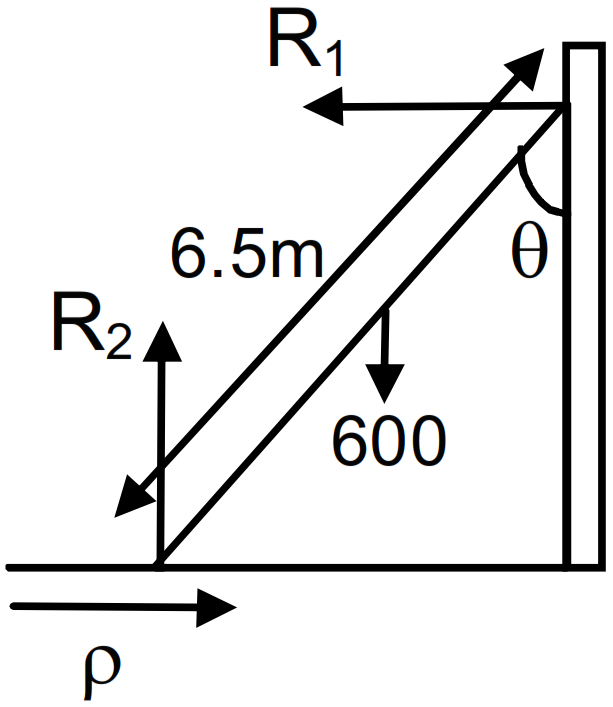 m = 60kg, ladder length = 6.5m, height of the wall = 6m
Therefore torque due to the weight of the body
- $\tau=\frac{600\times6.5}{2\sin\theta}=\text{i}$
$\Rightarrow\tau=735\text{N-m}$
- $\text{R}_2=\text{mg}=60\times9.8$
$\Rightarrow6.5\text{R}_1\cos\theta=60\text{g}\sin\theta\times\frac{6.5}{2}$
$\Rightarrow\text{R}_1=60\text{g}\tan\theta=60\text{g}\times\Big(\frac{2.5}{12}\Big)\ \Big[$Because $\tan\theta=\frac{2.5}{6}\Big]$
$\Rightarrow\text{R}_1=\Big(\frac{25}{2}\Big)\text{g}=122.5\text{N}$

Download our appand get started for free
Experience the future of education. Simply download our apps or reach out to us for more information. Let's shape the future of learning together!No signup needed.*
Similar Questions
- 1An isolated particle of mass m is moving in a horizontal plane (x - y), along the x-axis at a certain height about the ground. It explodes suddenly into two fragments of masses $\frac{\text{m}}{4}$ and $3\frac{\text{m}}{4}.$ An instant later, the smaller fragment is at y = + 15 cm. What is the position of larger fragment at this instant?View Solution
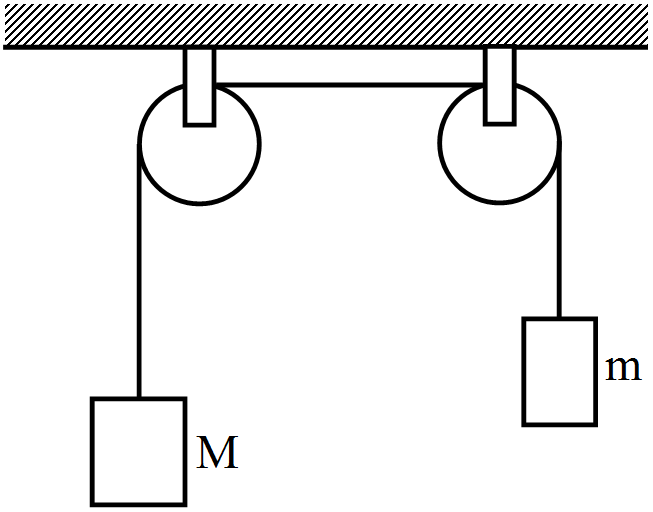
- 2View SolutionThe pulleys in figure are identical, each having a radius R and moment of inertia I. Find the acceleration of the block M.
- 3The oxygen molecule has a mass of $5.30 \times 10^{-26}kg$ and a moment of inertia of $1.94 \times 10^{-46}kgm^2$ about an axis through its centre perpendicular to the lines joining the two atoms. Suppose the mean speed of such a molecule in a gas is $500m/s$ and that its kinetic energy of rotation is two thirds of its kinetic energy of translation. Find the average angular velocity of the molecule.View Solution
- 4A meter stick held vertically, with one end on the ground, is then allowed to fall. What is the value of the radial and tangential acceleration of the top end of the stick when the stick has turned through on angle $\theta?$ What is the speed with which the top end of the stick hits the ground? Assume that the end of the stick in. contact with the ground does not slip.View Solution
- 5A car weighs $1800kg$. The distance between its front and back axles is $1.8m$. Its centre of gravity is $1.05m$ behind the front axle. Determine the force exerted by the level ground on each front wheel and each back wheel.View Solution
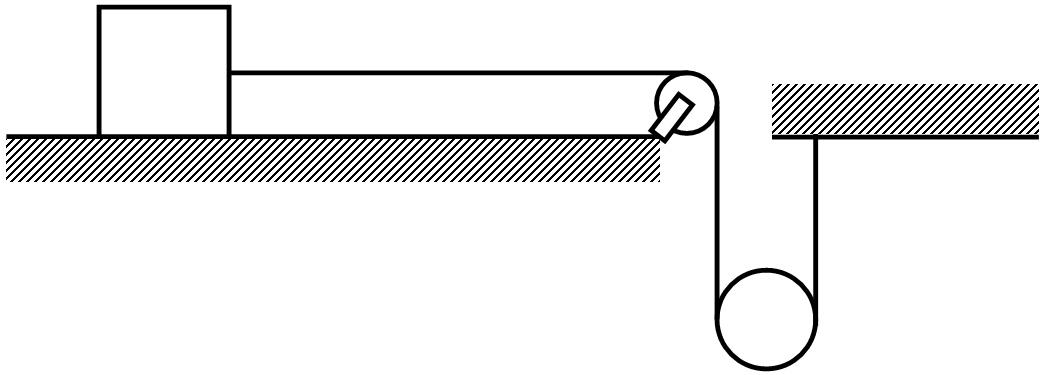
- 6The descending pulley shown in figure has a radius $20cm$ and moment of inertia $0.20kg-m^2$. The fixed pulley is light and the horizontal plane frictionless. Find the acceleration of the block if its mass is $1.0kg$.View Solution
- 7Point masses $m_1$ and $m_2$ are placed at the opposite ends of a rigid rod of length L, and negligible mass. The rod is to be set in rotation about an axis perpendicular to it. Find the position on this rod through which the axis should pass in order that the work required to set the rod in rotation with angular velocity $\omega_0$ should be minimum.View Solution
- 8A car weighs $1800kg$. The distance between its front and back axles is $1.8m$. Its centre of gravity is $1.05m$ behind the front axle. Determine the force exerted by the level ground on each front wheel and each back wheel.View Solution
- 9View SolutionWhat do you mean by the term "equilibrium"? What are equilibrium of rest and equilibrium of motion? State the conditions for complete equilibrium of a body.
- 10View SolutionA metre stick is balanced on a knife edge at its centre. When two coins, each of mass 5g are put one on top of the other at the 12.0cm mark, the stick is found to be balanced at 45.0cm. What is the mass of the metre stick?