Question
Find the centroid of $\triangle\text{ABC}$ whose vertices are A(2, 2), B(-4, -4) and C(5, -8).

Answer

The given points are $A(2,2), B(-4,-4)$ and $C(5,-8)$. Here, $\left( x _1=2, y _1=2\right),\left( x _2=-4, y _2=-4\right)$ and $\left( x _3=5, y _3=-8\right)$
Let G(x, y) be the centroid of $\triangle\text{ABC}.$ Then,
$\text{x}=\frac{1}{3}(\text{x}_1+\text{x}_2+\text{x}_3)$
$=\frac{1}{3}(2-4+5)$
$=1$
$\text{y}=\frac{1}{3}(\text{y}_1+\text{y}_2+\text{y}_3)$
$=\frac{1}{3}(2-4-8)$
$=\frac{-10}{3}$
Hence, the centroid of $\triangle\text{ABC}$ is $\text{G}\Big(1,\frac{-10}{3}\Big).$

Need a full question paper?

Generate a complete, print-ready paper with questions like this in minutes — across 16+ boards, with answer keys.
Start Generating Free

Similar questions

In the following, determine whether the given values are solution of the given equation or not:
$\text{a}^2\text{x}^2-3\text{abx}+2\text{b}^2=0,$ $\text{x}=\frac{\text{a}}{\text{b}},\text{x}=\frac{\text{b}}{\text{a}}$
If two pipes function simultaneously, a reservoir will be filled in 12 hours. One pipe fills the reservoir 10 hours faster than the other. How many hours will the second pipe take to fill the reservoir?
Solve the following system of linear equations graphically:
3x + y - 11 = 0,
x - y - 1 = 0.
Shade the region bounded by these lines and y-axis. Also, find the area of the region bounded by these lines and y-axis.
Show that the cube of a positive integer is of the form $6q + r$, where q is an integer and $r = 0, 1, 2, 3, 4, 5.$
The diagonals of quadrilateral ABCD intersect at O. Prove that $\frac{\text{ar}(\triangle\text{ACB})}{\text{ar}(\triangle\text{ACD})}=\frac{\text{BO}}{\text{DO}}.$
Find the zeros of the following quadratic polynomial and verify the relationship between the zeros and their coefficients:
$\text{f}(v)=v^2+4\sqrt{3}v-15$
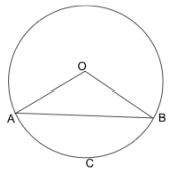
The perimeter of sector OACB of the circle centred at O and of radius 24, is 73.12 cm.
Image
(i) Find the central angle $\angle A O B$.
(ii) Find the area of the minor segment ACB. (Use $\pi=3.14$ and $\sqrt{3}=1.73$ )
The $17^{\text {th }}$ term of an A.P. is 5 more than twice its $8^{\text {th }}$ term. If the $11^{\text {th }}$ term of the A.P. is 43 . find the $n^{\text {th }}$ term.
If $(\sec\theta+\tan\theta)=\text{m}$ and $(\sec\theta-\tan\theta)=\text{n},$ show that mn = 1.
Determine k so that (3k - 2), (4k - 6) and (k + 2) are three consecutive terms of an AP.