Question
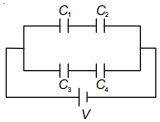
Find the charge on capacitor $C_3$

Given, that $C_1=C_2=C$ and $C_3=C_4=3 C$.
Answer

(a)

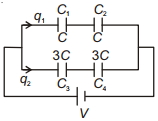
$C_{\text {net }}=2 C$

$q=2 C V$

$\frac{q_1}{q_2}=\frac{1}{3}$

$3 q_1=q_2$

$q_1+q_2=2 CV$

$q_1=\frac{C V }{2}$

$q_2=\frac{3 CV }{2}$
Need a full question paper?

Generate a complete, print-ready paper with questions like this in minutes — across 16+ boards, with answer keys.

Start Generating Free

Similar questions

Which of the following has the mass closest in value to that of the positron

 $(1\;a.m.u = 931\;MeV)$

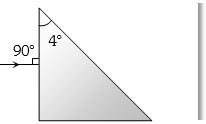
A prism having an apex angle $4^o$ and refraction index $1.5$ is located in front of a vertical plane mirror as shown in figure. Through what total angle is the ray deviated after reflection from the mirror.....$^o$
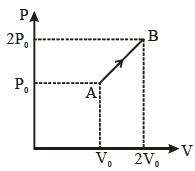
The $P-V$ diagram of $2\,g$ of helium gas for a certain process $A$ $\to$ $B$ is shown in the figure. What is the heat given to the gas during the process $A$ $\to$ $B$?
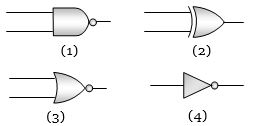
Given below are symbols for some logic gates The $XOR$ gate and $NOR$ gate respectively are
In $N-$type semiconductors, majority charge carriers are
An ideal gas initially at pressure $1$ bar is being compressed from $30 \,m ^{3}$ to $10\, m ^{3}$ volume and its temperature decreases from $320\, K$ to $280\, K$. then find final pressure of gas (in bar)
Benzoin is
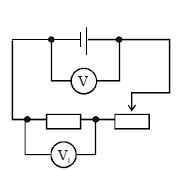
If the rheostat slider were to move from the extreme right to the far left, How will the reading of voltmeter $V_1$ change?
A binary star consists of two stars $\mathrm{A}$ (mass $2.2 \mathrm{M}_5$ ) and $\mathrm{B}$ (mass $11 \mathrm{M}_5$ ), where $\mathrm{M}_5$ is the mass of the sun. They are separated by distance $\mathrm{d}$ and are rotating about their centre of mass, which is stationary. The ratio of the total angular momentum of the binary star $\mathrm{A}$ to the angular momentum of star $\mathrm{B}$ about the centre of mass is
Inside a closed furnace held at a temperature of $400\,\, K,$ we have a black body. A hole of area $10\,\, cm^2$ is opened in the furnace so that sunlight starts falling on black body. The intensity of sunlight is $2000\, W/m^2.$ In the steady state