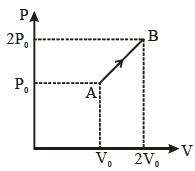
The $P-V$ diagram of $2\,g$ of helium gas for a certain process $A$ $\to$ $B$ is shown in the figure. What is the heat given to the gas during the process $A$ $\to$ $B$?
Diffcult
Download our app for free and get started
$\Delta \mathrm{U}=\mathrm{nC}_{\mathrm{v}} \mathrm{dT}$
$\Delta \mathrm{Q}=\Delta \mathrm{W}+\Delta \mathrm{V}$
$\Delta \mathrm{W}=\frac{1}{2} \times\left(2 \mathrm{P}_{0}+\mathrm{P}_{0}\right) \times \mathrm{V}_{0}=\frac{3}{2} \mathrm{P}_{0} \mathrm{V}_{0}$
$\frac{\mathrm{PV}}{\mathrm{T}}=\mathrm{const}=\mathrm{nR}$
$\frac{P_{0} V_{0}}{T_{0}}=\frac{2 P_{0} 2 V_{0}}{T^{\prime}}$
$\mathrm{T}^{\prime}=4 \mathrm{T}_{\mathrm{o}}$
change in temperature $=3 \mathrm{T}_{0}$
$\Delta \mathrm{U}=\mathrm{n} \times \frac{3}{2} \mathrm{R} \times 3 \mathrm{T}_{0}=\frac{9}{2}\left(\mathrm{nRT}_{0}\right)=\frac{9}{2} \mathrm{P}_{0} \mathrm{V}_{0}$
$\Delta \mathrm{Q}=6 \mathrm{P}_{0} \mathrm{V}_{0}$

Download our appand get started for free
Experience the future of education. Simply download our apps or reach out to us for more information. Let's shape the future of learning together!No signup needed.*
Similar Questions
- 1A thermodynamic process in which temperature $T$ of the system remains constant though other variable $P$ and $V$ may change, is calledView Solution
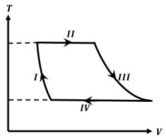
- 2One mole of a monatomic ideal gas undergoes a cyclic process as shown in the figure (where $V$ is the volume and $T$ is the temperature). Which of the statements below is (are) true?View Solution
(image)
$(A)$ Process $I$ is an isochoric process $(B)$ In process $II$, gas absorbs heat
$(C)$ In process $IV$, gas releases heat $(D)$ Processes $I$ and $III$ are $not$ isobaric
- 3$Assertion :$ When a glass of hot milk is placed in a room and allowed to cool, its entropy decreases.View Solution
$Reason :$ Allowing hot object to cool does not violate the second law of thermodynamics. - 4A Carnot engine has an efficiency of $50 \%$ when its source is at a temperature $327^{\circ}\,C$. The temperature of the sink is $.........^{\circ} C$View Solution
- 5One gm mol of a diatomic gas $(\gamma = 1.4)$ is compressed adiabatically so that its temperature rises from ${27^o}C$ to ${127^o}C$. The work done will beView Solution
- 6View SolutionA measure of the degree of disorder of a system is known as
- 7View SolutionThe temperature of an ideal gas is kept constant as it expands. The gas does external work. During this process, the internal energy of the gas
- 8For an adiabatic expansion of an ideal gas, the fractional change in its pressure is equal to (where $\gamma$ is the ratio of specific heats):View Solution
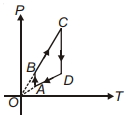
- 9A $P-T$ graph is shown for a cyclic process. Select correct statement regarding thisView Solution
- 10Following figure shows $P-T$ graph for four processes $A, B, C$ and $D$. Select the correct alternative.View Solution