Question
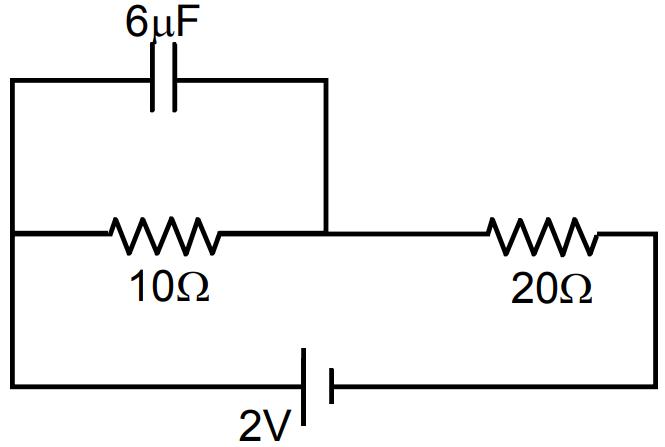
Find the charge on the capacitor shown in figure.

Answer

In steady stage condition no current flows through the capacitor. $\text{R}_\text{eff}=10+20=30\Omega$
$\text{i}=\frac{2}{30}=\frac{1}{15}\text{A}$
Voltage drop across $10\Omega$ resistor = i × R$=\frac{1}{15}\times10=\frac{10}{15}=\frac{2}{3}\text{V}$
Charge stored on the capacitor (Q) = CV$=6\times10^{-6}\times\frac{2}{3}=4\times10^{-6}\text{C}=4\mu\text{C}.$

Need a full question paper?

Generate a complete, print-ready paper with questions like this in minutes — across 16+ boards, with answer keys.
Start Generating Free

Similar questions

Draw a graph showing the variation of binding energy per nucleon with mass number of different nuclei. Write any two salient features of the curve. How does this curve explain the release of energy both in the processes of nuclear fission and fusion?
What should be the orientation of a magnetic dipole in a uniform magnetic field so that its potential energy is maximum?
Using Kirchhoff’s rules, calculate the current through the $40\Omega$ and $20\Omega$ resistors in the following circuit:
How will establish displacement current of 6 A between the plates of a capacitor of capacitance $6 \mu F$ ?
Define electric current and current density. By giving an example prove that electric current is a scalar quantity but not a vector quantity. Explain electric current in any conductor.
What is Wheatstone bridge? Explain its principle.
  1. Find the value of the phase difference between the current and the voltage in the series LCR circuit shown below. Which one leads in phase: current or voltage?
  2. Without making any other change, find the value of the additional capacitor $C_1,$ to be connected in parallel with the capacitor C, in order to make the power factor of the circuit unity.
Obtain essential expression for balanced position of Wheatstone Bridge.###Explain the principle of Wheatstone Bridge. How can we find the resistance of any resistor using this principle?
The wavelength of light from the spectral emission line of sodium is 589 nm. Find the kinetic energy at which,
  1. An electron, and
  2. A neutron, would have the same de Broglie wavelength.
From molecular view point, discuss the temperature dependence of susceptibility for diamagnetism, paramagnetism and ferromagnetism.