Question
Find the condition under which the charged particles moving with different speeds in the presence of electric and magnetic field vectors can be used to select charged particles of a particular speed.
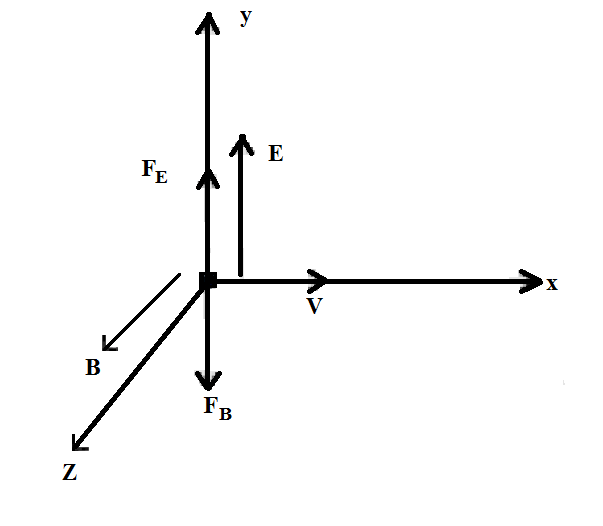
Answer

The velocity $\vec{v}$, of the charged particles, and the $\overrightarrow{E}$ and $\overrightarrow{B}$ vectors, should be mutually perpendicular. Also the forces on q, due to $\overrightarrow{E}$ and $\overrightarrow{B}$ must be oppositely directed.

$qE=qvB$
$or\text{ }v=\frac{E}{B}$
Alternate Answer
Force due to electric field $= q\overrightarrow{E}$
Force due to magnetic field $=q\text{ }(\overrightarrow{v}\times\overrightarrow{B} )$
The required condition is
$q\overrightarrow{E}=-q\text{ }(\overrightarrow{v}\times\overrightarrow{B})$
$[or\text{ }\overrightarrow{E}=-(\overrightarrow{v}\times\overrightarrow{B})=(\overrightarrow{B}\times\overrightarrow{v})]$

Need a full question paper?

Generate a complete, print-ready paper with questions like this in minutes — across 16+ boards, with answer keys.

Start Generating Free

Similar questions

In a potentiometer arrangement, a cell of emf 1.25 V gives a balance point at 35.0 cm length of the wire. If the cell is replaced by another cell and the balance point shifts to 63.0 cm, what is the emf of the second cell?
Draw a labelled ray diagram of a reflecting telescope. Mention its two advantages over the refracting telescope.
A current of 10A is established in a long wire along the positive z-axis. Find the magnetic field $\overrightarrow{\text{B}}$ at the point (1m, 0, 0).
Can the dispersive power $\omega=\frac{\mu_\text{v}-\mu\text{r}}{\mu-1}$ be negative? What is the sign of co if a hollow prism is immersed into water?
In a double-slit experiment the angular width of a fringe is found to be 0.2° on a screen placed 1 m away. The wavelength of light used is 600 nm. What will be the angular width of the fringe if the entire experimental apparatus is immersed in water? Take refractive index of water to be 4/3.
Find the average frictional force needed to stop a car weighing 500kg in a distance of 25m if the initial speed is 72km/ h.
You are facing a circular wire carrying an electric current. The current is clockwise as seen by you. Is the field at the centre coming towards you or going away from you?
Two protons are brought nearer; what will be the effect on potential energy of system?
For a given light sensitive material and a source of incident radiation of fixed frequency, how does the photoelectric current decay with the intensity of incident light?
Consider the situation of the previous problem. Take "the table plus the ball" as the system. Friction between the table and the ball is then an internal force. As the ball slows down, the momentum of the system decreases. Which external force is responsible for this change in the momentum?