Question

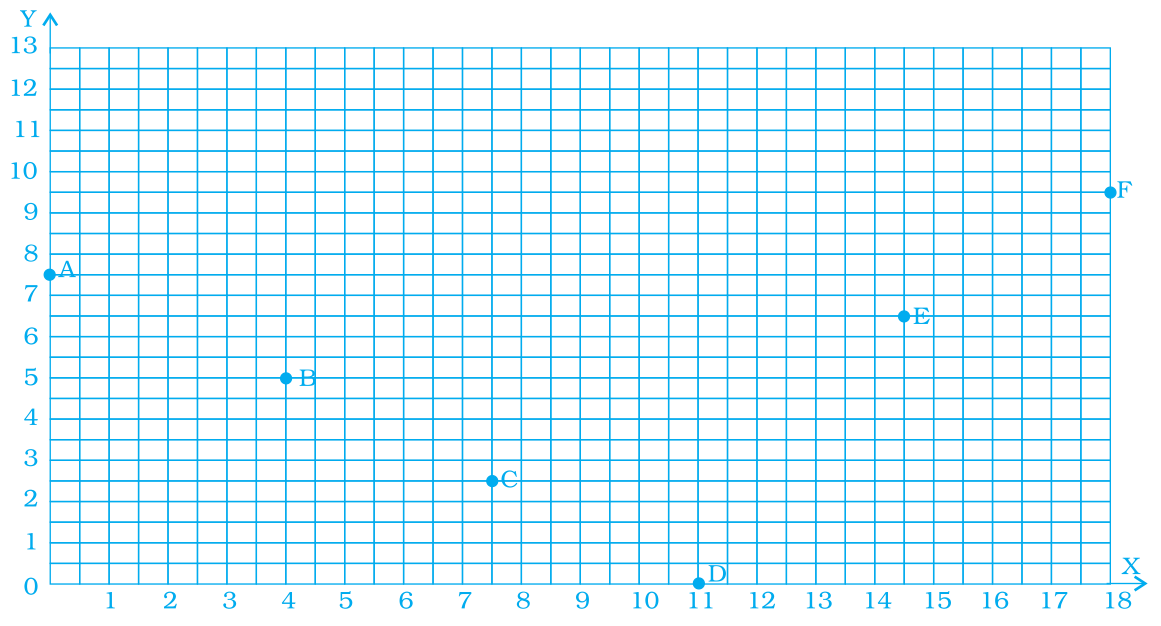
Find the coordinates of all letters in the graph given below.

Answer

The point $A$ is on the $Y$-axis at a distance of $7.5$ units from the origin.
$\therefore\ $The coordinates are $(0, 7.5)$.
The point $B$ is at a distance of $4$ units from $Y$-axis and $5$ units from $X$-axis.
$\therefore\ $ The coordinates of $B$ are $(4, 5)$.
The point $C$ is at a distance of $7.5$ units from $Y$-axis and $2.5$ units from $X$-axis .
$\therefore\ $The coordinates of $C$ denotes $(7.5, 2.5)$.
The point $D$ lies on $X$-axis at a distance of $11$ units from the origin.
$\therefore\ $The coordinates of $D$ are $(11, 0)$.
The point $£$ is at a distance of $14.5$ units from $Y$-axis and $6.5$ units from $X$-axis.
$\therefore\ $The coordinates of $£$ are $(14.5, 6.5).$
The point $F$ is at a distance of $18$ units from $Y$-axis and $9.5$ units from $X$-axis.
$\therefore\ $The coordinates of $£$ are $(18, 9.5)$.

Need a full question paper?

Generate a complete, print-ready paper with questions like this in minutes — across 16+ boards, with answer keys.

Start Generating Free

Similar questions

Arunima bought household items whose marked price and discount $\%$ is as follows:
 
 
Item
Quantity
Rate
Amount
Discount$\%$
$(a)$
Atta
$1$ packet
$200$
$200$
$16\%$
$(b)$
Detergent
$1$ packet
$371$
$371$
$22.10\%$
$(c)$
Namkeen
$1$ packet
$153$
$153$
$18.30%$
 
Find the total amount of the bill she has to pay.
The following table shows the percentages of buyers of four different brands of bathing soaps.
Brand
$A$ $B$ $C$ $D$
Percentage of buyers
$20\%$
$40\%$
$25\%$
$15\%$
Represent the above data by a pie chart.
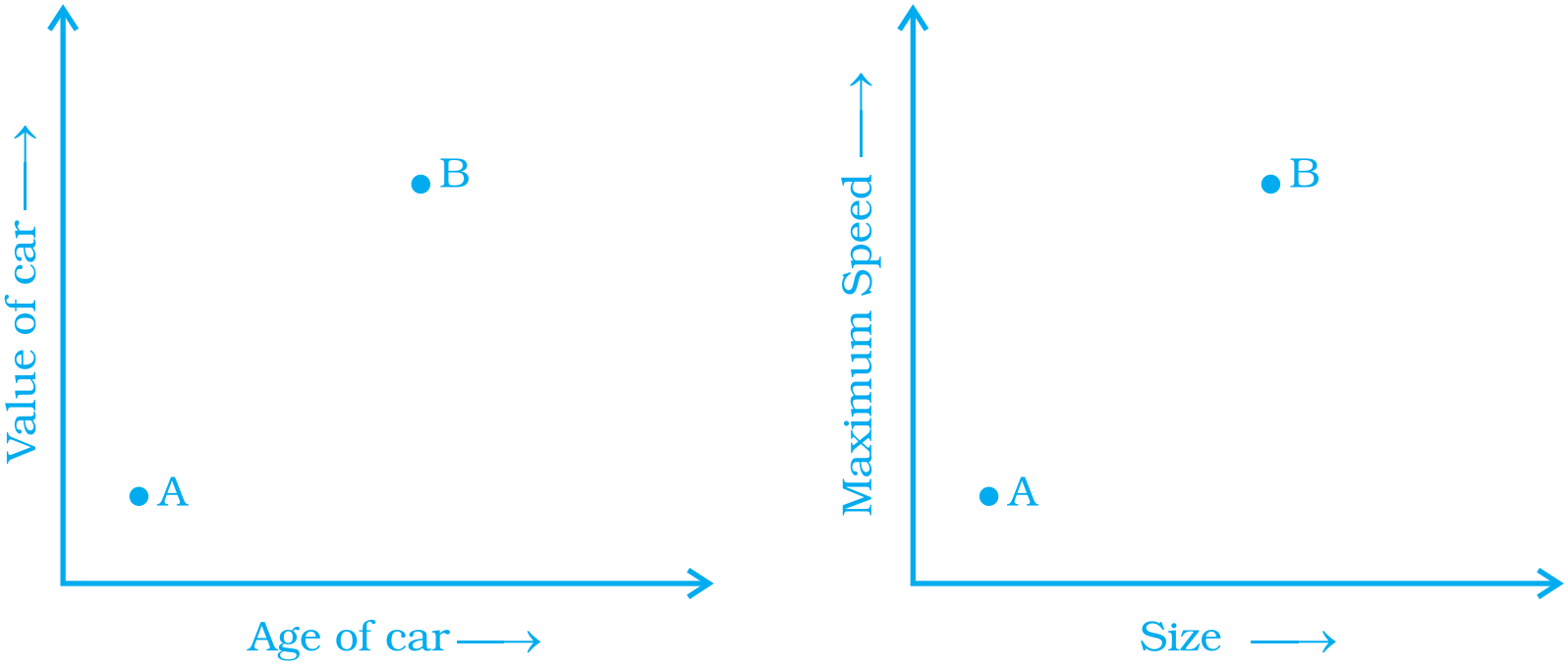
The two graphs below compare Car $A$ and Car $B$. The left graph shows the relationship between age and value. The right graph shows the relationship between size and maximum speed.

Use the graphs to determine whether each statement is true or false, and explain your answer.
$a.$ The older car is less valuable.
$b.$ The faster car is larger.
$c.$ The larger car is older.
$d.$ The faster car is older.
$e.$ The more valuable car is slower.
The final marks in mathematics of $30$ students are as follows:
$53, 61, 48, 60, 78, 68, 55, 100, 67, 90, 75, 88, 77, 37, 84, 58, 60, 48, 62, 56, 44, 58, 52, 64, 98, 59, 70, 39, 50, 60.$
Now answer the following:
$i.$ Arrange these marks in the ascending order, $30$ to $39$ one group, $40$ to $49$ second group etc.
$ii.$ What is the highest score?
$iii.$ What is the lowest score?
$iv.$ What is the range?
$v.$ If $40$ is the pass mark how many have failed?
$vi.$ How many have scored $75$ or more?
$vii.$ Which observations between $50$ and $60$ have not actually appeared?
$viii.$ How many have scored less than $50$?
A shopkeeper allows $23\%$ commision on his advertised price and still makes a profit of $10\%$. If he gain $Rs. 56$ on one item, find his advertised price.
Predicting the ones digit, copy and complete this table and answer the questions that follow.
$x$
$1^x$
$2^x$
$3^x$
$4^x$
$5^x$
$6^x$
$7^x$
$8^x$
$9^x$
$10^x$
$1$
$1$
$2$


$2$
$1$
$4$


$3$
$1$
$8$


$4$
$1$
$16$


$5$
$1$
$32$


$6$
$1$
$64$


$7$
$1$
$128$


$8$
$1$
$256$


Ones Digit of the Powers
$1$
$2, 4, 8, 6$


$a.$ Describe patterns you see in the ones digits of the powers.
$b.$ Predict the ones digit in the following:
$i. 4^{12}$
$ii. 9^{20}$
$iii. 3^{17}$
$iv. 5^{100}$
$v. 10^{500}$
$c.$ Predict the ones digit in the following:
$i. 31^{10}$
$ii. 12^{10}$
$iii.17^{21}$
$iv. 29^{10}$
Complete the table.
First expressionSecond expressionProduct
(i)$a$$b+c+d$
(ii)$x+y-5$$5xy$
(iii)$p$$6 p^2-7 p+5$
(iv)$4 p^2 q^{2}$$p^2-q^2$
(v)$a+b+c$$abc$
$A$ and $B$ can do a piece of work in $6$ days and $4$ days respectively. $A$ started the work; worked at it for $2$0 days and then was joined by $B$. Find the total time taken to complete the work.
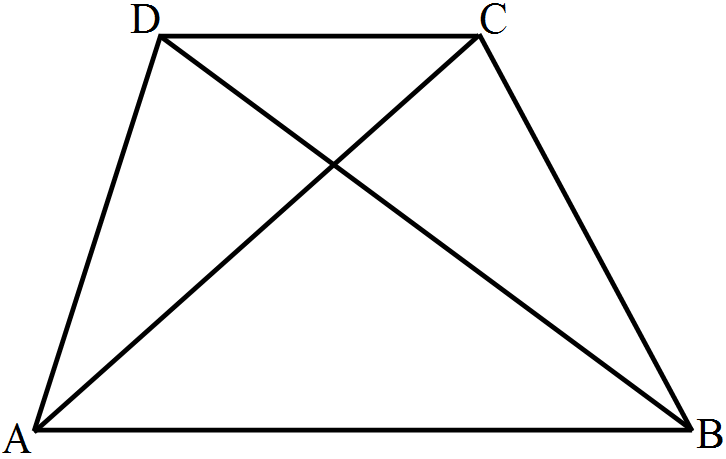
In the adjoining figure, $\text{ABCD}$ is a quadrilateral.

$i.$ How many pairs of adjacent sides are there? Name them.
$ii.$ How many pairs of opposite sides are there? Name them.
$iii.$ How many pairs of adjacent angles are there? Name them.
$iv.$ How many pairs of opposite angles are there? Name them.
$v.$ How many diagonals are there? Name them.
It $x$ and $y$ vary inversely, fill in the following blanks:
$x$
$12$
$16$
$...$
$8$
$...$
$y$
$...$
$6$
$4$
$...$
$0.25$