Question
The two graphs below compare Car $A$ and Car $B$. The left graph shows the relationship between age and value. The right graph shows the relationship between size and maximum speed.
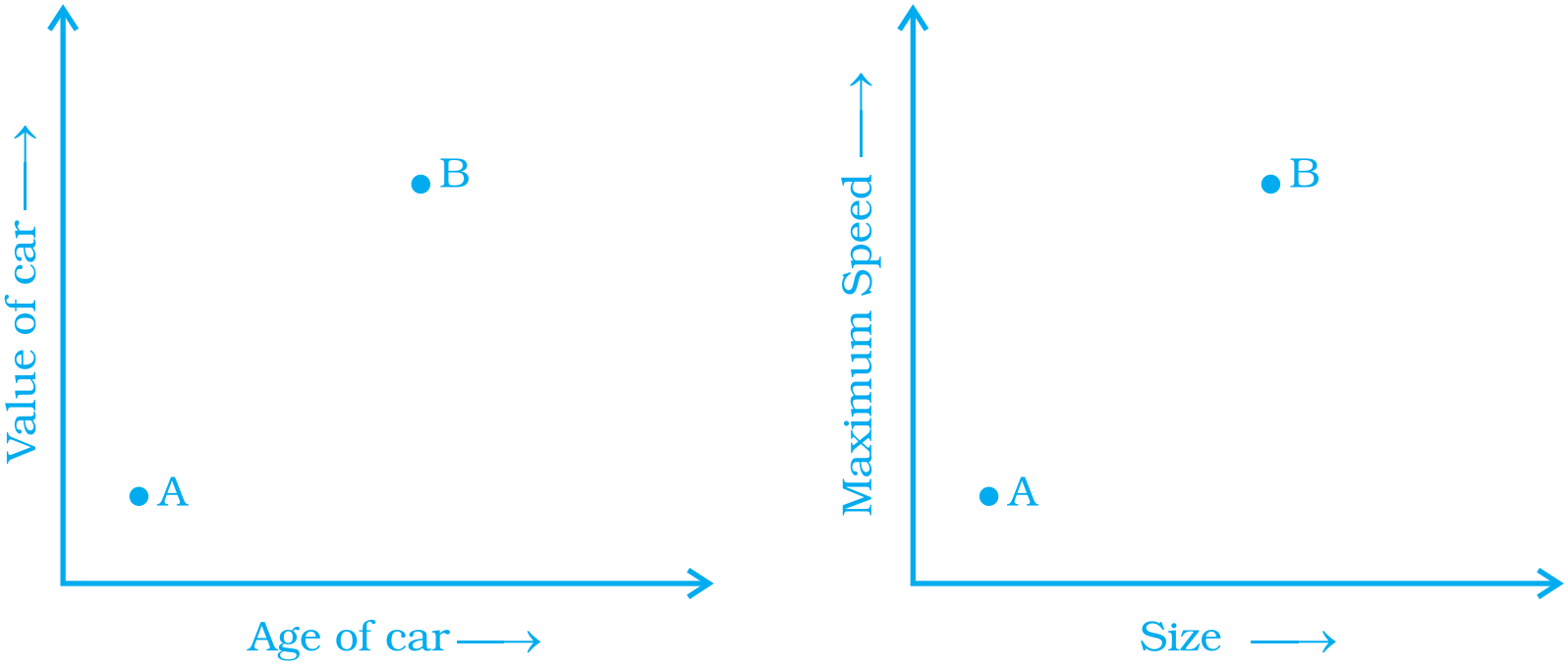
Use the graphs to determine whether each statement is true or false, and explain your answer.
$a.$ The older car is less valuable.
$b.$ The faster car is larger.
$c.$ The larger car is older.
$d.$ The faster car is older.
$e.$ The more valuable car is slower.
Answer

$a.$ False, the older car is $8$ i.e. $8$ valuable more than car $A$.
$b.$ True, in the second graph $8$ is larger car having greater speed.
$c.$ True, larger car is $8$ which is older than $A$
$d.$ True, as $8$ is faster as well as older than $A$.
$e.$ False, as $8$ is more valuable but not slower.

Need a full question paper?

Generate a complete, print-ready paper with questions like this in minutes — across 16+ boards, with answer keys.

Start Generating Free

Similar questions

In a quadrilateral $ABCD, CO$ and $DO$ are the bisectors of $\angle\text{C}$ and $\angle\text{D}$ respectively. Prove that $\angle\text{COD}=\frac{1}{2}(\angle\text{A}+\angle\text{B})$.
Construct a quadrilateral $PQRS$ in which $QR = 7.5\ cm, PR = PS = 6\ cm, RS = 5\ cm$ and $QS = 10\ cm$. Measure the fourth side.
Construct a quadrilateral $ABCD$, in which $AD = 3.5\ cm, AB = 4.4\ cm, BC = 4.7\ cm$, $\angle\text{A}=125^\circ.$ and $\angle\text{B}=120^\circ.$
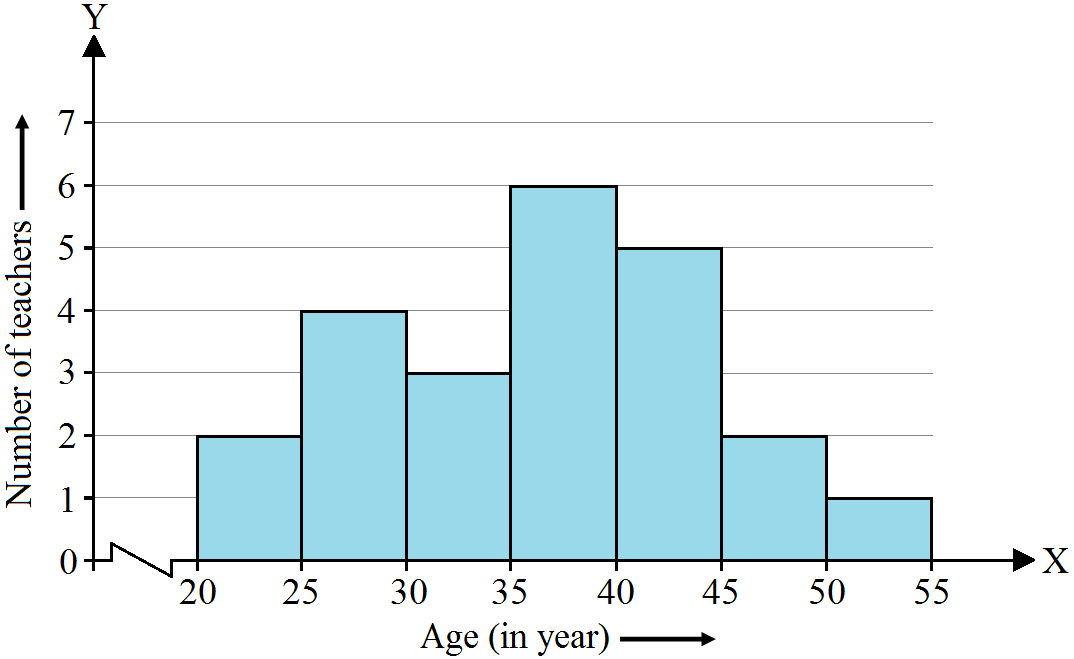
The following histogram shows the frequency distribution $f$ the ages of $22$ teachers in a school:
$i.$ What is the number of eldest and youngest teachers in the school?
$ii.$ Which age group teachers are more in the school and which least?
$iii.$ What is the size of the classes?
$iv.$ What are the class marks of the classes?
Solve the following equation and also check your result in case: $\frac{(3\text{x}+1)}{16}+\frac{(2\text{x}-3)}{7}=\frac{(\text{x}+3)}{8}+\frac{(3\text{x}-1)}{14}$
A $5\ m$ $60\ cm$ high vertical pole casts a shadow $3\ m 20\ cm$ long. Find at the same time the length of the shadow cast by another pole $10\ m$ $50\ cm$ high.
Simplify:
$ (2 x-1)(2 x+1)\left(4 x^2+1\right)\left(16 x^4+1\right) $

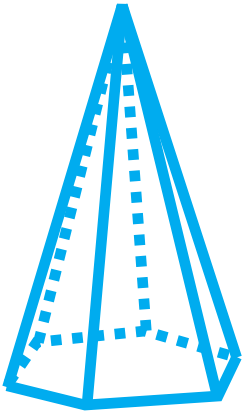
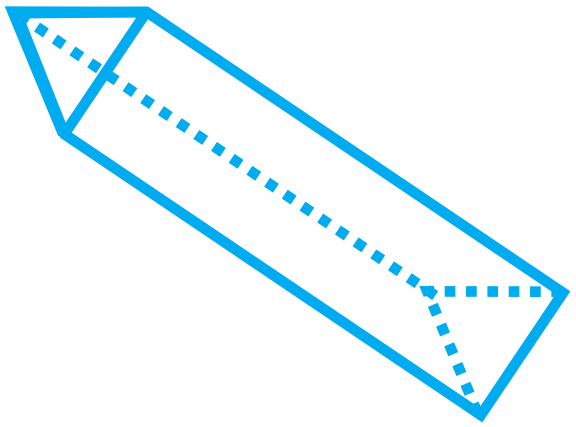
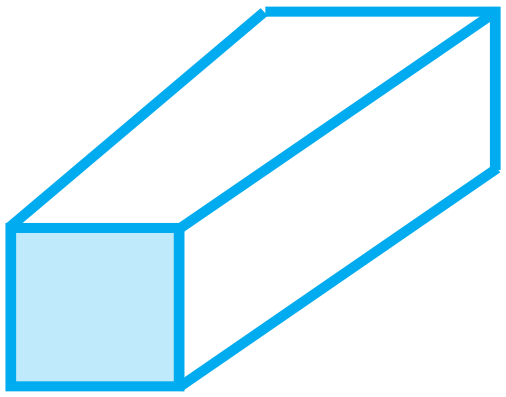
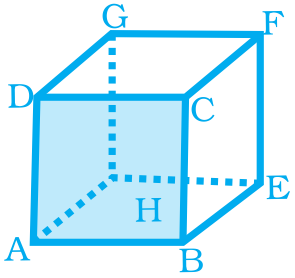
Complete the table given below:

S. NoSolidShape of SolidNo.
of
faces
F
No.
of
Vertices
V
No.
of
edges
E
F + V E + 2
a.Cuboid
     
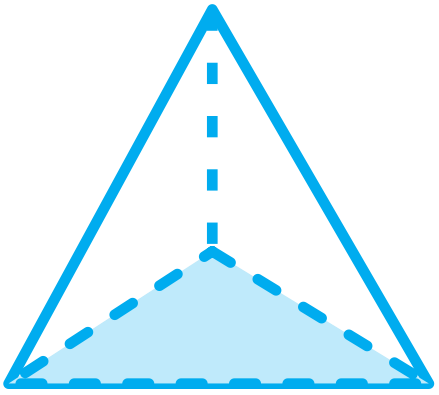
b.Triangular Pyramid
     
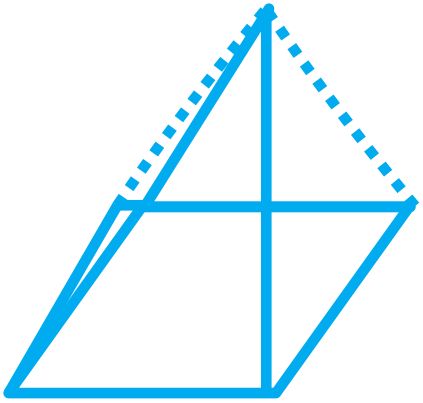
c.Square Pyramid
     
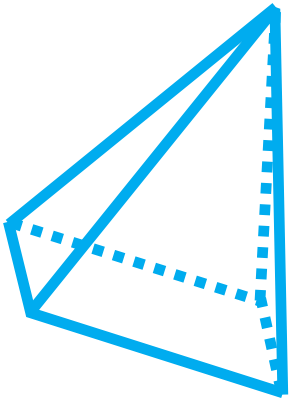
d.Rectangular Pyramid
     
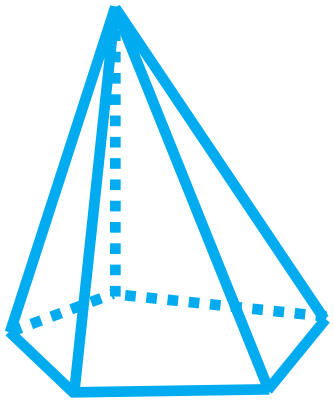
e.Pentagonal Pyramid
     
f.Hexagonal Pyramid
     
g.Triangular Prism
     
h.Square Prism
     
i.Cube
     
j.Pentagonal Prism
     
k.Octagonal Prism
     
l.Heptagonal Prism


Find the volume, curved surface area and total surface area of the cylinders whose dimensions are: Radius of the base $= 5.6\ m$ and height $= 1.25\ m.$
Diagonals of a parallelogram $ABCD$ intersect at $O$. $AL$ and $CM$ are drawn perpendiculars to $BD$ such that $L$ and $M$ lie on $BD$. Is $AL = CM$? Why or why not?