Question
Find the cube root of $13824$ by prime factorisation method.

Answer


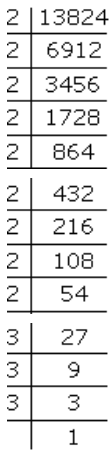
Prime factorisation of $13824$  is
$2 \times 2 \times 2 \times 2 \times 2 \times 2 \times 2 \times 2 \times 2 \times 3 \times 3 \times 3$ [grouping the factors in triplets]
$=2^3 \times 2^3 \times 2^3 \times 3^3=(2 \times 2 \times 2 \times 3)^3=24^3$
Therefore, $\sqrt[3]{{13824}} = 2 \times 2 \times 2 \times 3 = 24$

Need a full question paper?

Generate a complete, print-ready paper with questions like this in minutes — across 16+ boards, with answer keys.

Start Generating Free

Similar questions

Verify Euler's relation for the following: A tetrahedron.
The sum of four consecutive numbers is 34. What are these numbers?
In a model of a ship, the mast is $9\ cm$ high, while the mast of the actual ship is $15\ m$ high. If the length of the ship is $35$ metres, how long is the model ship?
$11$ men can dig $6\frac{3}{4}$ metre long trench in one day. How many men should be employed for digging $27$ metre long trench of the same type in one day?
Find the area of the shaded portion in the following figures.
A closed cylindrical tank of diameter $14\ m$ and height $5\ m$ is made from a sheet of metal. How much sheet of metal will be required?
The following data gives the number of children in $40$ families:
$1, 2, 6, 5, 1, 5, 1, 3, 2, 6, 2, 3, 4, 2, 0, 4, 4, 3, 2, 2, 0, 0, 1, 2, 2, 4, 3, 2, 1, 0, 5, 1, 2, 4, 3, 4, 1, 6, 2, 2$.
Represent it in the form of a frequency distribution.
Simplify: $ x^2\left(x^2+1\right)-x^3(x+1)-x\left(x^3-x\right) $
Construct a frequency distribution table for the following weights $($in grams$)$ of $35$ mangoes, using the equal class intervals, one of them is $40-45 (45$ not included$).$
$30, 40, 45, 32, 43, 50, 55, 62, 70, 70, 61, 62, 53, 52, 50,$
$42, 35, 37, 53, 55, 65, 70, 73, 74, 45, 46, 58, 59, 60, 62, 74, 34, 35, 70, 68.$
$a.$ How many classes are there in the frequency distribution table?
$b.$ Which weight group has the highest frequency?
Multiply the following
(i) $-7 \text{p} \text{q}^2 \text{r}^3,-26 \text{p}^3 \text{q} \text{r}^2$
(ii) $-5 \text{a} \text{b} \text{c}^2, 11 \text{a} \text{b}^2, 13 \text{a}^2 \text{b} \text{c}$