Questions

3 Marks Question

Take a timed test

12 questions · self-marked practice — reveal the answer and mark yourself.

Question 13 Marks
Find the cube root of $175616$ by prime factorisation method.
Answer
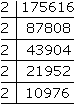
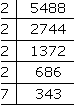


Prime factorisation of $175616$ is
$2 \times 2 \times 2 \times 2 \times 2 \times 2 \times 2 \times 2 \times 2 \times 7 \times 7 \times 7$ [grouping the factors in triplets]
$=2^3 \times 2^3 \times 2^3 \times 7^3=(2 \times 2 \times 2 \times 7)^3=56^3$ Therefore, $\sqrt[3]{{175616}} = 2 \times 2 \times 2 \times 7 = 56 .$
View full question & answer
Question 23 Marks
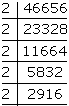
Find the cube root of $46656$ by prime factorisation method.
Answer


Prime factorisation of $46656$ is
$2 \times 2 \times 2 \times 2 \times 2 \times 2 \times 3 \times 3 \times 3 \times 3 \times 3 \times 3$ [grouping the factors in triplets]
$=2^3 \times 2^3 \times 3^3 \times 3^3=(2 \times 2 \times 3 \times 3)^3=36^3$ [by laws of exponents]
Therefore, $\sqrt[3]{{46656}} = 2 \times 2 \times 3 \times 3 = 36 .$
View full question & answer
Question 33 Marks
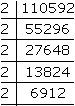
Find the cube root of $110592$ by prime factorisation method.
Answer


Prime factorisation of $110592$ is
$2 \times 2 \times 2 \times 2 \times 2 \times 2 \times 2 \times 2 \times 2 \times 2 \times 2 \times \times 3 \times 3 \times 3$ [grouping the factors in triplets]
$=2^3 \times 2^3 \times 2^3 \times 2^3 \times 3^3=(2 \times 2 \times 2 \times 2 \times 3)^3=24^3$
Therefore, $\sqrt[3]{{110592}} = 2 \times 2 \times 2 \times 2 \times 3 = 48 .$
View full question & answer
Question 43 Marks
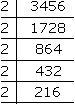
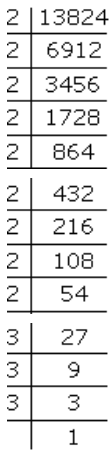
Find the cube root of $13824$ by prime factorisation method.
Answer

Prime factorisation of $13824$  is
$2 \times 2 \times 2 \times 2 \times 2 \times 2 \times 2 \times 2 \times 2 \times 3 \times 3 \times 3$ [grouping the factors in triplets]
$=2^3 \times 2^3 \times 2^3 \times 3^3=(2 \times 2 \times 2 \times 3)^3=24^3$
Therefore, $\sqrt[3]{{13824}} = 2 \times 2 \times 2 \times 3 = 24$
View full question & answer
Question 53 Marks
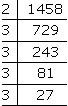
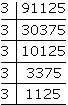
Find the cube root of $91125$ by prime factorisation method.
Answer


Prime factorisation of $91125$ is
$3 \times 3 \times 3 \times 3 \times 3 \times 3 \times 5 \times 5 \times 5$ [grouping the factors in triplets]
$=3^3 \times 3^3 \times 5^3=(3 \times 3 \times 5)^3=45^3$
Therefore, $\sqrt[3]{{91125}} = 3 \times 3 \times 5 = 45.$
View full question & answer
Question 63 Marks
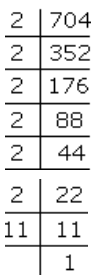
Find the smallest number by which $704$ must be divided to obtain a perfect cube.
Answer

By prime factorisation,
$704 = 2 \times 2 \times 2 \times 2 \times 2 \times 2 \times 11$ [grouping the factors in triplets]
The prime factor $11$ does not appear in a group of three. So $704$ is not a perfect cube. In the factorisation $11$ appears only ones time. So if we divide $704$ by $11$, then the prime factorisation of the quotient will not contain $11$. In that case,
$704 \div 11 = 2 \times 2 \times 2 × 2 \times 2 \times 2$
$ 64 =  2^3 \times 2^3$ [by laws of exponent]
$= 4^3 $
$= 4 \times 4 \times 4$
$= 64$ which is a perfect cube.
Hence, the smallest whole number by which $704$ must be divided to obtain a perfect cube is $11$. The resulting perfect cube is $64 (= 4^3) .$
View full question & answer
Question 73 Marks
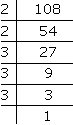
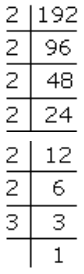
Find the smallest number by which $192$ must be divided to obtain a perfect cube.
Answer

By prime factorisation,
$192 = 2 \times 2 \times 2 \times 2 \times 2 \times 2 \times 3$ [grouping the factors in triplets]
The prime factor $3$ does not appear in a group of three. So $192$ is not a perfect cube. In the factorisation $192, 3$ appears only ones. So If we divide the number by $3$, then the prime factorisation of the quotient will not contain $3$. In that case,
$192 \div 3 = 2 \times 2 \times 2 \times 2 \times 2 \times 2$
$ 64=2^3 \times 2^3 $
$ =(2 \times 2)^3 $
$ =4^3$ which is a perfect cube.
Hence, the smallest whole number by which $192$ must be divided to obtain a perfect cube is $3.$
The resulting perfect cube is $64 (= 4^3)$.
View full question & answer
Question 83 Marks
Find the smallest number by which $135$ must be divided to obtain a perfect cube.
Answer


By prime factorisation,
 $135 = 3 \times 3 \times 3 \times 5$ [grouping the factors in triplets]
The prime factor $5$ does not appear in a group of three. So $135$ is not a perfect cube. In the factorisation $5$ appears only once. If we
divide $135$ by $5$, then prime factorisation of the quotient will not contain $5$. In that case,
$135 \div 5 = 3 \times 3 \times 3$
$27 = 3^3$ which is a perfect cube.
Hence, the smallest whole number by which $135$ must be divided to obtain a perfect cube is $5$.
The resulting perfect cube is $27 (= 3^3)$.
View full question & answer
Question 93 Marks
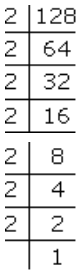
Find the smallest number by which $128$ must be divided to obtain a perfect cube.
Answer

By prime factorisation,
$128 = 2 \times  2 \times 2 \times 2 \times 2 \times 2 \times 2$ [grouping the factors in triplets]
In the above factorisation, $2$ remains after grouping the $2's$ in triplets. Therefore, $128$ is not a perfect cube. If we divide the number by $2$, then in the prime factorisation of the quotient, this $2$ will not remain. In that case,
$128 \div 2 = 2 \times 2 \times 2 \times 2 \times 2 \times 2$
$64=2^3 \times 2^3$
$ =(2 \times 2)^3$
$=4^3$ which is a perfect cube.
Hence, the smallest whole number by which $128$ must be divided to obtain a perfect cube is $2.$
View full question & answer
Question 103 Marks
Find the smallest number by which $81$ must be divided to obtain a perfect cube.
Answer

By prime factorisation,
$81 = 3 \times 3 \times 3 \times 3$ [grouping the factors in triplets]
In the above factorisation $3$ remains after grouping the $3's$ in triplets. Therefore, $81$ is not a perfect cube. If we divide the number by $3$, then in the prime factorisation of the quotient, this $3$ will not remain. In that case,
$81 \div 3 = 3 \times 3 \times 3$
$27 = 3^3$ which is a perfect cube.
Hence, the smallest whole number by which$ 81$ must be divided to obtain a perfect cube is $3.$
View full question & answer
Question 113 Marks
Find the cube root of $17576$ through estimation.
Answer
We have given a number $=17576$.
Step $1$ Form groups of three starting from the rightmost digit of $17576.$
$17 576. $ In this case one group i.e., $576$ has three digits whereas $17$ has only two digits.
Step $2$ Take $576.$
The digit $6$ is at its one's place.
Thus, one's place of the required cube root as $6 .$
Step $3$ Take the other group, i.e., $17.$
Cube of $2$ is $8$ and cube of $3$ is $27.17$ lies between $8$ and $27 .$
The smaller number among $2$ and $3$ is $2$ .
The one's place of $2$ is $2$ itself. Take $2$ as ten's place of the cube root of $17576 .$
Therefore, $3 \sqrt{17576}=26$
View full question & answer
Question 123 Marks
Find the cube root of $13824$ by prime factorisation method.
Answer

Prime factorisation of $13824$ is
$2 \times 2 \times 2 \times 2 \times 2 \times 2 \times 2 \times 2 \times 2 \times 3 \times 3 \times 3$ [grouping the factors in triplets]
$=2^3 \times 2^3 \times 2^3 \times 3^3=(2 \times 2 \times 2 \times 3)^3=24^3$
Therefore, $\sqrt[3]{{13824}} = 2 \times 2 \times 2 \times 3 = 24$
View full question & answer