Question
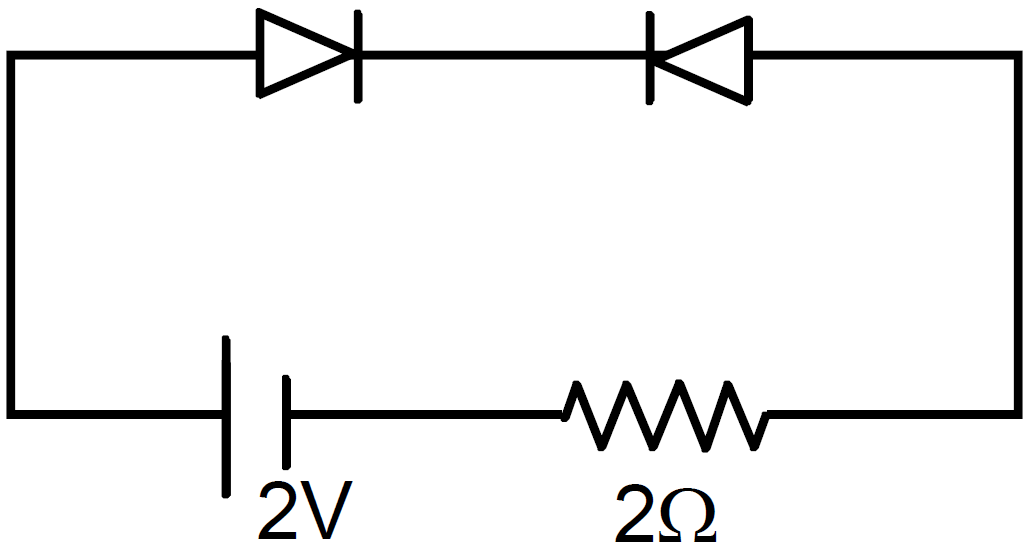
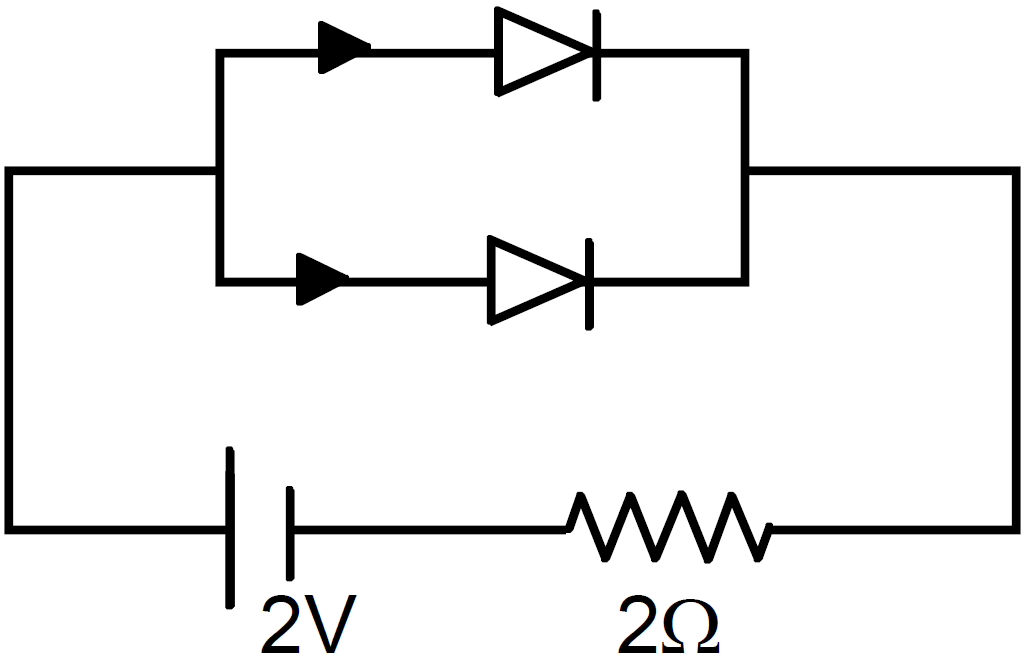
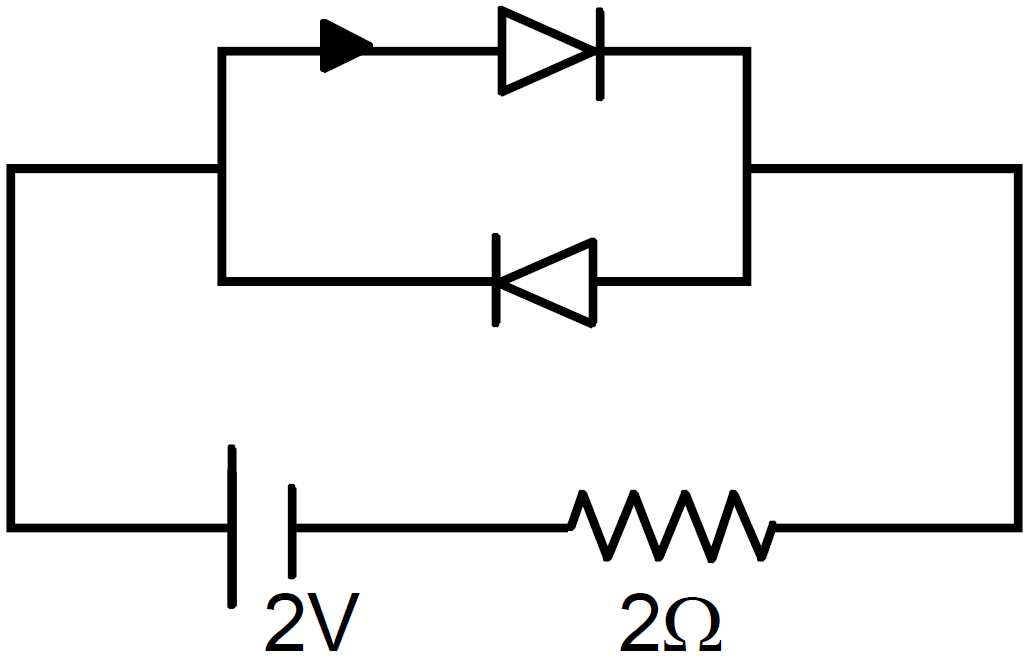
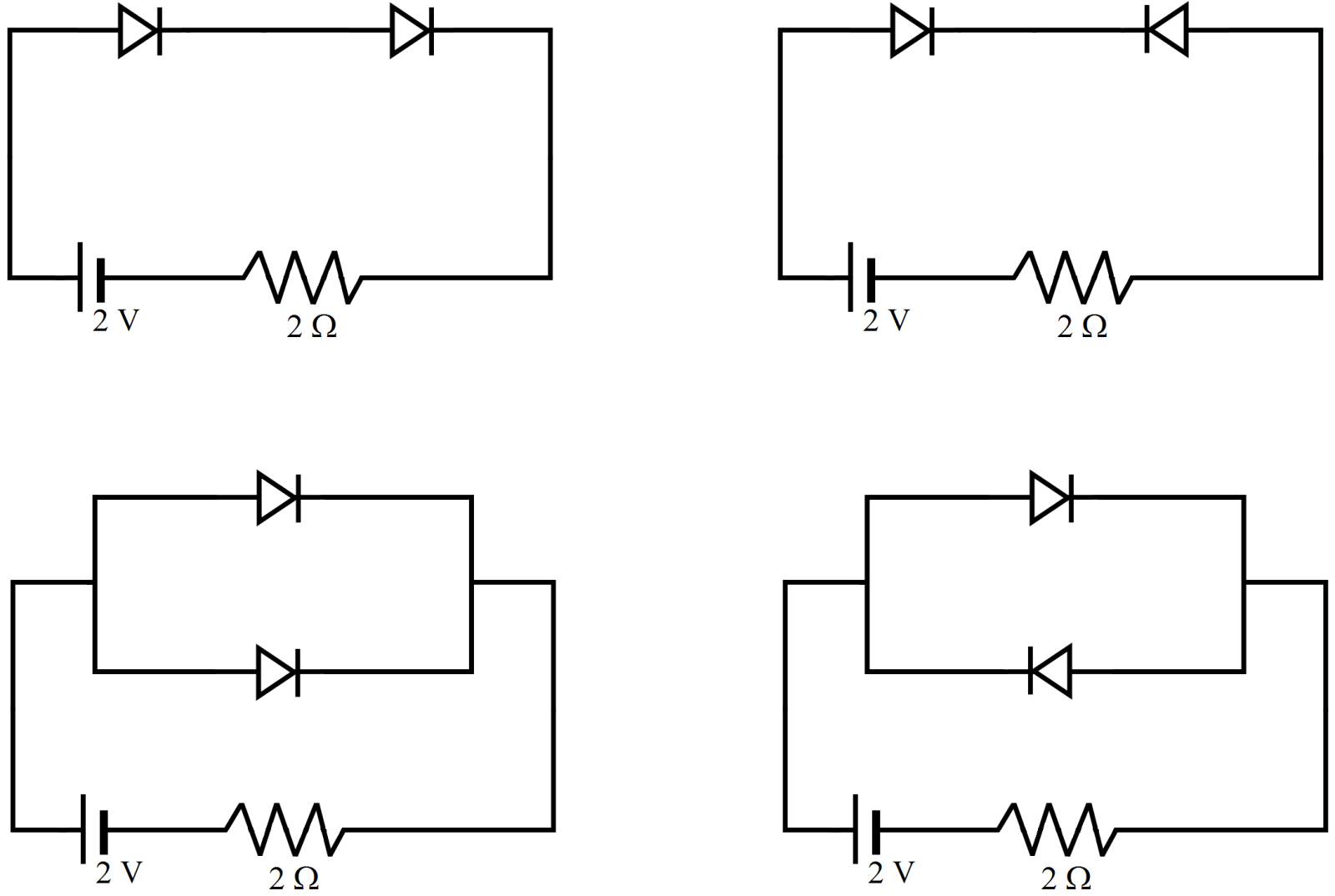
Find the currents through the resistances in the circuits shown in figure.

Answer

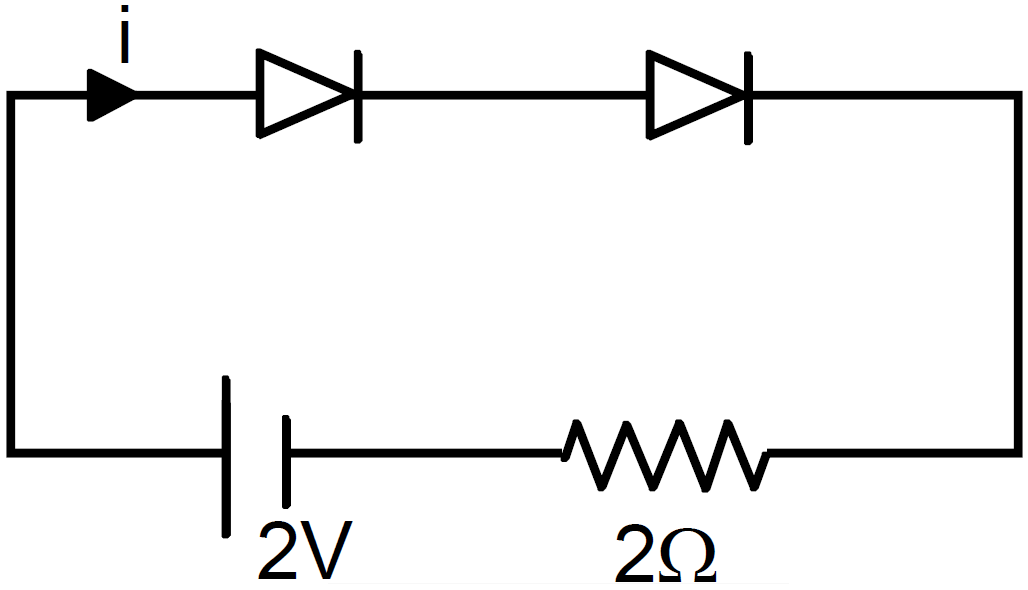
  1. Since both the diodes are forward biased net resistance = 0


$\text{i}=\frac{2\text{V}}{2\Omega}=1\text{A}$
  1. One of the diodes is forward biased and other is reverse biase.
Thus the resistance of one becomes $\infty.$


$\text{i}=\frac{2}{2+\infty}=0\text{A}$

Both are forward biased.

Thus the resistance is 0.


$\text{i}=\frac{2}{2}=1\text{A}.$

One is forward biased and other is reverse biased.

Thus the current passes through the forward biased diode.


$\therefore\text{i}=\frac{2}{2}=1\text{A}.$

Need a full question paper?

Generate a complete, print-ready paper with questions like this in minutes — across 16+ boards, with answer keys.
Start Generating Free

Similar questions

Calculate the center of mass of a uniform thin rod.
Explain:
  1. Why are ball bearings used in machinery?
  2. Why does a horse have to apply more force to start a cart than to keep it moving?
  3. What is the need for banking the tracks?
  4. State two advantages and two disadvantages of friction.
From a uniform disk of radius R , a circular hole of radius $\frac{R}{2}$ is cut out. The centre of the hole is at $\frac{R}{2}$ from the centre of the original disc. Locate the centre of gravity of the resulting flat body.
$(n - 1)$ equal point masses each of mass m are placed at the vertices of a regular n-polygon. The vacant vertex has a position vector a with respect to the centre of the polygon. Find the position vector of centre of mass.
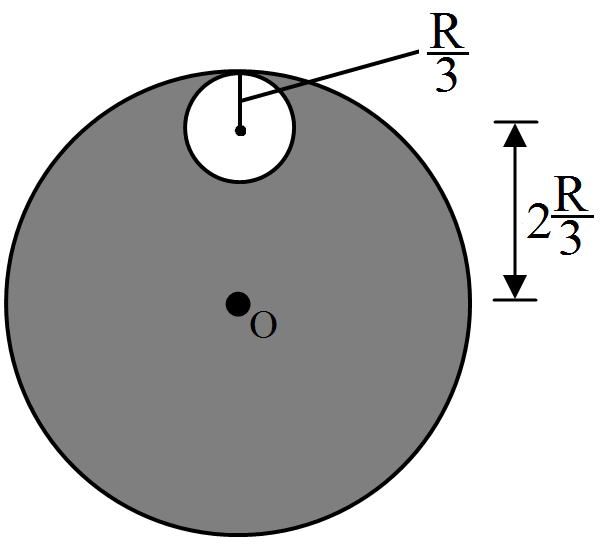
From a circular disc of radius R and mass 9M, a small disc of radius $\frac{\text{R}}{3}$ is removed as shown in Fig. Find the moment of inertia of the remaining disc about an axis perpendicular to the plane of the disc and passing through the point O.
A glass surface is coated by an oil film of uniform thickness $1.00 \times 10^{-4}cm$. The index of refraction of the oil is $1.25$ and that of the glass is $1.50$. Find the wavelengths of light in the visible region ($400nm - 750nm$) which are completely transmitted by the oil film under normal incidence.
Suppose the ends of the coil in the previous problem are connected to a resistance of $100\Omega.$ Neglecting the reaiatance of the coil, find the heat produced in the circuit in one minute.
Differentiate between progressive and non- progressive waves.
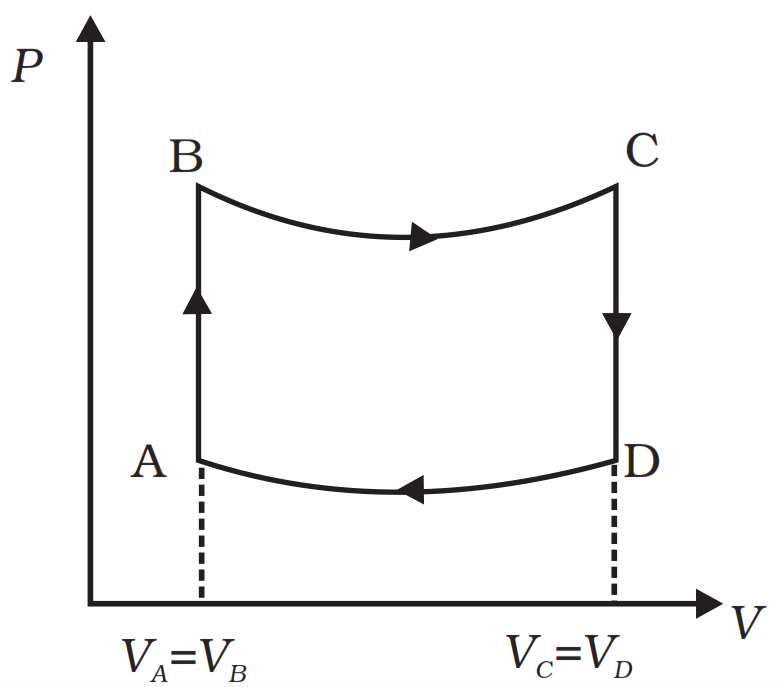
A cycle followed by an engine (made of one mole of perfect gas in a cylinder with a piston) is shown in Fig.
A to B : volume constant B to C : adiabatic C to D : volume constant D to A : adiabatic $V_C= V_D= 2V_A= 2V_B$
  1. In which part of the cycle heat is supplied to the engine from outside?
  2. In which part of the cycle heat is being given to the surrounding by the engine?
  3. What is the work done by the engine in one cycle? Write your answer in term of $P_A, P_B, V_A$.
  4. What is the efficiency of the engine?[$\gamma=\frac{5}{3}$ for the gas], $\big(\text{C}_\text{v}=\frac{3}{2}\text{R for one mole}\big)$
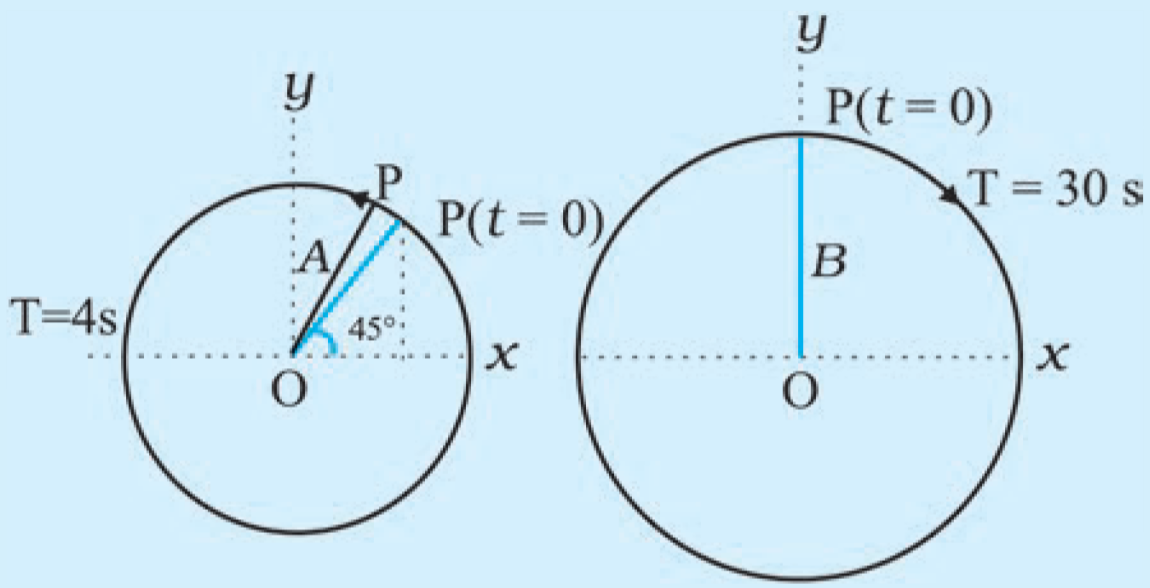
The figure given below depicts two circular motions. The radius of the circle, the period of revolution, the initial position and the sense of revolution are indicated in the figures. Obtain the simple harmonic motions of the x-projection of the radius vector of the rotating particle P in each case.
Image