From a circular disc of radius R and mass 9M, a small disc of radius $\frac{\text{R}}{3}$ is removed as shown in Fig. Find the moment of inertia of the remaining disc about an axis perpendicular to the plane of the disc and passing through the point O.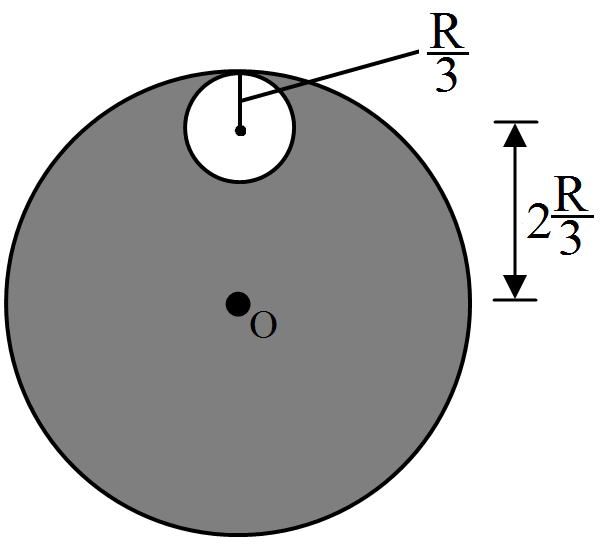
Download our app for free and get started
Moment of inertia of the complete disc about the given axis $=\frac{1}{2}(9\text{M})\text{R}^2$ Moment of removed disc $=\frac{9\text{M}}{\pi\text{R}^2}\pi\Big(\frac{\text{R}}{3}\Big)^2=\text{M}$ Moment of intertia of this disc about the given axis $=\frac{1}{2}\text{M}\Big(\frac{\text{R}}{3}\Big)^2+\text{M}\Big(\frac{2\text{R}}{3}\Big)^2=\frac{1}{2}\text{MR}^2$ $\therefore$ Moment of inertia of the remaining disc about the given axis $=\frac{9}{2}\text{MR}^2-\frac{1}{2}\text{MR}^2=4\text{MR}^2$

Download our appand get started for free
Experience the future of education. Simply download our apps or reach out to us for more information. Let's shape the future of learning together!No signup needed.*
Similar Questions
- 1View SolutionA ball is whirled in a circle by attaching it to a fixed point with a string. Is there an angular rotation of the ball about its centre? If yes, is this angular velocity equal to the angular velocity of the ball about the fixed point?
- 2View SolutionFind the components along the x, y, z axes of the angular momentum l of a particle, whose position vector is r with components x, y, z and momentum is p with components px, py and pz. Show that if the particle moves only in the x-y plane the angular momentum has only a z-component.
- 3View Solution
- Prove the theorem of perpendicular axes.
- Prove the theorem of parallel axes.
- 4Two particles of mass $2kg$ and $1kg$ are moving along the same line with speeds $2ms-1$ and $5ms^{-1}$ respectively. What is the speed of the centre of mass of the system if both the particles are moving (a) in same direction (b) in opposite direction?View Solution
- 5View SolutionHow much fraction of the kinetic energy of rolling is purely:
- Translational.
- Rotational.
- 6View SolutionA body is in translational equilibrium under the action of coplanar forces. If the torque of these forces is zero about a point, is it necessary that it will also be zero about any other point?
- 7View SolutionA sphere of a radius 10cm weighs 1kg, calculate the moment of inertia.
- About the diameter.
- About the tangent.
- 8A cord of negligible mass is wound round the rim of a fly wheel of mass $20 \ kg$ and radius $20 \ cm$. A steady pull of $25 N$ is applied on the cord as shown in Fig. $6.31$. The flywheel is mounted on a horizontal axle with frictionless bearings.View Solution
$(a)$ Compute the angular acceleration of the wheel.
$(b)$ Find the work done by the pull, when $2m$ of the cord is unwound.
$(c)$ Find also the kinetic energy of the wheel at this point. Assume that the wheel starts from rest.
$(d)$ Compare answers to parts $(b)$ and $(c).$ - 9View SolutionA 3m long ladder weighing 20 kg leans on a frictionless wall. Its feet rest on the floor 1 m from the wall as shown in Fig.6.27. Find the reaction forces of the wall and the floor.
- 10View SolutionA hoop of radius 2m weighs 100kg. It rolls along a horizontal floor so that its centre of mass has a speed of 20cm/s. How much work has to be done to stop it?