Question

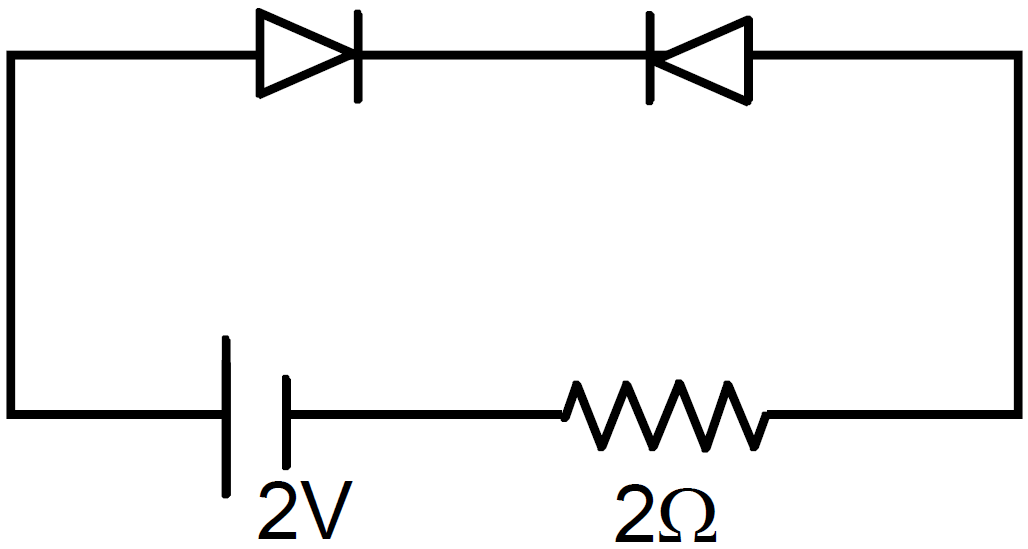
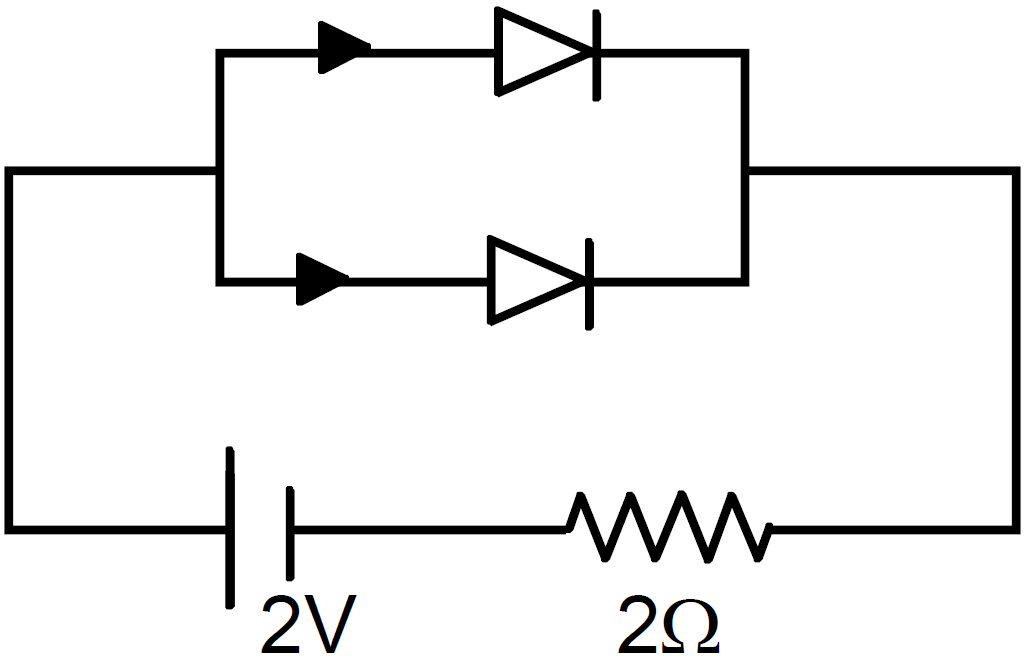
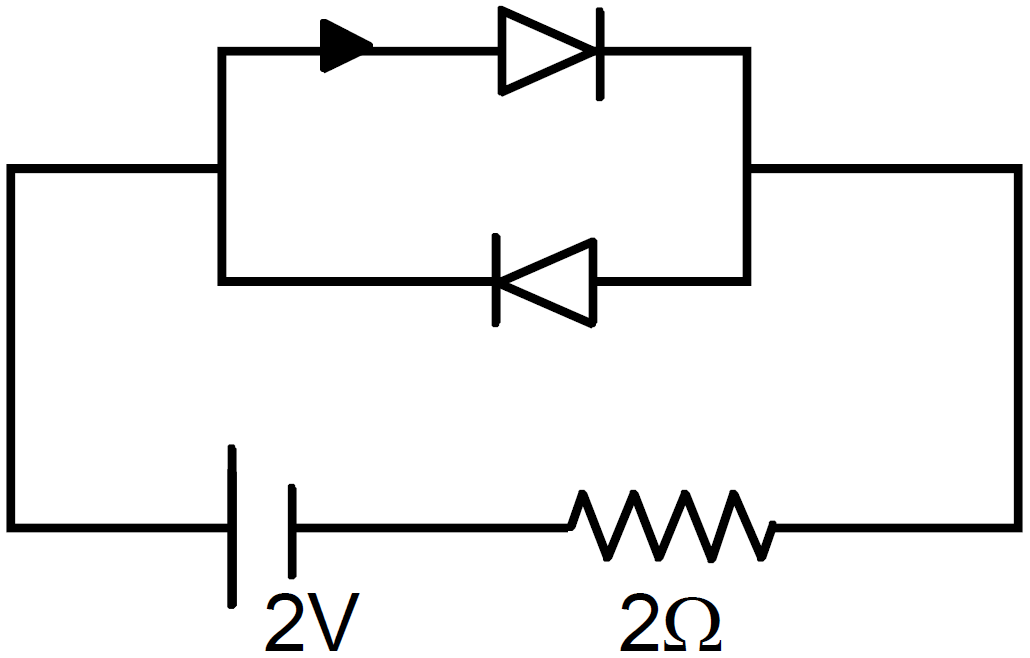
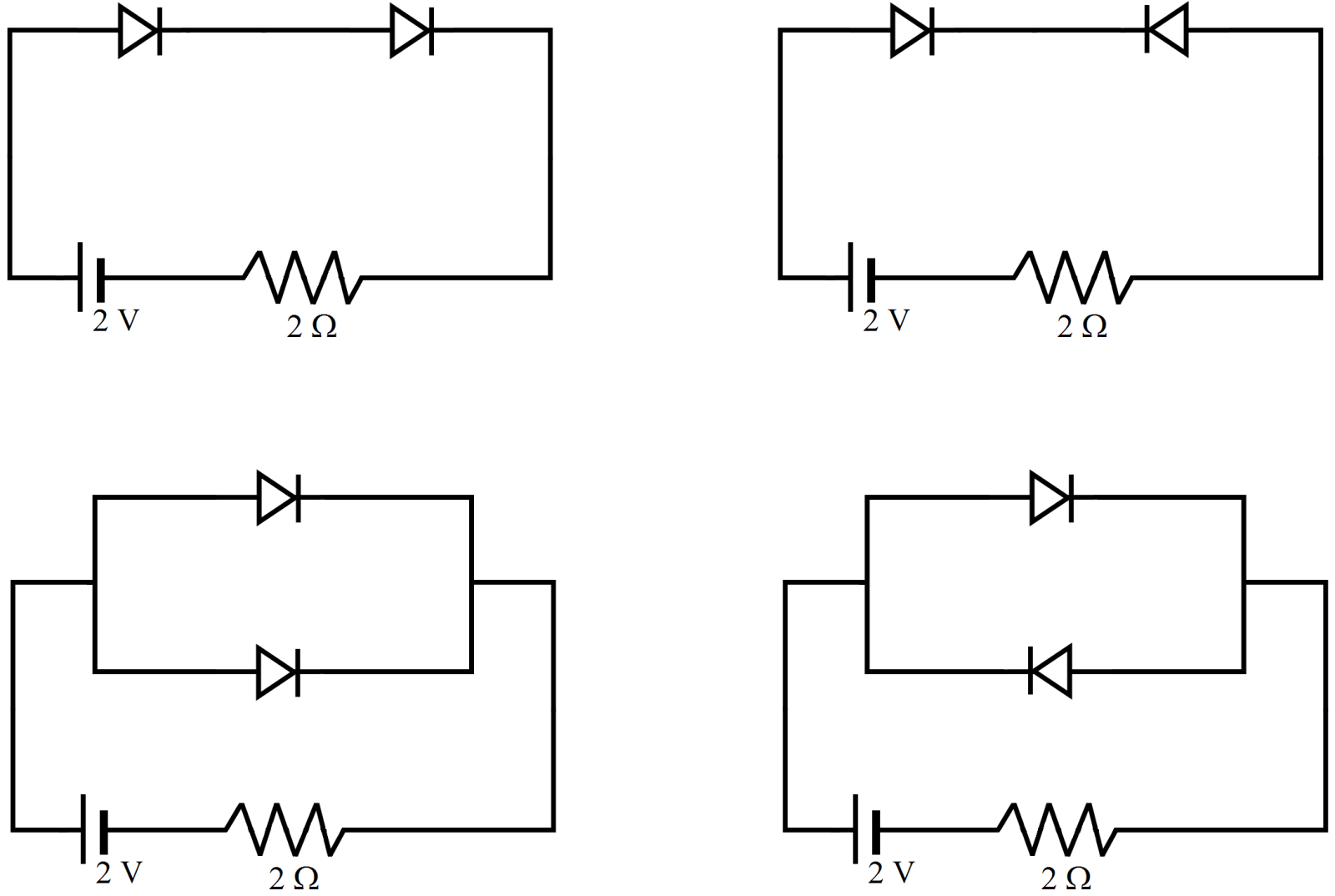
Find the currents through the resistances in the circuits shown in figure.

Answer

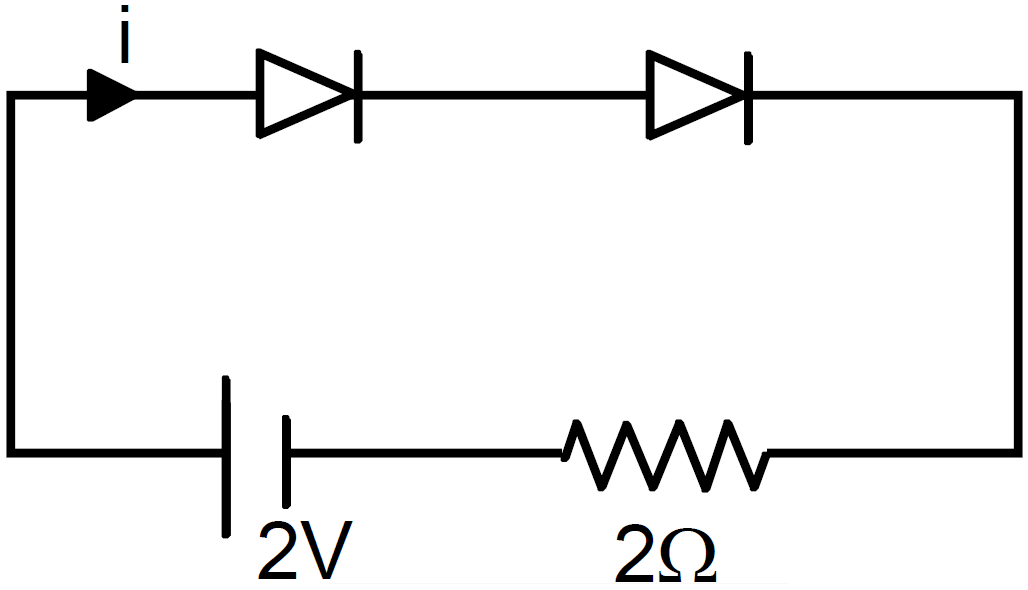
  1. Since both the diodes are forward biased net resistance = 0

$\text{i}=\frac{2\text{V}}{2\Omega}=1\text{A}$
  1. One of the diodes is forward biased and other is reverse biase.
Thus the resistance of one becomes $\infty.$

$\text{i}=\frac{2}{2+\infty}=0\text{A}$
Both are forward biased.
Thus the resistance is 0.

$\text{i}=\frac{2}{2}=1\text{A}.$
One is forward biased and other is reverse biased.
Thus the current passes through the forward biased diode.

$\therefore\text{i}=\frac{2}{2}=1\text{A}.$

Need a full question paper?

Generate a complete, print-ready paper with questions like this in minutes — across 16+ boards, with answer keys.
Start Generating Free

Similar questions

Two small balls A and B, each of mass m, are joined rigidly to the ends of a light rod of lengh L (figure). The system translates on a frictionless horizontal surface with a velocity vo in a direction perpendicular to the rod. A particle P of mass m kept at rest on the surface sticks to the ball A as the ball collides with it. Find:
  1. The linear speeds of the balls A and B after the collision.
  2. The velocity of the centre of mass C of the system A + B + P.
  3. The angular speed of the system about C after the collision.

[Hint: The light rod will exert a force on the ball B only along its length.]
The refractive index of a material $M_1$ changes by 0.014 and that of another material $M_2$ changes by 0.024 as the colour of the light is changed from red to violet. Two thin prisms one made of $M_1(A = 5.3^\circ)$ and other made of $M_2(A = 3.7^\circ)$ are combined with their refracting angles oppositely directed.
  1. Find the angular dispersion produced by the combination.
  2. The prisms are now combined with their refracting angles similarly directed. Find the angular dispersion produced by the combination.
Deutrium was discovered in 1932 by Harold Urey by measuring the small change in wavelength for a particular transition in ${ }^1 \mathrm{H}$ and ${ }^2 \mathrm{H}$. This is because, the wavelength of transition depend to a certain extent on the nuclear mass. If nuclear motion is taken into account then the electrons and nucleus revolve around their common centre of mass. Such a system is equivalent to a single particle with a reduced mass $\mu$, revolving around the nucleus at a distance equal to the electron-nucleus separation. Here $\mu=\frac{m_e M}{m_e+M}$ where $M$ is the nuclear mass and me is the electronic mass. Estimate the percentage difference in wavelength for the $1^{\text {st }}$ line of the Lyman series in ${ }^1 \mathrm{H}$ and ${ }^2 \mathrm{H}$. (Mass of ${ }^1 \mathrm{H}$ nucleus is $1.6725 \times 10^{-27} \mathrm{~kg}$, Mass of ${ }^2 \mathrm{H}$ nucleus is $3.3374 \times 10^{-27} \mathrm{~kg}$, Mass of electron $=9.109 \times 10^{-31} \mathrm{~kg}$ ).
Two wires carrying equal currents i each, are placed perpendicular to each other, just avoiding a contact. If one wire is held fixed and the other is free to move under magnetic forces, what kind of motion will result?
A cylindrical vessel, whose diameter and height both are equal to 30cm, is placed on a horizontal surface and a small particle P is placed in it at a distance of 5.0cm from the centre. An eye is placed at a position such that the edge of the bottom is just visible. The particle P is in the plane of drawing. Up to what minimum height should water be poured in the vessel to make the particle P visible?
The conduction band of a solid is partially filled at 0K. Will it be a conductor, a semiconductor or an insulator?
$4 \times 10^{23}$ tritium atoms are contained in a vessel. The half-life of decay tritium nuclei is 12.3y. Find:
  1. The activity of the sample.
  2. The number of decay in the next 10 hours.
  3. The number of decays in the next 6.15y.
The Bohr model for the H-atom relies on the Coulomb’s law of electrostatics. Coulomb’s law has not directly been verified for very short distances of the order of angstroms. Supposing Coulomb’s law between two opposite charge $+q_1, -q_2$ is modified to
$|\text{F}|=\frac{\text{q}_1\text{q}_2}{(4\pi\in_0)}\frac{1}{\text{r}^2}.\text{r}\geq\text{R}_0$
$=\frac{\text{q}_1\text{q}_2}{(4\pi\in_0)}\frac{1}{\text{R}^2_0}\Big(\frac{\text{R}_0}{\text{r}}\Big)^{\in}.\text{r}\geq\text{R}_0$
Calculate in such a case, the ground state energy of a H-atom, if $\in=0.1,\text{R}_0=1\mathring{\text{A}}$.
A biconvex thick lens is constructed with glass $(\mu=1.50)$ Each of the surfaces has a radius of 10cm and the thickness at the middle is 5cm. Locate the image of an object placed far away from the lens.
A compound microscope consists of an objective lens of focal length $2.0 \ cm$ and an eyepiece of focal length $6.25 \ cm$ separated by a distance of $15 \ cm$. How far from the objective should an object be placed in order to obtain the final image at
$a$ .the least distance of distinct vision $(25 \ cm),$ and
$b$. at infinity?
What is the magnifying power of the microscope in each case?