Question
Two wires carrying equal currents i each, are placed perpendicular to each other, just avoiding a contact. If one wire is held fixed and the other is free to move under magnetic forces, what kind of motion will result?

Answer

The magnetic force on a wire carrying an electric current i is $\overrightarrow{\text{F}}=\text{i}.\big(\overrightarrow{\text{l}}\times\overrightarrow{\text{B}}\big),$ where l is the length of the wire and B is the magnetic field acting on it. Suppose we have one wire in the horizontal direction (fixed) and other wire in the vertical direction (free to move). If the horizontal wire is carrying current from right to left is held fixed perpendicular to the vertical wire, which is free to move, the upper portion of the free wire will tend to move in the left direction and the lower portion of the wire will tend to move in the right direction, according to Fleming's left hand rule, as the magnetic field acting on the wire due to the fixed wire will point into the plane of paper above the wire and come out of the paper below the horizontal wire and the current will flow in upward direction in the free wire. Thus, the free wire will tend to become parallel to the fixed wire so as to experience maximum attractive force.

Need a full question paper?

Generate a complete, print-ready paper with questions like this in minutes — across 16+ boards, with answer keys.
Start Generating Free

Similar questions

A neutron initially at rest, decays into a proton, an electron and an antineutrino. The ejected electron has a momentum of $1.4 \times 10^{-26}$kg-m/s and the antineutrino $6.4 \times 10^{-27}$kg-m/s. Find the recoil speed of the proton:
  1. If the electron and the antineutrino are ejected along the same direction.
  2. If they are ejected along perpendicular directions. Mass of the proton $= 1.67 \times 10^{-27}$kg.
An unsymmetrical double convex thin lens forms the image of a point object on its axis. Will the position of the image change if the lens is reversed?
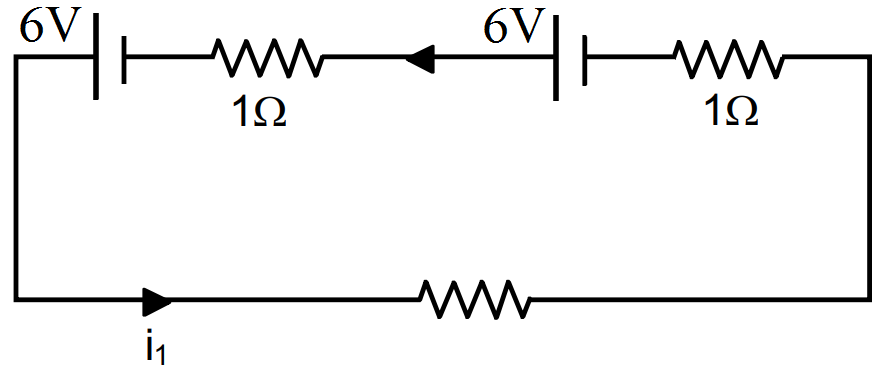
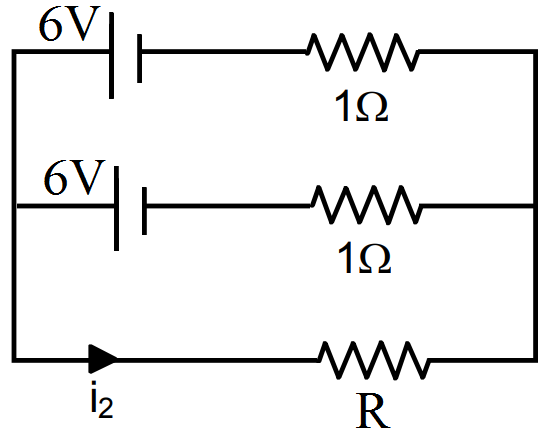
Find the value of $\frac{\text{i}_1}{\text{i}_2}$ in the figure. if (a) $\text{R}=0.1\Omega$ (b) $\text{R}=1\Omega$ and (c) $\text{R}=10\Omega.$ Note from your answers that in order to get more current from a combination of two batteries, they should be joined in parallel if the external resistance is small and in series if the external resistance is large, compared to the internal resistance.
The internal energy of a gas is given by U = 1.5PV. It expands from $100cm^3$ to $200cm^3$ against a constant pressure of $1.0 x 10^5$ Pa. Calculate the heat absorbed by the gas in the process.
Check that the ratio ke$^2$/G $m_em_p$ is dimensionless. Look up a Table of Physical Constants and determine the value of this ratio. What does the ratio signify?
Consider the de Broglie wavelength of an electron and a proton. Which wavelength is smaller if the two particles have.
  1. The same speed.
  2. The same momentum.
  3. The same energy?.
What will be the total flux through the faces of the cube (Fig.) with side of length a if a charge q is placed at:
  1. A: a corner of the cube.
  2. B: mid-point of an edge of the cube.
  3. C: centre of a face of the cube.
  4. D: mid-point of B and C.
Positive charge Q is distributed uniformly over a circular ring of radius R. A particle having a mass m and a negative charge q, is placed on its axis at a distance x from the centre. Find the force on the particle. Assuming x << R, find the time period of oscillation of the particle if it is released from there.
0.040g of He is kept in a closed container initially at 100.0°C. The container is now heated. Neglecting the expansion of the container, calculate the temperature at which the internal energy is increased by 12J.
A concave mirror forms an image of 20cm high object on a screen placed 5.0m away from the mirror. The height of the image is 50cm. Find the focal length of the mirror and the distance between the mirror and the object.