Question
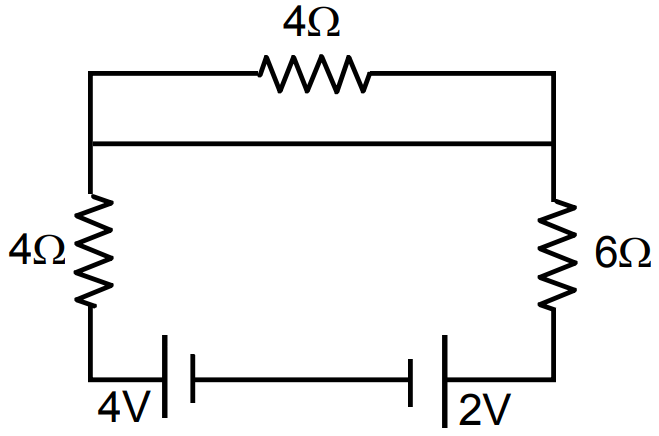
Find the currents through the three reaiators shown in figure.

Answer


  1. Current through (1) $4\Omega$ resistor = 0
  2. Current through (2) and (3)
net E = 4V - 2V = 2V

(2) and (3) are in series,

$\text{R}_\text{eff}=4+6=10\Omega$

$\text{i}=\frac{2}{10}=0.2\text{A}$

Current through (2) and (3) are 0.2A.

Need a full question paper?

Generate a complete, print-ready paper with questions like this in minutes — across 16+ boards, with answer keys.
Start Generating Free

Similar questions

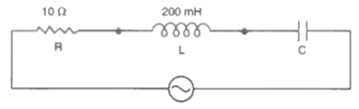
In the following circuit, calculate:
$i.$ the capacitance of the capacitor, if the power factor of the circuit is unity,
$ii$. the $Q-$ factor of this circuit. What is the significance of the $Q-$ factor in $ac$ circuit? Given the angular frequency of the $ac$ source to be $100 \text{rad/s}$. Calculate the average power dissipated in the circuit.

Image
A sound source, fixed at the origin, is continuously emitting sound at a frequency of 660Hz. The sound travels in air at a speed of 330m/s. A listener is moving along the line x = 336m at a constant speed of 26m/s. Find the frequency of the sound as observed by the listener when he is:
  1. At y = - 140m.
  2. At y = 0.
  3. At y = 140m.
Explain "Electron Theory of Electric Charge".
A 50-turn circular coil of radius 2.0cm carrying a current of 5.0A is rotated in a magnetic field of strength 0.20T.
  1. What is the maximum torque that acts on the coil?
  2. In a particular position of the coil, the torque acting on it is half of this maximum. What is the angle between the magnetic field and the plane of the coil?
A particle is moving at a constant speed V from a large distance towards a concave mirror of radius R along its principal axis. Find the speed of the image formed by the mirror as a function of the distance x of the particle from the mirror.
An eye can distinguish between two points of an object if they are separated by more than 0.22mm when the object is placed at 25cm from the eye. The object is now seen by a compound microscope having a 20D objective and 10D eyepiece separated by a distance of 20cm. The final image is formed at 25cm from the eye. What is the minimum separation between two points of the object which can now be distinguished?
A current of 1.0A exists in a copper wire of cross-section $1.0mm^2$. Assuming one free electron per atom, calculate the drift speed of the free electrons in the wire. The density of copper is $9000kg/m^{-3}.$
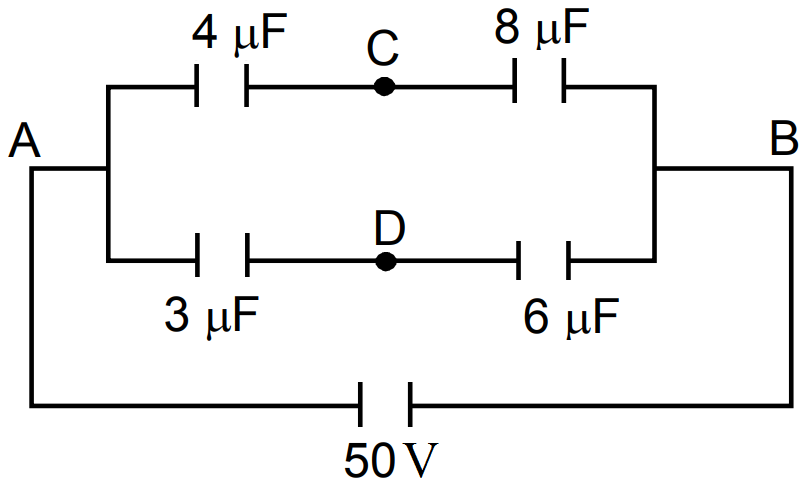
Take the potential of the point B in figure to be zero:
  1. Find the potentials at the points C and D.
  2. If a capacitor is connected between C and D, what charge will appear on this capacitor?
Coulomb's law for electrostatic force between two point charges and Newton's law for gravitational force between two stationary point masses, both have inverse-square dependence on the distance between the charges and masses respectively. (a) Compare the strength of these forces by determining the ratio of their magnitudes (i) for an electron and a proton and (ii) for two protons. (b) Estimate the accelerations of electron and proton due to the electrical force of their mutual attraction when they are $1 \mathring A\left(=10^{-10} m \right)$ apart? $\left(m_p=1.67 \times\right.$ $\left.10^{-27} kg , m_e=9.11 \times 10^{-31} kg \right)$
Find the reading of the spring balance shown in figure. The elevator is going up with an acceleration of $\frac{\text{g}}{10},$ the pulley and the string are light and the pulley is smooth.