Question
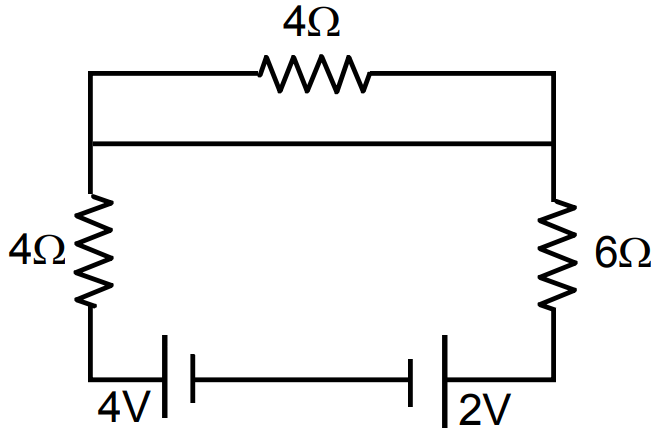
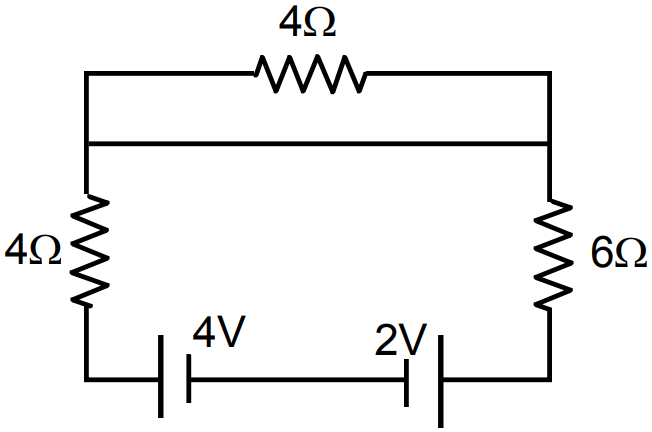
Find the currents through the three reaiators shown in figure.
Answer


  1. Current through (1) $4\Omega$ resistor = 0
  2. Current through (2) and (3)

net E = 4V - 2V = 2V

(2) and (3) are in series,

$\text{R}_\text{eff}=4+6=10\Omega$

$\text{i}=\frac{2}{10}=0.2\text{A}$

Current through (2) and (3) are 0.2A.

Need a full question paper?

Generate a complete, print-ready paper with questions like this in minutes — across 16+ boards, with answer keys.

Start Generating Free

Similar questions

A magnetic field of $(4.0\times10^{-3}\vec{\text{k}})$ T exerts a force of $(4.0\vec{\text{i}}+3.0\vec{\text{j}})\times10^{-10}$ N on a particle with a charge of $1.0\times10^{-9}\text{C}$ and going in the x−y plane. Find the velocity of the particle.
Quite often, connecting wires carrying currents in opposite directions are twisted together in using electrical appliances. Explain how it avoids unwanted magnetic fields.
A mercury lamp is a convenient source for studying frequency dependence of photoelectric emission, since it gives a number of spectral lines ranging from the UV to the red end of the visible spectrum. In our experiment with rubidium photo-cell, the following lines from a mercury source were used:
$\lambda_1=3650\ \mathring{\text{A}},\ \lambda_2=4047\ \mathring{\text{A}},\ \lambda_3=4358\ \mathring{\text{A}},\ \lambda_4=5461\ \mathring{\text{A}},\ \lambda_5=6907\ \mathring{\text{A}},$
The stopping voltages, respectively, were measured to be:
V01 = 1.28 V, V02 = 0.95 V, V03 = 0.74 V, V04 = 0.16 V, V05 = 0 V
Determine the value of Planck’s constant h, the threshold frequency and work function for the material.
[Note: You will notice that to get h from the data, you will need to know e (which you can take to be 1.6 × 10–19 C). Experiments of this kind on Na, Li, K, etc. were performed by Millikan, who, using his own value of e (from the oil-drop experiment) confirmed Einstein’s photoelectric equation and at the same time gave an independent estimate of the value of h.]
In beta decay, an electron (or a positron) is emitted by a nucleus. Does the remaining atom get oppositely charged?
A conducting loop of area 5.0cm2 is placed in a magnetic field which varies sinusoidally with time as $\text{B}=\text{B}_0\sin\omega\text{t}$ wherer $\text{B}_0=0.20\text{T}$ and $\omega=300\text{s}^{-1}.$ The normal to the coil makes an angle of 60° with the field. Find
  1. The maximum emf induced in the coil.
  2. The emf induced at $\text{t}=\Big(\frac{\pi}{900}\Big)\text{s}$
  3. $\text{t}=\Big(\frac{\pi}{600}\Big)\text{s}.$
  4. The emf induced at $\text{t}=\Big(\frac{\pi}{600}\Big)\text{s}.$
Obtain the relation for equivalence in series combination of capacitors. Make a circuit diagram.
Why does blowing over a spoonful of hot tea cools it? Does evaporation play a role? Does radiation play a role?
Repeat part (a) of problem 6 if the push is applied horizontally and not parallel to the incline.
(a) What do you mean by mean life time? Establish its relation with half-life time.
(b) One gram of uranium $({}_{92}^{238}U)$ emits $1.24 \times 10^{4}$ $\alpha$-particle per second. Calculate the half-life time of ${}_{92}^{238}U$ (Avogadro's Number $N_{A}=6\times10^{23}$ per gm mole)
(c) What do you mean by activity of radioactive substance?
Describe the procedure for obtaining V-I characteristic curve in forward bias of P-N junction diode. Make a circuit diagram of the experimental arrangement.