Question
Find the dimensions of:

  1. Angular speed $\omega.$
  2. Angular acceleration $\alpha.$
  3. Torque $\tau$ and
  4. Moment of interia I.
Some of the equations involving these quantities are

$\omega=\frac{\theta_2-\theta_1}{\text{t}_2-\text{t}_1},\alpha=\frac{\omega_2-\omega_1}{\text{t}_2-\text{t}_1},\tau=\text{F.r}$ and $\text{I = mr}^2.$

The symbols have standard meanings.
Answer

  1. Angular speed $\omega=\frac{\theta}{\text{t}}=[\text{M}^0\text{L}^0\text{T}^{-1}]$

  2. Angular acceleration $\alpha=\frac{\omega}{\text{t}}=\frac{\text{M}^0\text{L}^0\text{T}^{-1}}{\text{T}}=[\text{M}^0\text{L}^0\text{T}^{-2}]$

  3. Torque $\tau=\text{Fr}=[\text{MLT}^{-2}][\text{L] = [ML}^2\text{T}^{-2}]$

  4. Moment of inertia $=\text{Mr}^2=[\text{M}][\text{L}^2]=[\text{ML}^2\text{T}^0]$

Need a full question paper?

Generate a complete, print-ready paper with questions like this in minutes — across 16+ boards, with answer keys.

Start Generating Free

Similar questions

What is electrostatics?
An $\alpha$–particle and a proton are moving in the plane of paper in a region where there is a uniform magnetic field directed normal to the plane of the paper. If the particles have equal linear momenta, what would be the ratio of the radii of their trajectories in the field?
The contact angle between pure water and pure silver is 90º. If a capillary tube made of silver is dipped at one end in pure water, will the water rise in the capillary?
Find the wavelength of the electron orbiting in the first excited state in hydrogen atom.
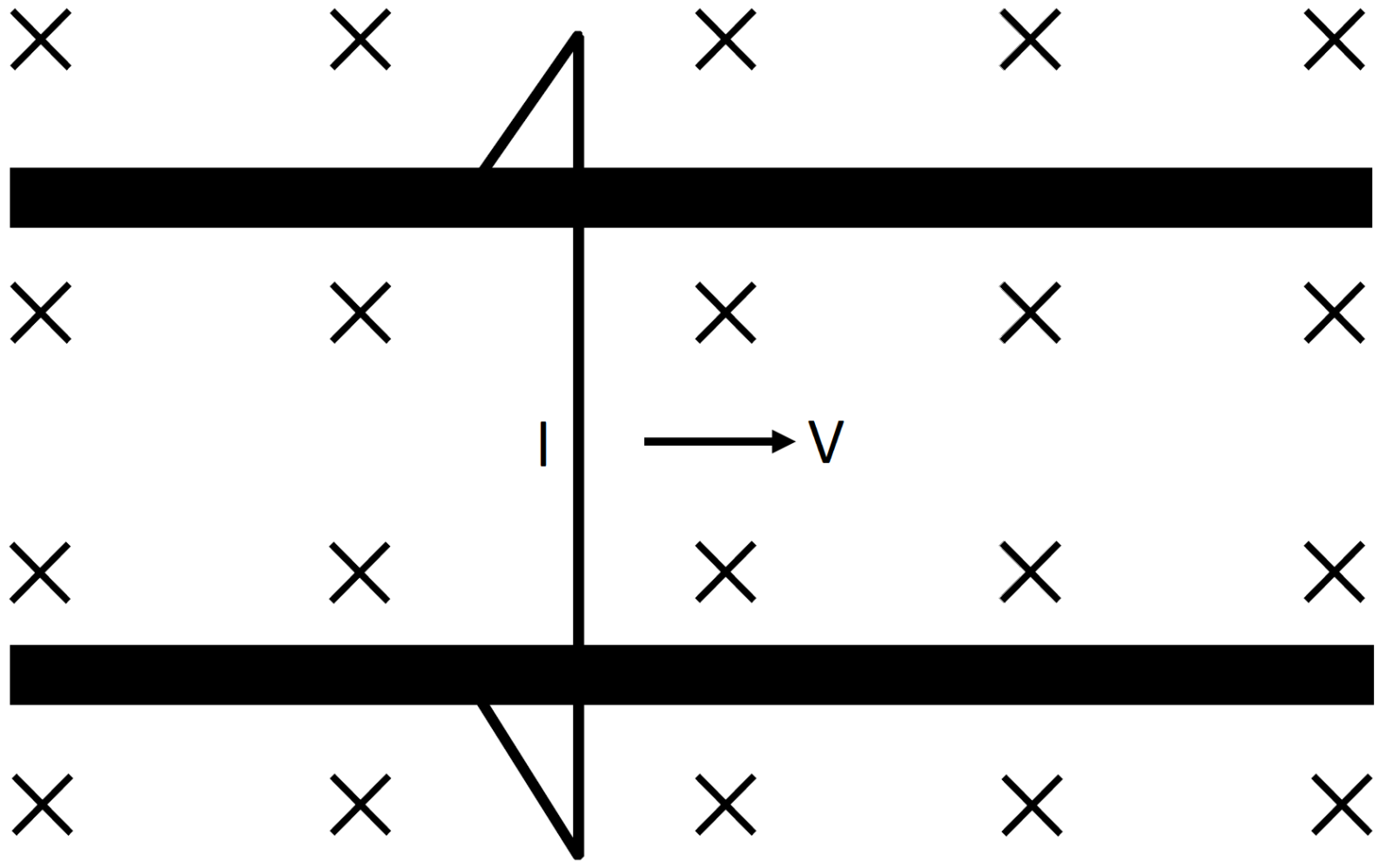
Figure shows a wire sliding on two parallel, conducting rails placed at a separation l. A magnetic field B exists in a direction perpendicular to the plane of the rails. What force is necessary to keep the wire moving at a constant velocity v?

Answer the following question:
 virtual image, we always say, cannot be caught on a screen.
Yet when we 'see' a virtual image, we are obviously bringing it on to the 'screen' (i.e., the retina) of our eye. Is there a contradiction?
Can the entire charge of a charged object 'A' be transferred to another object 'B'? If yes then how would it be possible, if not then why?
What is Electromagnetic induction ? Give names of experiments of Faraday and Henry explaining this phenomenon.
Show mathematically how Bohr's postulate of quantization of orbital angular momentum in hydrogen atom is explained by de-Broglie's hypothesis.
Using Ampere’s circuital law, obtain an expression for the magnetic field along the axis of a current carrying solenoid of length l and having N number of turns.