Question
Show mathematically how Bohr's postulate of quantization of orbital angular momentum in hydrogen atom is explained by de-Broglie's hypothesis.

Answer

de Broglie wavelength, $\lambda = \frac{\text{h}}{\text{mv}}$
For electron moving in the nth orbit, $2 \pi\text{r} = \text{n}\lambda$
$\therefore2\pi\text{r} = \frac{\text{nh}}{\text{mv}}$
$\therefore\text{mvr} = \frac{\text{nh}}{2\pi} = \text{L}$ (orbital angular momentum)
This is Bohr’s Postulate of quantization of orbital angular momentum.

Need a full question paper?

Generate a complete, print-ready paper with questions like this in minutes — across 16+ boards, with answer keys.
Start Generating Free

Similar questions

Sketch the magnetic field lines for a current-carrying circular loop near its centre. Replace the loop by an equivalent magnetic dipole and sketch the magnetic field lines near the centre of the dipole. Identify the difference.
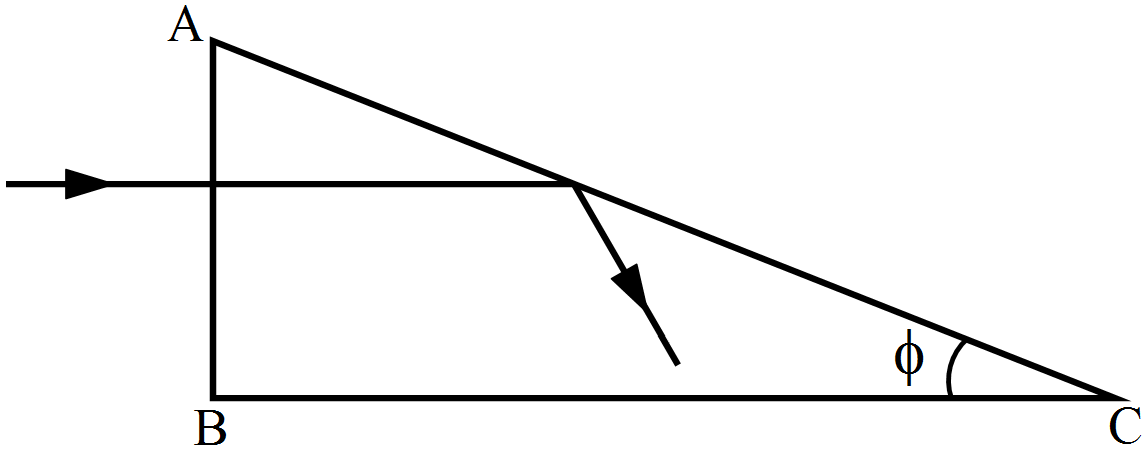
 A light ray is incident normally on the face AB of a right-angled prism ABC $(\mu=1.50)$ as shown in figure. What is the largest angle $\phi$ for which the light ray is totally reflected at the surface AC? 

Derive the relation between focal length $(f)$ and radius of curvature ( R ) for a spherical convex mirror with the help of a geometrical diagram of reflection of incident ray on a convex spherical mirror.
Each side of a square is 90 cm long. At its corners $-2,+3,-4$ and +5 micro coulomb charges are placed respectively. Find the electric potential at the centre of the square.
Verify that the cyclotron frequency ω = eB/m has the correct dimensions of [T]–1.
Write the formula of spherical mirror and explain it.
A parallel beam of monochromatic light falls normally on a single narrow slit. How does the angular width of the principal maximum in the resulting diffraction pattern depend on the width of the slit?
The force on a charged particle due to electric and magnetic fields is given by $\overrightarrow{\text{F}}=\text{q}\overrightarrow{\text{E}}+\text{q}\overrightarrow{\text{v}}\times\overrightarrow{\text{B}}.$ Suppose $\overrightarrow{\text{E}}$ is along the X-axis and $\overrightarrow{\text{B}}$ along the Y-axis. In what direction and with what minimum speed v should a positively charged particle be sent so that the net force on it is zero?
State one feature by which the phenomenon of interference can be distinguished from that of diffraction.
A parallel beam of light of wavelength 600 nm is incident normally on a slit of width ‘a’. If the distance between the slit and the screen is 0.8 m and the distance of 2nd order maximum from the centre of the screen is 15 mm, calculate the width of the slit.
Write limitations of Ohm's law.