Question
Find the dimensions of:
  1. Linear momentum.
  2. Frequency.
  3. Pressure.

Answer

  1. Linear momentum: $\text{mv}=[\text{MLT}^{-1}]$

  2. Frequency: $\frac{1}{\text{T}}=[\text{M}^0\text{L}^0\text{T}^{-1}]$

  3. Pressure: $\frac{\text{Force}}{\text{Area}}=\frac{[\text{MLT}^{-2}]}{\text{[L}^2]}=[\text{ML}^{-1}\text{T}^{-2}]$

Need a full question paper?

Generate a complete, print-ready paper with questions like this in minutes — across 16+ boards, with answer keys.
Start Generating Free

Similar questions

Is there any lower limit to the electric force between two particles placed at a separation of 1cm ?
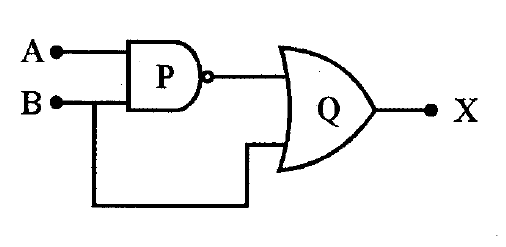
Identify the logic gates marked 'P' and 'Q' in the given circuit. Write the truth table for the combination.

Write the equation of electric potential for electric dipole and discuss its special cases.
A parallel beam of monochromatic light falls normally on a single narrow slit. How does the angular width of the principal maximum in the resulting diffraction pattern depend on the width of the slit?
A point source is placed at a depth h below the surface of water (refractive index = μ).
  1. Show that light escapes through a circular area on the water surface with its centre directly above the point source.
  2. Find the angle subtended by a radius of the area on the source.
State Kirchhoff's rules. Explain briefly how these rules are justified.
The electric field intensity and electric potential at a point due to a point charge are 30 Newton/ Coulomb and 15 Joule/Coulomb respectively. Find (i) the distance of the charge from the observation point and (ii) the magnitude of the charge.
Think over the experiment number 2 of Faraday and Henry and tell :
(a) What will you do to obtain more deflection in the galvanometer?
(b) How will you show the presence of current in the absence of a galvanometer?
Suppose the tube in the previous problem is kept vertical with A upward but the other conditions remain the same. The separation between the cross- sections at A and B is $\frac{15}{16}\text{cm}.$ Repeat parts (a), (b) and (c) of the previous problem. Take g = 10m/s2.
The fundamental frequency of a closed pipe is 293Hz when the air in it is at a temperature of 20°C. What will be its fundamental frequency when the temperature changes to 22°C?