Question
Find the distance between the following pair of points:$(\text{a}\sin\alpha, -\text{b}\cos\alpha)$ and $(-\text{a}\cos\alpha, \text{b}\sin\alpha)$

Answer

Here, $\text{x}_1=\text{a}\sin\alpha,\ \text{y}_1=-\text{b}\cos\alpha$ $\text{x}_2=-\text{a}\cos\alpha,\ \text{y}_2=\text{b}\sin\alpha$ Let D be the distance between two points $(\text{a}\sin\alpha, -\text{b}\cos\alpha)$and $(-\text{a}\cos\alpha, \text{b}\sin\alpha)$ The distance between two points is given by,$\text{D}=\sqrt{(\text{x}_2-\text{x}_1)^2+(\text{y}_2-\text{y}_1)^2}$
$=\sqrt{(-\text{a}\cos\alpha-\text{a}\sin\alpha)^2+(\text{b}\sin\alpha-(-\text{b}\cos\alpha))^2}$
$=\sqrt{\text{a}^2(\cos\alpha+\sin\alpha)^2+\text{b}^2(\sin\alpha+\cos\alpha)^2}$
$=\sqrt{\text{a}^2+\text{b}^2(\cos\alpha+\sin\alpha)^2}$
$=(\sin\alpha+\cos\alpha)\sqrt{\text{a}^2+\text{b}^2}$
Hence, distance between two points is $(\sin\alpha+\cos\alpha)\sqrt{\text{a}^2+\text{b}^2}$

Need a full question paper?

Generate a complete, print-ready paper with questions like this in minutes — across 16+ boards, with answer keys.
Start Generating Free

Similar questions

ABC is a triangle and PQ is a straight line meeting AB in P and AC in Q. If AP = 1cm, PB = 3cm, AQ = 1.5cm, QC = 4.5m, prove that the area of $\triangle\text{APQ}$ is one-sixteenth of the area of $\triangle\text{ABC}.$
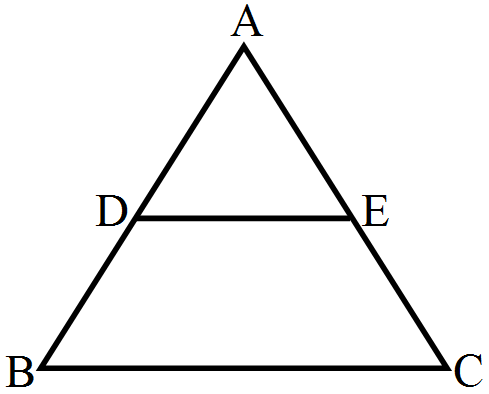
D and E are points on the sides AB and AC respectively of a $\triangle\text{ABC}.$ In the following cases, determine whether DE || BC or not. AD = 7.2cm, AE = 6.4cm, AB = 12cm and AC = 10cm.
Ayush starts walking from his house to office. Instead of going to the office directly, he goes to a bank first, from there to his daughter’s school and then reaches the office. What is the extra distance travelled by Ayush in reaching the office? (Assume that all distance covered are in straight lines). If the house is situated at (2, 4), bank at (5, 8), school at (13, 14) and office at (13, 26) and coordinates are in kilometers.
Kantabai bought $1\frac{1}{2}$ kg tea and 5 kg sugar from a shop. She paid Rs 50 as return fare for rickshaw. Total expense was Rs 700. Then she realised that by ordering online the goods can be bought with free home delivery at the same price. So next month she placed the order online for 2 kg tea and 7 kg sugar. She paid Rs 880 for that. Find the rate of sugar and tea per kg.
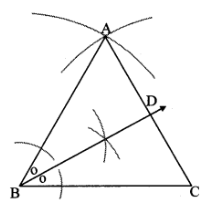
i. Draw a ∆ABC.
ii. Bisect ∠B and name the point of intersection of AC and the angle bisector as D.
iii. Measure the sides.
AB = ⬜ cm, BC = ⬜ cm,
AD = ⬜ cm, DC = ⬜ cm
iv. Find ratios $\frac{A B}{B C}$ and $\frac{A D}{D C}$
v. You will find that both the ratios are almost equal.
vi. Bisect remaining angles of the triangle and find the ratios as above.
Verify that the ratios are equal.
Image
$\frac{ AB }{ BC }=\frac{4}{4}=1$$\quad$$\quad$(i)
$\frac{ AD }{ DC }=\frac{2}{2}=1$$\quad$$\quad$(ii)
$\therefore \quad \frac{ AB }{ BC }=\frac{ AD }{ DC }$...[From (i) and (ii)]
A chord PQ of a circle of radius $10\ cm$ subtends an angle of $60^\circ $ at the centre of the circle. Find the area of major and minor segments of the circle. $\Big[\text{Use }\pi=\frac{22}{7}\Big]$
Fill in the blanks given in the contract note of sale-purchase of shares. (B - buy S - sell)

No.of shares

M.V.of shares

Total Value

Brokerage 0.2%

18% GST on Brokerage

Total Value of shares

75 B

Rs.200

100S

Rs.45

Solve the following quadratic equations by factorization:
$5x^2 - 3x - 2 = 0$
Prove that for any prime positive integer $\text{p},\sqrt{\text{p}}$ is an irrational number.
Show that ΔABC, where A(-2, 0), B(2, 0), C(0, 2) and ΔPQR where P(-4, 0), Q(4, 0), R(0, 4) are similar triangles.