Question
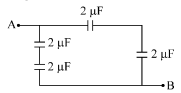
Find the equivalence between A and B in the given circuit diagram.
Image

Answer

Sol. Due to the equivalence at A being in series
$\frac{1}{ C }=\frac{1}{ C _1}+\frac{1}{ C _2}$
$\frac{1}{C}=\frac{1}{2}+\frac{1}{2}=1 \quad \therefore C =1 \mu F$
Similarly at $B$, from $\frac{1}{C}=\frac{1}{C_1}+\frac{1}{C_2}$
$\frac{1}{ C }=\frac{1}{2}+\frac{1}{2}=1=1 \mu F$
$C =1 \mu F$
Therefore, capacitance between A and $B =1+1=2 \mu F$.

Need a full question paper?

Generate a complete, print-ready paper with questions like this in minutes — across 16+ boards, with answer keys.
Start Generating Free

Similar questions

Answer the following questions regarding earth’s magnetism:
A vector needs three quantities for its specification. Name the three independent quantities conventionally used to specify the earth’s magnetic field.
Explain the refraction by two transparent spherically curved surface.
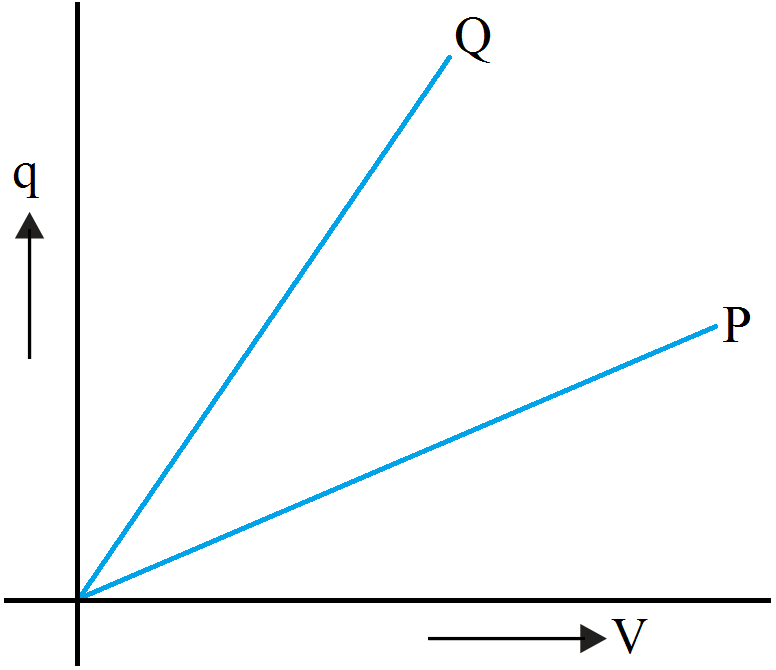
The given graph shows the variation of charge $q$ versus potential difference $V$ for two capacitors $C_1$ and $C_2$. The two capacitors have same plate separation but the plate area of $C_2$ is double than that of $C_1$. Which of the two graphs $P$ and $Q$ correspond to capacitors $C_1$ and $C_2$ and why?
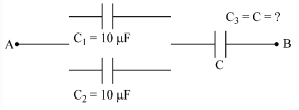
Calculate the capacitance of capacitor $C$ if the equivalent capacitance of the connection between $A$ and $B$ is $15 \mu F$.
Image
A gas thermometer measures the temperature from the variation of pressure of a sample of gas. If the pressure measured at the melting point of lead is 2.20 times the pressure measured at the triple point of water, find the melting point of lead.
Use the mirror equation to show that an object placed between f and 2f of a concave mirror produces a real image beyond 2f.
The frequency ν of incident radiation is greater than threshold frequency $(ν_0)$ in a photocell. How will the stopping potential vary if frequency (ν) is increased, keeping other factors constant?
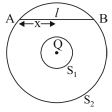
Calculate the electric flux passing through the spheres $S_1$ and $S_2$ shown in the figure. The linear charge density of the wire $A B$ shown in the figure is $\lambda=K x$ where $x=$ distance from the end $A$ of the wire measured along its length.
Image
The contact angle between water and glass is $0^\circ$. When water is poured in a glass to the maximum of its capacity, the water surface is convex upward. The angle of contact in such a situation is more than $90^\circ$. Explain.
Why cannot longitudinal waves be polarized?