Question
Explain the refraction by two transparent spherically curved surface.

Answer

→At infinitesimal part of a spherical surface can be regarded as planar and the same laws of refraction can be applied at every point on the surface.
→Just as for reflection by a spherical mirror, the normal at the point of incidence is perpendicular to the tangent plane to the spherical surface at that point and therefore, passes through its centre of curvature.

Need a full question paper?

Generate a complete, print-ready paper with questions like this in minutes — across 16+ boards, with answer keys.
Start Generating Free

Similar questions

A simple microscope is rated 5 for a normal relaxed eye. What will be its magnifying power for a relaxed farsighted eye whose near point is 40cm?
State factors on which the resistance of a conductor depends.
How are infrared waves produced? Why are these referred to as 'heat waves'? Write their one important use.
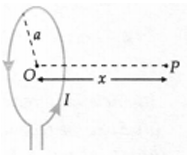
A student records the following data for the magnitudes $(B)$ of the magnetic field at axial points at different distances $x$ from the centre of a circular coil of radius a carrying a current $I.$ Verify $($for any two$)$ that these observations are in good agreement with the expected theoretical variation of $B$ with $x.$
Image
$x \rightarrow$ $x = 0$ $x - a$ $x = 2 a$ $x = 3a$
$y \rightarrow$ $B _0$ $0.25 \sqrt{2} B_0$ $0.039 \sqrt{5} B_0$ $0.010 \sqrt{10} B_0$

 
Monochromatic light entering from one medium to another, its wavelength changes but the frequency does not change, explain.
Write formula for Bohr's frequency.
Find the amount of silver liberated at cathode if 0.500A of current is passed through $AgNO_3$ electrolyte for 1 hour. Atomic weight of silver a 107.9 g/mole.
In a resonance column experiment, a tuning fork of frequency 400Hz is used. The first resonance is observed when the air column has a length of 20.0cm and the second resonance is observed when the air column has a length of 62.0cm.
  1. Find the speed of sound in air.
  2. How much distance above the open end does the pressure node form?
Give an example for which $\overrightarrow{\text{A}}.\overrightarrow{\text{B}}=\overrightarrow{\text{C}}.\overrightarrow{\text{B}}$ but $\overrightarrow{\text{A}}\neq\overrightarrow{\text{C}}.$
Two stable isotopes of lithium $^6_3\text{Li }\text{ and }\ ^7_3\text{Li}$ have respective abundances of 7.5% and 92.5%. These isotopes have masses 6.01512 u and 7.01600 u, respectively. Find the atomic mass of lithium.