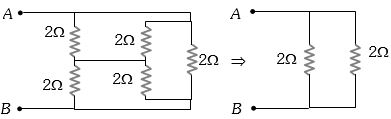
MCQ
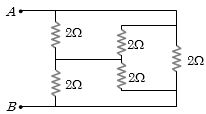
Find the equivalent resistance across $AB$ .............. $\Omega$
  • $1$ 
  • B
    $2$ 
  • C
    $3$
  • D
    $4$ 

Answer

Correct option: A.
$1$ 
a
(a) ${R_{AB}} = \frac{{2 \times 2}}{{2 + 2}} = 1\,\Omega $.

Need a full question paper?

Generate a complete, print-ready paper with questions like this in minutes — across 16+ boards, with answer keys.
Start Generating Free

Similar questions

Considering a group of positive charges, which of the following statements is correct?
A magnetic dipole is acted upon by two magnetic fields which are inclined to each other at an angle of  $75^o$. One of the fields has a magnitude of $15\,\,mT.$ The dipole attains stable equilibrium at an angle of $30^o$ with this field. The magntidue of the other field (in $mT$ ) is close to
In the circuit shown in the figure below, which of the following statement is incorrect ?
Symbol  represents
One end of a Nichrome wire of length $2\,L$ and cross-sectional area $A$ is attatched to an end of another Nichrome wire of length $L$ and cross-sectional area $2\,A$. If the free end of the longer wire is at an electric potential of $8.0$ $\mathrm{volts}$, and the free end of the shorter wire is at an electric potential of $1.0$ $\mathrm{volt}$, the potential at the junction of the two wires is equal to ............. $V$
The average kinetic energy of the thermal neutrons is of the order of

(Boltzmann's constant ${K_B} = 8 \times {10^{ - 5}}\,eV/Kelvin$)

In one average$-$life:
For the angle of minimum deviation of a prism to be equal to its refracting angle, the prism must be made of a material whose refractive index 
A coil having n turns and resistance R W is connected with a galvanometer of resistance 4RΩ. This combination is moved in time t seconds from a magnetic field $W_1$ weber to $W_2$ weber. The induced current in the circuit is
An electric field due to a positively charged long straight wire at a distance $r$ from it is proportional to $r^{-1}$ in magnitude. Two electrons are orbiting such a long straight wire in circular orbits of radii $1 A$ and $2 A$. The ratio of their respective time periods is