MCQ
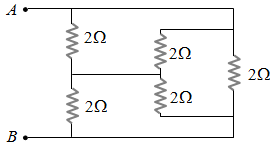
Find the equivalent resistance across $AB$
  • $1 \Omega$
  • B
    $2 \Omega$
  • C
    $3 \Omega$
  • D
    $4 \Omega$

Answer

Correct option: A.
$1 \Omega$
$1 \Omega$

Need a full question paper?

Generate a complete, print-ready paper with questions like this in minutes — across 16+ boards, with answer keys.
Start Generating Free

Similar questions

A coil of wire of resistance 50Ω  is embedded in a block of ice. If a potential difference of 210 V is applied across the coil, the amount of ice melted per second will be(a) 4.12 gm(b) 4.12 kg(c) 3.68 kg(d) 2.625 gm
       
In a PN-junction diode not connected to any circuit (a) The potential is the same everywhere(b) The P-type is a higher potential than the N-type side(c) There is an electric field at the junction directed from the N- type side to the P- type side(d) There is an electric field at the junction directed from the P-type side to the N-type side


A horizontal circular loop carries a current that looks clockwise when viewed from above. It is replaced by an equivalent magnetic dipole consisting of a south pole S and a north pole N:
  1. The line SN should be along a diameter of the loop.
  2. The line SN should be perpendicular to the plane of the loop.
  3. The south pole should be slow the loop.
  4. The north pole should be below the loop.
For a common base amplifier, the values of resistance gain and voltage gain are 3000 and 2800 respectively. The current gain will be:
Let p and E denote the linear momentum and energy of a photon. If the wavelength is decreased:
  1. Both p and E increase.
  2. P increases and E decreases.
  3. P decreases and E increases.
  4. Both p and E decrease.
The relationship between potential difference V, charge Q and capacitance C is:
The possible quantum number for $3d$ electron are
If a steady current of $4 \ \text{amp}$ maintained for $40$ minutes, deposits $4.5 \ gm$ of zinc at the cathode and then the electro chemical equivalent will be
 
A charged conducting sphere does not produce an electric field:
In an ac circuit, the potential differences across an inductance and resistance joined in series are, respectively, 16V and 20V. The total potential difference across the circuit is.