Question
Find the false statement.

Answer

Kirchhoff’s $2^{nd}$ year is applied in a closed loop. Kirchhoff’s $2^{nd}$ law supports the law of conservation of energy. This means that energy is neither created nor destroyed in the closed loop. Whatever energy enters the loop, same amount leaves the loop.

Need a full question paper?

Generate a complete, print-ready paper with questions like this in minutes — across 16+ boards, with answer keys.
Start Generating Free

Similar questions

A particle executes simple harmonic motion under the restoring force provided by a spring. The time period is $T$. If the spring is divided in two equal parts and one part is used to continue the simple harmonic motion, the time period will:
A coil having $N$ turns is wound tightly in the form of a spiral with inner and outer radii $a$ and $b$ respectively. When a current $I$ passes through the coil, the magnetic field at the centre is
The transverse nature of light is shown by:
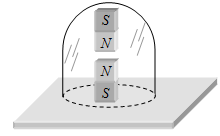
Two identical bar magnets with a length $10 \ cm$ and weight $50$ $gm-$weight are arranged freely with their like poles facing in a inverted vertical glass tube. The upper magnet hangs in the air above the lower one so that the distance between the nearest pole of the magnet is $3\ mm.$ Pole strength of the poles of each magnet will be
Which of the following statement is false(a) Heat produced in a conductor is proportional to its resistance(b) Heat produced in a conductor is proportional to the square of the current(c) Heat produced in a conductor is proportional to charge(d) Heat produced in a conductor is proportional to the time for which current is passed


Two identical short bar magnets, each having magnetic moment of $10 \ \mathrm{Am}^2,$ are arranged such that their axial lines are perpendicular to each other and their centres be along the same straight line in a horizontal plane. If the distance between their centres is $0.2 m ,$ the resultant magnetic induction at a point midway between them is $(\left.\mu_0=4 \pi \times 10^{-7} \mathrm{Hm}^{-1}\right)$
A moving coil galvanometer is based on the:
A capacitor of capacitance $C_1 = 1mF$ can with stand maximum voltage $V_1 = 6kV ($kilo-volt$)$ and another capacitor of capacitance $C_2 = 3mF$ can withstand maximum voltage $V_2 = 4 kV.$ When the two capacitors are connected in series, the combined system can withstand a maximum voltage of
According to classical theory, the path of an electron in Rutherford atomic model is:
The audio signal: