MCQ
Find the frequency of minimum distance between compression & rarefaction of a wire. If the length of the wire is $1m$ & velocity of sound in air is $360\, m/s$ .... $sec^{-1}$
  • $90$
  • B
    $180$
  • C
    $120$
  • D
    $360$

Answer

Correct option: A.
$90$
a
(a) The minimum distance between compression and rarefaction of the wire

$l = \frac{\lambda }{4}$

$\therefore $ Wave length $\lambda = 4l$

Now by $v = n\lambda \Rightarrow n = \frac{{360}}{{4 \times 1}} = 90\,{\sec ^{ - 1}}.$

Need a full question paper?

Generate a complete, print-ready paper with questions like this in minutes — across 16+ boards, with answer keys.
Start Generating Free

Similar questions

Consider a collision between an oxygen molecule and a hydrogen molecule in a mixture of oxygen and hydrogen kept at room temperature. Which of the following are pcssible?
  1. The kinetic energies of both the molecules increase.
  2. The kinetic energies of both the molecules decrease.
  3. The Kinetic energy of the oxygen molecule increases and that of the hydrogen molecule decreases.
  4. The kinetic energy of the hydrogen molecule increases and that of the oxygen molecule decreases.
Suppose the gravitational force varies inversely as the ${n^{th}}$ power of distance. Then the time period of a planet in circular orbit of radius $R$ around the sun will be proportional to
In an inelastic collision:
If the frequency of an object in uniform circular motion is doubled, its acceleration becomes
Two forces $P$ and $Q$, of magnitude $2F$ and $3F$, respectively, are at an angle $\theta $ with each other. If the force $Q$ is doubled, then their resultant also gets doubled. Then, the angle $\theta $ is ....... $^o$
A person standing on a spring balance inside a stationary lift measures $60 \,kg$. The weight of that person if the lift descends with uniform downward acceleration of $1.8\, m / s ^{2}$ will be $_{-} N$. $\left[ g =10\, m / s ^{2}\right]$
Two simple harmonic motions of angular frequency 100rad/s$^{-1}$ and 1000rad/s$^{-1}$ have the same displacement amplitude. The ratio of their maximum acceleration is:
In an isothermal process $2$ water drops of radius $1 \,mm$ are combined to form a bigger drop. Find the energy (in $\mu J$) change in this process if $T =0.1\, N / m$ 
A ball falls from a height of $5\,m$ and strikes the roof of a lift. If at the time of collision, lift is moving in the upward direction with a velocity of $1\,m/s$, then the velocity with which the ball rebounds after collision will be $-(e = 1)$
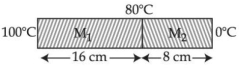
Two metallic blocks $M_{1}$ and $M_{2}$ of same area of cross-section are connected to each other (as shown in figure). If the thermal conductivity of $M _{2}$ is $K$ then the thermal conductivity of $M _{1}$ will be ]...............$K$ [Assume steady state heat conduction]