Question
Find the frequency of note emitted by a string of length $10\sqrt{10}\text{cm},$ under tension of 3.14kg. Radius of string is 0.5mm and density = 9.8g/cc.

Answer

Here $\text{l}=10\sqrt{10}\text{cm}=0.1\sqrt{10}\text{m}$
$\text{T}=3.14\text{kg wt}=3.14\times9.8\text{N}$
$\text{D}=2\text{r}=2\times0.5\text{mm}$
$=1\text{mm}=0.001\text{m}$
$\rho=9.8\text{g/cc}=9.8\times10^3\text{kg/m}^3$
As $\text{V}=\frac{1}{\text{lD}}\sqrt{\frac{\text{T}}{\pi\rho}}$
$\text{V}=100\text{Hz}$

Need a full question paper?

Generate a complete, print-ready paper with questions like this in minutes — across 16+ boards, with answer keys.
Start Generating Free

Similar questions

Two identical point masses, each of mass $M$ are connected to one another by a massless string of length $L$. $A$ constant force $F$ is applied at the mid-point of the string. If l be the instantaneous distance between the two masses, what will be the acceleration of each mass?
Two parallel rail tracks run north-south. Train A moves north with a speed $54 km / h ^{-1}$ and $\operatorname{train} B$ moves south with a speed of $90 km / h ^{-1}$. What is the:
i. Velocity of $B$ with respect to $A$ ?
ii. Velocity of ground with respect to B?
iii. Velocity of a monkey running on the roof of train $A$ against its motion (with a speed of $10 km^{-1}$ with respect to train A ) as observed by a man standing on the ground?
OR
Obtain any one equation of motion for constant acceleration using method of calculus.
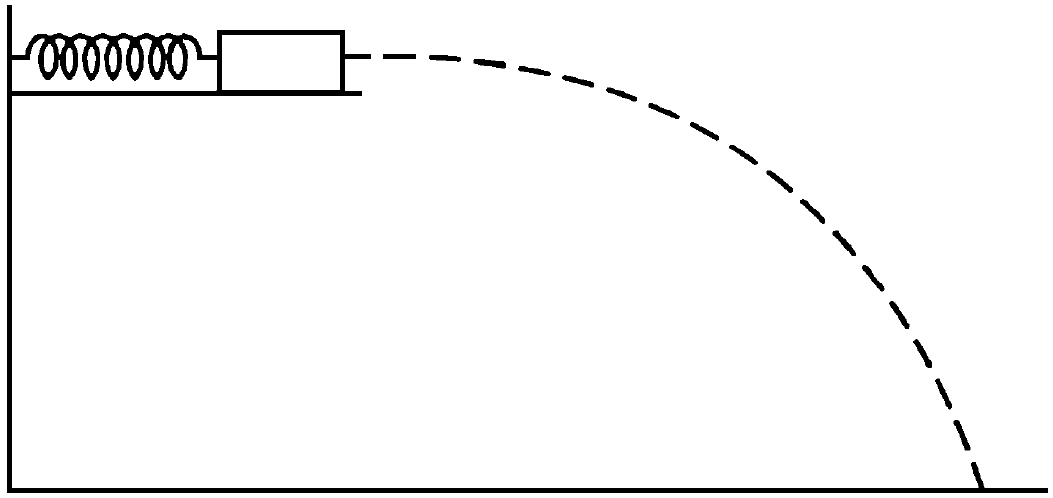
A small block of mass 100g is pressed against a horizontal spring fixed at one end to compress the spring through 5.0cm (figure). The spring constant is 100N/m. When released, the block moves horizontally till it leaves the spring. Where will it hit the ground 2m below the spring?
A calorie is a unit of heat (energy in transit) and it equals about $4.2 J$ where $1J = 1kg m^2 s^{–2}$. Suppose we employ a system of units in which the unit of mass equals $\alpha\text{ kg},$ the unit of length equals $\beta\text{ m},$ the unit of time is $\gamma\text{ s}.$ Show that a calorie has a magnitude $4.2\ \alpha^{-1}\ \beta^{-2}\ \gamma^2$ in terms of the new units.
Explain why The angle of contact of mercury with glass is obtuse, while that of water with glass is acute.
Differentiate between streamline flow and turbulent flow.
Describe Camot's cycle.
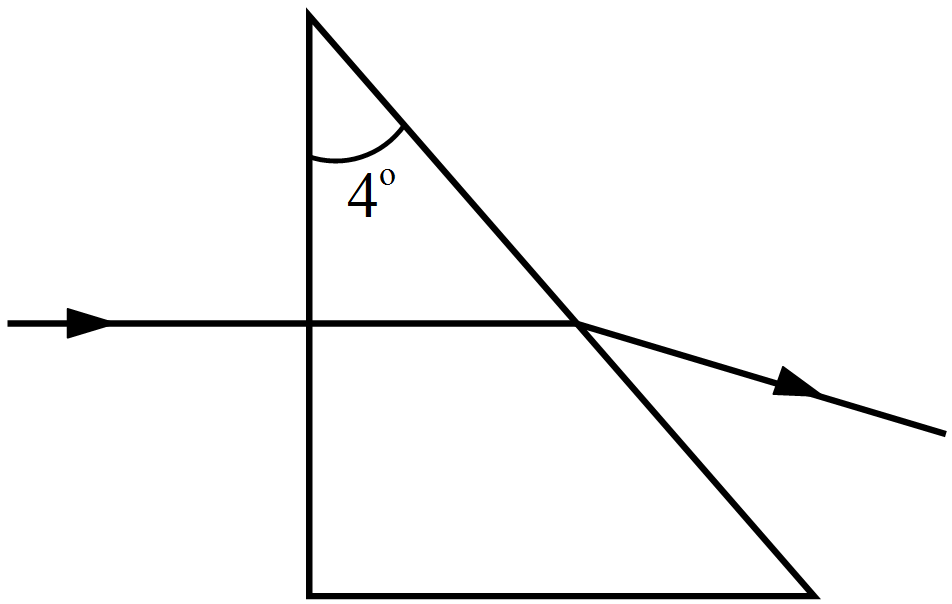
Find the angle of deviation suffered by the light ray shown in figure. The refractive index $\mu=1.5$ for the prism material.
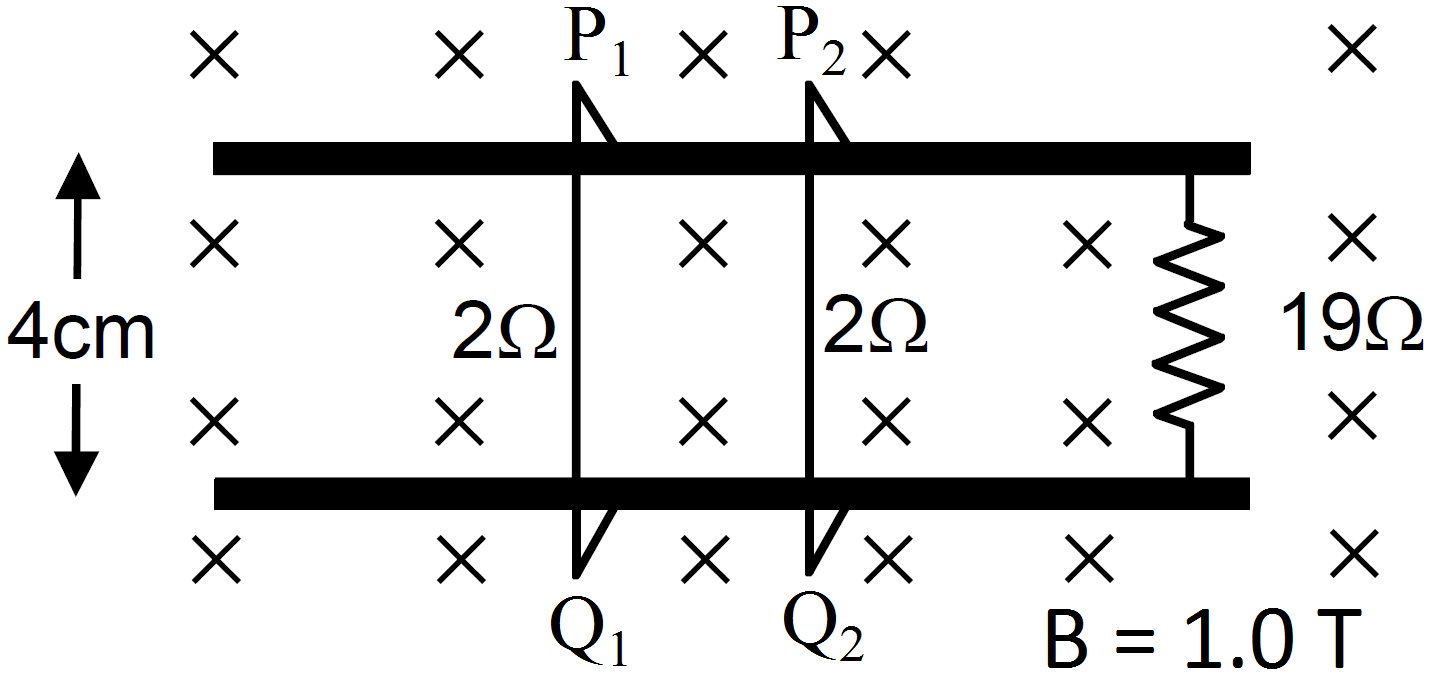
Consider the situation shown in figure. The wires $P_1Q_1$ and $P_2Q_2$ are made to slide on the rails with the same speed $5\ cm/s$. Find the electric current in the $19\Omega$ resistor if:
  1. Both the wires move towards right.
  2. If $P_1Q_1$ moves towards left but $P_2Q_2$ moves towards right.
Suppose a monochromatic X-ray beam of wavelength 100pm is sent through a Young's double slit and the interference pattern is observed on a photographic plate placed 40cm away from the slit. What should be the separation between the slits so that the successive maxima on the screen are separated by a distance of 0.1mm?